Why Artificial Intelligence Infrastructure Is Driving Up Prices for Everyday Electronics
Washington, Wednesday, 12 August 2026.
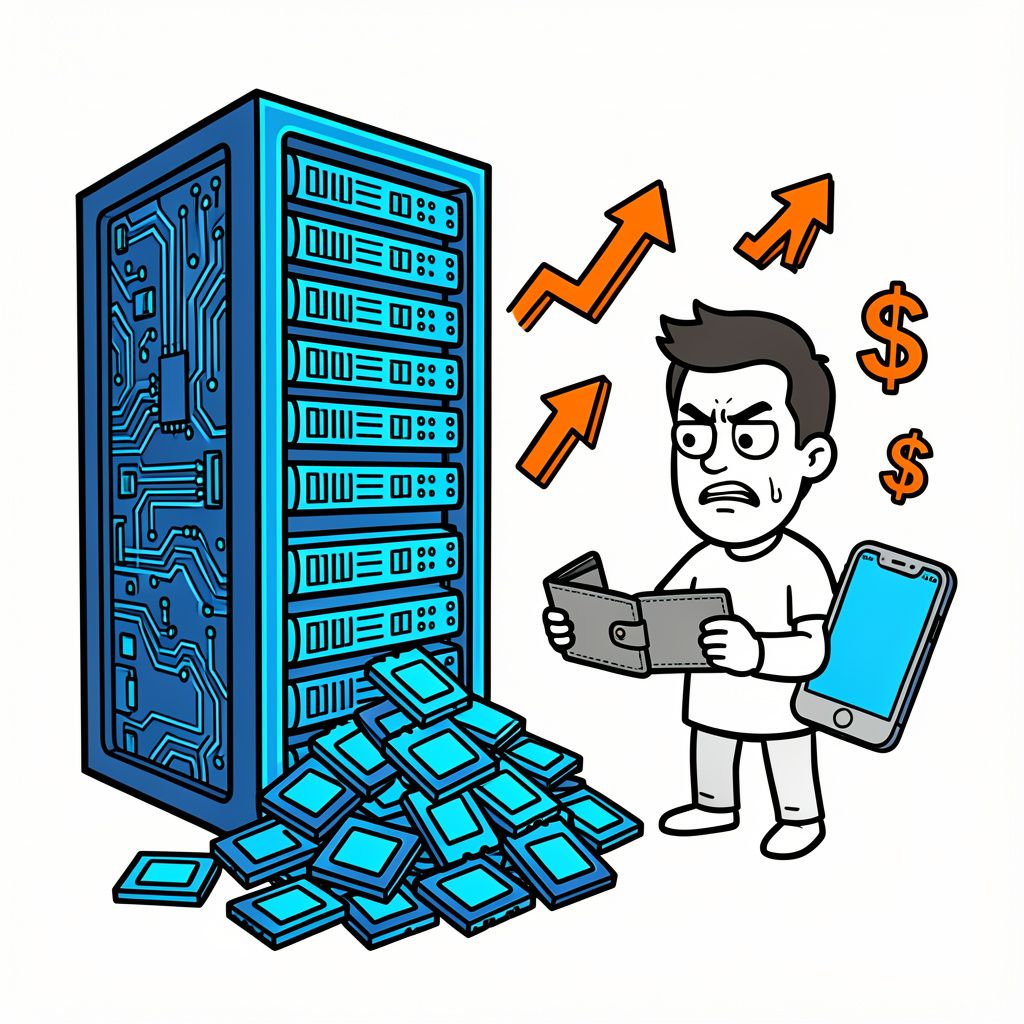
AI data centers are projected to consume up to 70% of memory chips in 2026, creating a severe supply crunch that is driving up consumer tech prices.
The AI-Driven Memory Crunch
A severe supply shortage in conventional memory chips is escalating costs across consumer electronics and enterprise IT as suppliers pivot capacity toward high-bandwidth memory (HBM) for artificial intelligence data centers [1]. This shift, often termed RAMageddon, is driven by hyperscalers like Google and Amazon securing priority access to HBM, forcing production away from dynamic random-access memory (DRAM) used in laptops and smartphones [1]. Data centers are projected to consume between 50% to 70% of all memory chips produced in 2026, creating a volatility range of 20 percentage points in market allocation [1]. The global memory chip supply is controlled by three firms—Micron, Samsung, and SK Hynix—which together hold 95% of the market share, intensifying the impact of any capacity constraints [1].
Industry Warnings and Timelines
Industry leaders have issued stark warnings regarding the duration and severity of the shortage throughout 2026 [1]. On 2026-07-10, SK Hynix’s CEO warned of the worst memory chip shortage in history, predicting that demand will continue to outpace supply through 2030 despite new facilities [1]. Earlier in the year, on 2026-02-03, Intel’s CEO stated there is no relief in sight until 2028, highlighting the long-term nature of the constraint [1]. While Micron is constructing new facilities in Idaho and New York with over $6 billion in CHIPS Act funding, production is not expected until at least 2027, leaving a gap in immediate supply [1].
Economic Impact on Consumers
The scarcity of conventional DRAM chips is causing a price surge for consumer electronics where DRAM accounts for up to 30% of input costs [1]. Dell has projected 2026 PC price increases of 15-20%, while Lenovo is raising laptop prices and Ericsson reported rising base station costs [1]. Despite rising costs, Best Buy reported as of June 26, 2026, that consumer demand for electronics like laptops remains largely undeterred, though analysts predict lower global shipments for the year [1]. In June 2026, nine industry associations warned Treasury Secretary Scott Bessent and Commerce Secretary Howard Lutnick that the imbalance threatens significant and sustained near-term price increases for American households [1].
Strategic Implications and Global Response
The memory chip shortage spotlights broader strategic challenges, as limited domestic manufacturing capacity constrains long-term capabilities to compete with China on compute [2]. The U.S. currently produces less than 10% of its memory chip supply domestically, with future federal investments aimed at reaching 10% capacity over the next decade [1]. Internationally, South Korea unveiled an ambitious technology strategy on Wednesday, 12 August 2026, centred on seven projects ranging from nuclear energy to space, seeking to secure new growth engines beyond semiconductors and AI [3]. This diversification underscores the geopolitical weight of the current supply chain constraints.