Why College Students Are Queuing Before Dawn for Entry-Level Jobs
New York, Thursday, 12 November 2026.
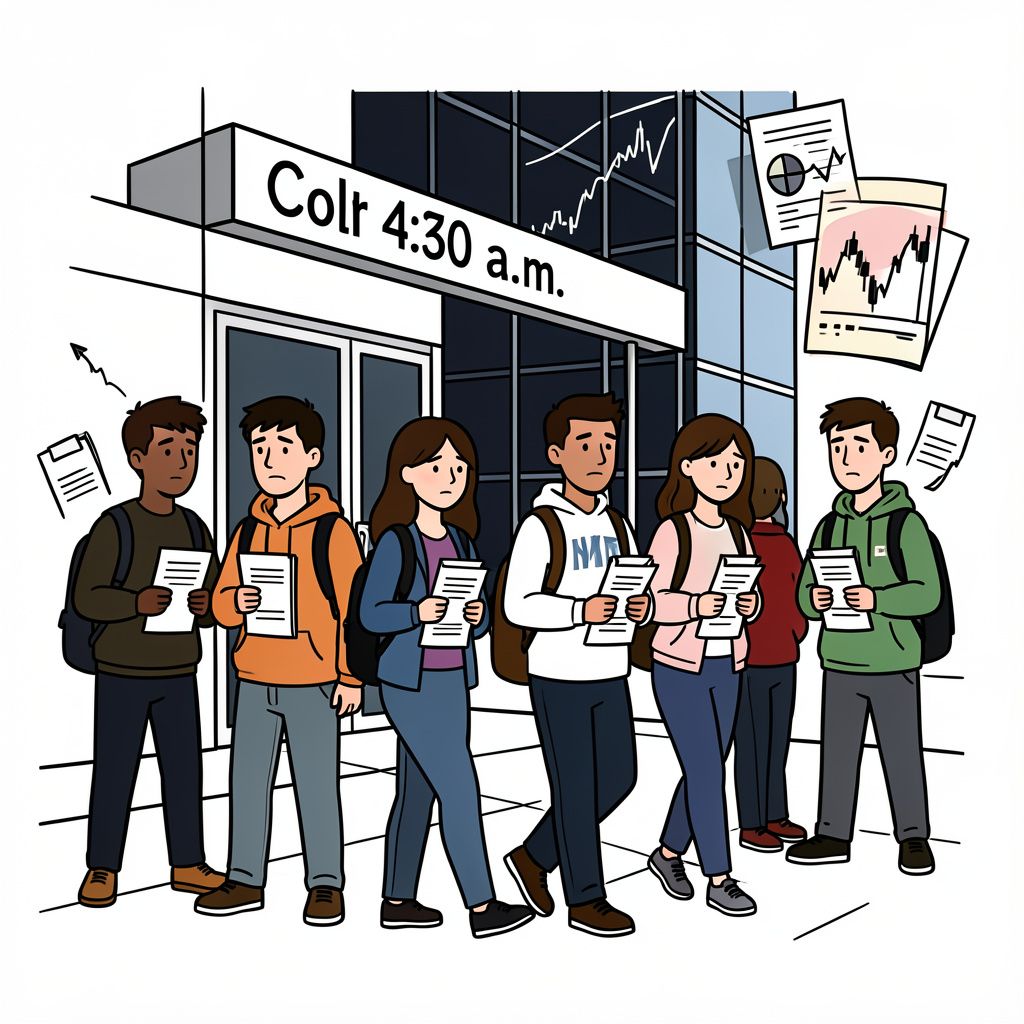
With recent graduate underemployment reaching 42.5%, students are lining up at 4:30 a.m. at career fairs, signaling a dramatic shift in entry-level white-collar hiring across corporate America.
Underemployment Crisis Drives Desperate Scramble for Entry-Level Roles
Recent college graduates face unprecedented labor market pressures in late 2026, with 42.5% classified as underemployed according to Federal Reserve data [3][4]. This staggering statistic reflects a broader economic contraction in white-collar employment where entry-level positions have become scarce commodities. The crisis manifests most visibly at university career fairs, where students are arriving as early as 4:30 a.m. to compete for recruiters’ attention, with the Society of Women Engineers’ (SWE) Boston conference drawing approximately 14,000 attendees on November 7-8, 2026 [1][3][5]. Isabella Wong, a 20-year-old biochemistry student at Simmons University, articulated the collective anxiety: ‘The crowds show how determined students are to get a foot in the door’ [1][3].
Corporate Hiring Shifts Exacerbate Student Anxiety
Employers have significantly reduced junior hiring initiatives, with many corporations eliminating campus visits and scaling back early-career recruitment programs [3]. The cancellation of the Grace Hopper Celebration conference in 2026 serves as a stark indicator of this trend [3]. Jennifer Scott, SWE’s chief growth officer, noted that students are being forced to ‘get jobs wherever they can,’ describing scenes where recruiters must ‘keep them from using their elbows and crawling over each other’ to access booths [1][3]. The competitive landscape has become so intense that students like Jocelyne Suerte, a 21-year-old mechanical engineering student at the University of Houston, secured job offers from multiple conferences by researching companies conducting on-site interviews [1][3].
The New Normal: Alternative Strategies for Career Survival
Faced with diminishing opportunities, students are adopting radical career strategies to remain competitive. Isabel Amaya, a 21-year-old informatics student at the University of Washington, observed that many peers have ‘shifted to other industries or stayed focused on internships, while others delayed graduation to remain eligible for intern programs’ [3]. This strategic pivot reflects a troubling reversal of traditional career progression pathways. Allan Morales, a sophomore chemical engineering student at the University of Michigan, found recruiters overwhelmingly seeking juniors and seniors rather than sophomores like himself [1]. The economic implications extend beyond individual frustration, signaling fundamental shifts in enterprise workforce planning where experience requirements are being inflated at entry-level positions.
Broader Economic Implications and Future Outlook
The career fair phenomenon extends beyond technology sectors, with local job fairs in Western New York scheduled through December 2026, including a Buffalo career fair on November 12 and additional events in Hamburg and Niagara Falls [6]. These concurrent hiring events underscore the nationwide nature of the entry-level job shortage. The Federal Reserve’s underemployment statistic of 42.5% represents 42.5 / 100 * 4.1 million recent graduates [alert! ‘exact recent graduate count not specified in sources’], though this figure highlights the severity of the situation [3][4]. With corporate America increasingly prioritizing experienced hires over entry-level talent, the long-term economic consequences could include delayed household formation, reduced consumer spending power among young adults, and potential skill gaps in emerging industries. The cancellation of major tech conferences suggests that this labor market contraction may persist through 2027, as SWE prepares for WE 27 in Denver [5][7].
Sources
- www.businessinsider.com
- www.facebook.com
- tradersunion.com
- www.bls.gov
- www.instagram.com
- www.wnyjobs.com
- www.facebook.com