Saudi Aramco Expands Critical Pipeline to Counter Regional Shipping Risks
Riyadh, Sunday, 8 November 2026.
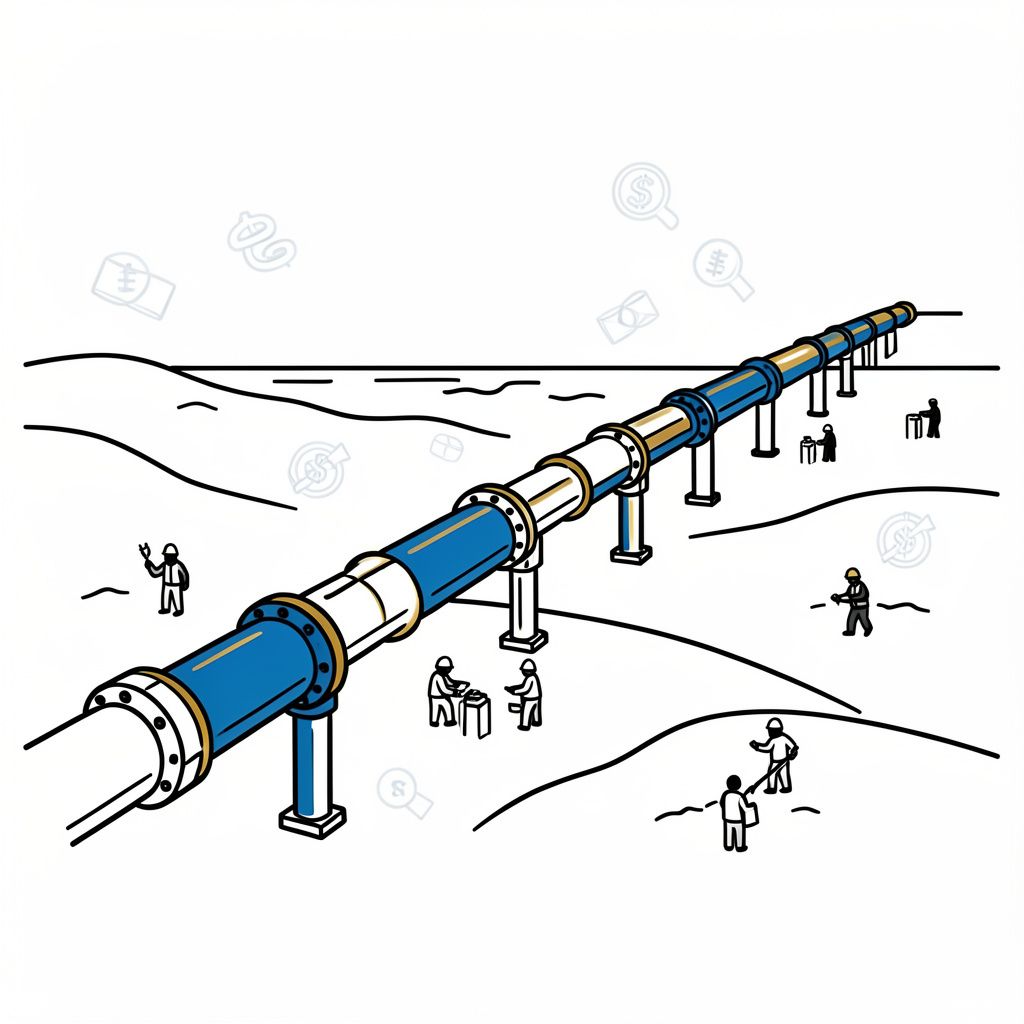
Saudi Aramco is boosting its East-West Pipeline capacity to 10 million barrels per day, fortifying export routes away from the vulnerable Strait of Hormuz amid escalating regional tensions.
Market Reaction to Aramco’s Strategic Expansion
Saudi Aramco’s announcement of expanding its East-West Pipeline capacity to 10 million barrels per day has triggered a measured but cautious response from investors in Riyadh as of 8 November 2026. The Tadawul-listed energy giant (TADAWUL: 2222) closed at 26.08 Saudi riyals (SAR), reflecting a marginal decline of 0.08 SAR or 0.31% from the previous session [3]. This modest pullback follows days of heightened volatility amid geopolitical developments in the Gulf, where a reported administrative building belonging to Aramco was targeted by falling debris [5]. While the incident caused limited damage, it underscored the operational risks facing the company’s infrastructure in a region marked by escalating tensions. Market analysts note that the pipeline expansion is being interpreted as a strategic hedge against potential disruptions in the Strait of Hormuz, a critical chokepoint for global oil shipments. As of the latest trading session, Aramco’s market capitalization stands at 6,311,360 million SAR, representing approximately 68% of the total Saudi Exchange’s valuation [4].
Financial Metrics Under the Microscope
Institutional investors are dissecting Aramco’s forward-looking financial metrics, which reveal a valuation framework that balances resilience with growth expectations. MarketScreener data indicates a trailing price-to-earnings (P/E) ratio of 13.3x for 2026, with a modest increase to 13.6x projected for 2027 [1]. Enterprise value to sales (EV/Sales) metrics further highlight the company’s operational scale, with 2026 at 3.31x and 2027 at 3.29x [1]. Dividend sustainability remains a focal point, with forecasted yields of 5.25% for 2026 and 5.65% for 2027, positioning Aramco as a high-yield anchor in a de-rated market [1]. The free-float of the stock remains exceptionally low at 2.48%, a structural feature that amplifies its sensitivity to institutional flows and geopolitical sentiment [1]. This constricted float, combined with Aramco’s outsized influence on the Saudi market, has contributed to a broader market narrative where the company’s performance is increasingly decoupled from regional peers. As one analyst noted, ‘Aramco is not just a stock; it is the market’s North Star, and its strategic maneuvers are reshaping the risk calculus for Gulf energy investments.’
Regional Tensions Amplify Operational Imperatives
The expansion of the East-West Pipeline, first announced by Aramco’s CEO Amin Nasser in late October 2026, represents a direct response to the mounting risks in the Strait of Hormuz. Nasser confirmed during the company’s third-quarter results call that construction had already commenced, with the goal of increasing capacity from 7 million to 10 million barrels per day [6]. This initiative is part of a broader strategy to diversify export routes, including engineering assessments of existing corridors such as the Suez Canal [6]. The urgency of these efforts has been underscored by recent maritime incidents, including reports of tankers striking mines and explosions in southern Iran, which have heightened concerns about the security of Gulf shipping lanes [5]. While Aramco has not disclosed specific details of its alternative routes, the move aligns with the company’s long-standing emphasis on supply chain redundancy. Analysts caution, however, that the timeline for completing the pipeline expansion remains subject to geopolitical developments, with some estimates suggesting a potential 18-24 month horizon for full operational capacity [alert! ‘unofficial industry projections’]. The company’s ability to execute this expansion without further disruptions will be closely scrutinized by investors, particularly as regional tensions show no signs of abating.
Broader Market Context: A De-Rated Energy Sector
Saudi Aramco’s strategic pivot occurs against a backdrop of broader macroeconomic challenges in the Gulf region. As of early November 2026, Saudi Arabia’s benchmark TASI index is down 3.9% year-to-date, with the median stock declining approximately 25% over the past 12 months [7]. The de-rating of the market has been particularly pronounced in the energy sector, where valuations have reset to a median of 14.6x earnings for profitable companies [7]. Brent crude, a key benchmark for Aramco’s pricing, has eased to around $100 per barrel, reflecting a combination of demand-side concerns and geopolitical de-escalation hopes [7]. However, the persistent risks in the Gulf—exemplified by the recent targeting of Aramco’s infrastructure and the broader regional instability—have tempered optimism about a sustained recovery in energy prices. The Saudi government’s strong credit profile (Aa3/A+/A+) provides a counterbalance to these challenges, offering a sovereign anchor for both the market and Aramco’s operations [7]. For investors, the calculus is clear: Aramco’s strategic initiatives are not merely about expanding capacity but also about mitigating risks in an increasingly volatile geopolitical landscape. As one market strategist noted, ‘In a region where the only constant is change, Aramco’s pipeline expansion is a calculated bet on resilience.’
Sources
- ca.marketscreener.com
- www.investing.com
- www.argaam.com
- www.saudiexchange.sa
- english.almayadeen.net
- www.al-monitor.com
- www.linkedin.com