Deadly NetJets Crash in Texas Raises Urgent Safety Questions
Laredo, Wednesday, 17 June 2026.
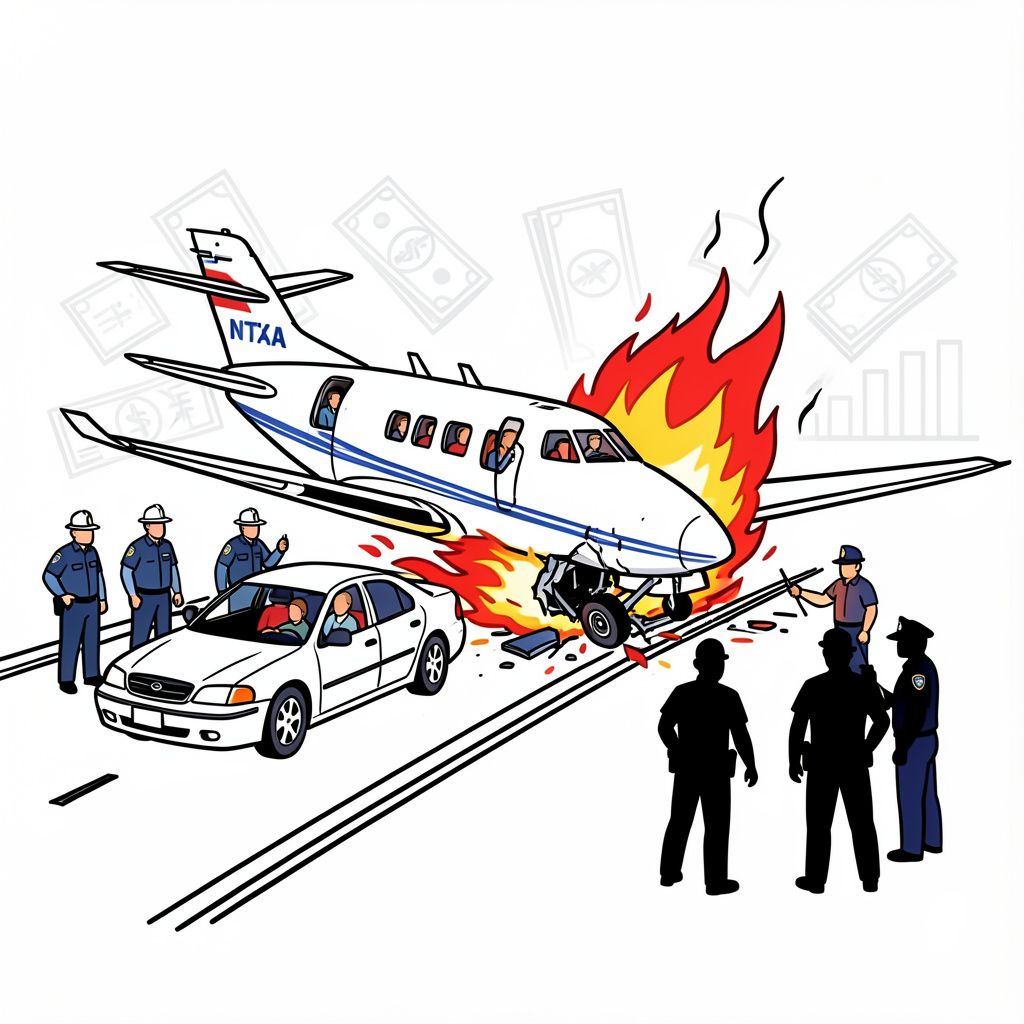
A NetJets-operated Cessna Citation Latitude crashed onto a Texas highway, killing one and injuring five, including police officers. The jet, en route from Mexico with reported mechanical issues, struck a vehicle and burst into flames. With six on board and the NTSB launching an investigation, this incident spotlights critical safety concerns in private aviation—especially for NetJets, Warren Buffett’s fractional-ownership giant.
The Crash: Timeline and Immediate Aftermath
At approximately 21:58 local time on Tuesday, 16 June 2026, a NetJets-operated Cessna 680 Citation Latitude (registration N523QS) crashed onto Loop 20, a highway in Laredo, Texas, while on approach to Laredo International Airport (LRD/KLRD) [1][2]. The aircraft, en route from San José del Cabo-Los Cabos International Airport (SJD/MMSD) in Mexico to Austin-Bergstrom International Airport (AUS/KAUS) in Texas, had diverted to Laredo due to an unspecified emergency [1]. Flight-tracking data confirmed the jet’s departure from Los Cabos at approximately 18:19 UTC, with the crash occurring roughly four hours later [3]. The aircraft struck a vehicle on the highway, resulting in at least one fatality and five injuries [1][4]. The identity of the deceased—whether a passenger or a ground victim—remains unconfirmed as of Wednesday, 17 June 2026 [3].
Casualties and Emergency Response
The crash scene unfolded with harrowing urgency. Video footage from the site showed rescuers smashing a cockpit window to extract trapped occupants, while a small fire that erupted was quickly extinguished [3]. Among the injured were five police officers hospitalized for smoke inhalation, though no immediate reports indicated injuries to occupants of vehicles on the highway [3]. The aircraft came to rest on its side against a highway barrier, with the tail section separated from the fuselage [3]. Loop 20 was closed in both directions as emergency crews worked the scene, and the National Transportation Safety Board (NTSB) was promptly notified to lead the investigation [1][3].
Aircraft and Operator: NetJets Under Scrutiny
The aircraft involved, a Cessna 680 Citation Latitude (model C68A), was manufactured in 2016 and operated by NetJets, the world’s largest private aviation company [1][5]. NetJets, a subsidiary of Berkshire Hathaway (NYSE: BRK.A, BRK.B), pioneered the fractional ownership model in private aviation, allowing customers to purchase shares in private jets rather than full aircraft [5][GPT]. The company, founded in 1964 and acquired by Warren Buffett’s conglomerate in 1998, manages a fleet of over 700 aircraft, serving more than 150,000 customers globally [GPT]. The Citation Latitude, a midsize business jet, is designed for transcontinental flights, with a range of 5,950 km (3,698 miles) and a maximum cruising speed of 876 km/h (544 mph) [GPT]. This incident marks a rare but severe event for NetJets, which has built its reputation on safety and reliability in the private aviation sector.
Regulatory and Industry Implications
This incident arrives at a pivotal moment for the private aviation industry, which has seen a surge in demand post-pandemic. NetJets, in particular, reported a 20% increase in flight hours in 2025 compared to pre-pandemic levels, driven by a growing clientele seeking alternatives to commercial air travel [GPT]. However, the crash in Laredo underscores persistent safety challenges in private aviation, where regulatory oversight is often perceived as less stringent than in commercial aviation [GPT]. The Federal Aviation Administration (FAA) and NTSB have historically scrutinized fractional ownership models for their unique operational complexities, including shared aircraft maintenance and pilot scheduling [GPT]. With the NTSB’s investigation expected to span several months, the findings could prompt regulatory reviews of emergency protocols, maintenance standards, and pilot training for fractional ownership operators [1]. For NetJets, the incident may also impact its market position, as competitors like Flexjet and Wheels Up seek to capitalize on any perceived vulnerabilities in safety or service reliability.
Broader Context: Safety Record of Private Aviation
While private aviation is statistically safer than general aviation, it is not immune to catastrophic failures. According to the NTSB, the accident rate for business jets in the U.S. was 0.84 per 100,000 flight hours in 2023, compared to 1.02 for general aviation [GPT]. However, high-profile incidents—such as the 2021 crash of a Bombardier Challenger 600 in Truckee, California, which killed six—have highlighted risks associated with pilot error, mechanical failure, and adverse weather conditions [GPT]. The Cessna Citation Latitude, the model involved in the Laredo crash, has a relatively clean safety record, with only two prior hull-loss accidents reported since its introduction in 2015 [GPT]. The first occurred in 2017 due to pilot error, while the second, in 2020, was attributed to a bird strike [GPT]. The NTSB’s preliminary report on the Laredo crash, expected within 30 days, will provide initial insights into whether this incident fits a pattern or represents an isolated failure [1].