How Surge in Solar Power Saved European Grids During Summer Drought
Paris, Thursday, 20 August 2026.
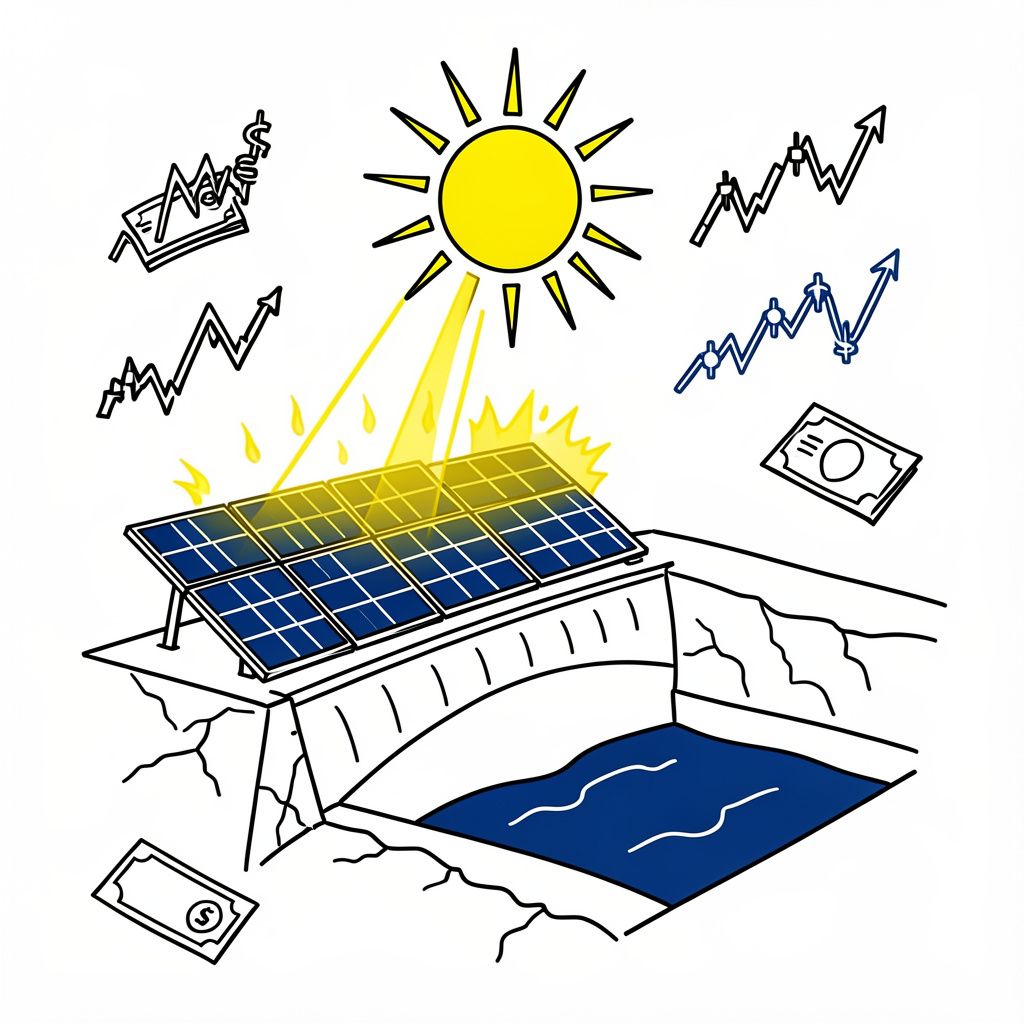
A 39-terawatt-hour surge in solar power offset severe European hydro deficits in summer 2026, fundamentally shifting water-based energy storage operations to peak midday hours.
Hydroelectric Shortfall and Solar Compensation
During the summer of 2026, specifically between June 1 and August 15, hydroelectric generation across ten reporting European systems totaled 31.65 TWh, marking the lowest output in seven years [1][5]. This figure represents a significant decline compared to the drought summer of 2022, where generation stood at 33.69 TWh [1]. The relative decrease in hydroelectric output calculates to -6.055 percent, confirming the severity of the water shortage impacting traditional renewable baseloads [1]. Reservoir stocks for these systems finished the period 7.7% below their eleven-year median, with France recording levels fractionally below its historical floor [1][5]. Despite these challenges, the geographic location of the drought shifted from the Iberian Peninsula in 2022 to the Alps, France, and the Danube region in 2026, altering regional dependency patterns [1].
Operational Shifts in Energy Storage
The surge in solar capacity has fundamentally reorganized grid operations, particularly regarding pumped hydro storage facilities [1]. Historically, primary charging operations occurred during pre-dawn hours, but peak charging has now shifted to the 13:00–14:00 window to align with peak midday solar production [1][5]. This operational pivot is evidenced by the correlation between hourly solar output and hourly pumping, which rose from zero to 0.86 over six summers [1]. Consequently, reservoir hydro output during midday hours dropped from 25.6% in 2020 to 10.1% in 2026, while evening generation increased to preserve water for high-demand periods [1]. This adaptation demonstrates that pumped storage did not choose midday arbitrarily but followed the price signals created by large midday solar volumes [1].
Broader EU Energy Mix Trends
Contextualizing these seasonal shifts within the broader European Union energy mix reveals a historic milestone achieved in 2025, where solar generation surpassed hydroelectric generation for the first time [2][4]. In 2025, EU solar generation reached 346,819 GWh, slightly exceeding hydroelectric generation at 346,244 GWh [2]. This trend accelerated into 2026, with solar power reaching a historic new peak in June 2026 alone, generating a record 52 TWh of EU electricity [3]. This single-month performance supplied 25% of the bloc’s monthly power, highlighting the accelerating capacity installation schedules that operated independently of immediate hydrological conditions [1][3]. Solar output has tripled since 2017, contributing to a renewable energy mix where wind and solar combined accounted for 30.7% of total EU electricity generation in 2025 [2][4].
Market Dynamics and Infrastructure Implications
The influx of midday solar volume has significantly impacted day-ahead price dynamics, with negative midday prices appearing in 29% of German and 28% of Spanish midday hours in 2026 [1]. While this indicates successful generation surplus, it also exposes genuine weaknesses in Europe’s energy infrastructure regarding stability and storage capacity [6]. Nuclear plants, for instance, remain dependent on river conditions for cooling, which can no longer be treated as stable during drought periods [6]. As the grid continues to evolve, the accounting relationship between hydro shortfalls and solar surpluses suggests a structural shift rather than a temporary anomaly, requiring continued adaptation in utility business models [1][5].