PGA Tour Leaders Question Commercial Value of Welcoming Back LIV Golf Players
Ponte Vedra Beach, Monday, 24 August 2026.
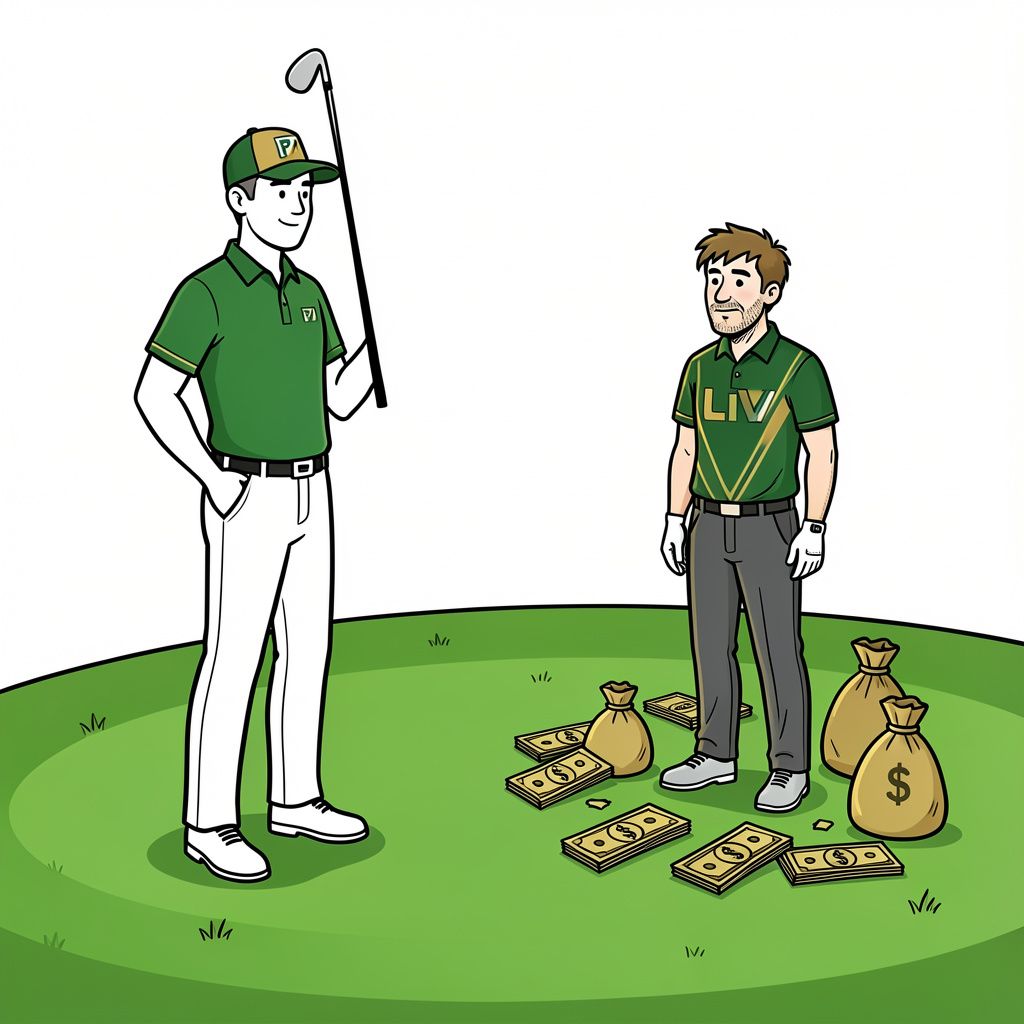
With PGA Tour viewership thriving and LIV Golf facing financial crisis following lost Saudi funding, golf leaders question whether integrating returning LIV players offers any true commercial value.
Commercial Viability Under Scrutiny
Prominent figures in professional golf are publicly questioning the strategic necessity of reintegrating LIV Golf players into the PGA Tour framework, citing robust health metrics within the traditional tour structure. CBS broadcaster Jim Nantz noted that the FedEx St. Jude Championship, held the week of August 10, 2026, achieved its highest broadcast viewership since 2013, suggesting the core business remains strong without LIV participation [1]. Rory McIlroy reinforced this sentiment on August 24, 2026, stating that the PGA Tour is in a really good spot and that any road back for LIV players would be tough [1]. Nantz added that the game is thriving without them, highlighting the loyalty of players who resisted financial incentives to leave [1].
The skepticism extends beyond viewership numbers to the fundamental value proposition of former LIV assets. McIlroy asked whether these players brought any tangible value to LIV during their tenure, implying a lack of commercial lift that would justify reintegration costs [1]. With the PGA Tour determining terms for potential returnees, including penalties for those who departed, the leverage appears to have shifted decisively toward the traditional tour leadership [1]. Scottie Scheffler, having secured a victory at the start of the 2026 FedEx Cup playoffs, noted that penalties must exist for those who left, leaving the specifics to tour management [1].
LIV Golf Financial Instability
In stark contrast to the PGA Tour’s stability, LIV Golf concluded its 2026 season finale on August 23, 2026, amidst severe uncertainty regarding its operational future [4]. The Saudi Arabian Public Investment Fund (PIF) withdrew its funding in April 2026, creating a precarious financial situation that has led to reports of unpaid vendors and canceled events [4][5]. To continue operations into a potential 2027 season, the league is seeking between $250 million and $350 million in new financing, a sum representing between 6.25 and 8.75 times the size of their final season’s total purse of $40 million [4][5].
Operational scaling back has already begun, with LIV Golf canceling concerts for artists Thomas Rhett and Disco Lines on August 17, 2026, and canceling a stand-alone Team Championship event scheduled for the week of August 30, 2026 [4]. Lead investor BC Partners has not yet finalized an agreement to inject necessary funding, leaving player contracts and league existence in doubt beyond the summer of 2026 [1][5]. Some players face the prospect of long-term contracts being canceled unless they accept equity in the tour, marking a significant shift from the league’s initial bounty-driven model [1].
Tour Championship and Future Outlook
While LIV Golf navigates potential bankruptcy proceedings, the PGA Tour is preparing for the Tour Championship at East Lake, scheduled for the week of August 31, 2026 [2]. Wyndham Clark secured a victory at the BMW Championship on August 23, 2026, marking his sixth PGA Tour title and third victory of the 2026 season, demonstrating the competitive depth remaining within the tour [2][3]. Six players, including Ryan Gerard and Min Woo Lee, are set to make their tournament debuts at the upcoming event, signaling continued interest and growth in the traditional circuit [2][3].
The divergence in trajectories between the two entities suggests that any future unification deal will heavily favor the PGA Tour’s existing structure. Jim Nantz expressed trust that PGA Tour CEO Brian Rolapp will figure out a solution that does not cause too much friction for the base that stayed loyal [1]. As of August 24, 2026, the period of active conflict appears to be concluding, with former LIV proponents seeking a return to the traditional structure now that financial subsidies have ceased [5].