Why Construction Delays in American Data Centers Threaten Tech Growth
New York, Sunday, 8 November 2026.
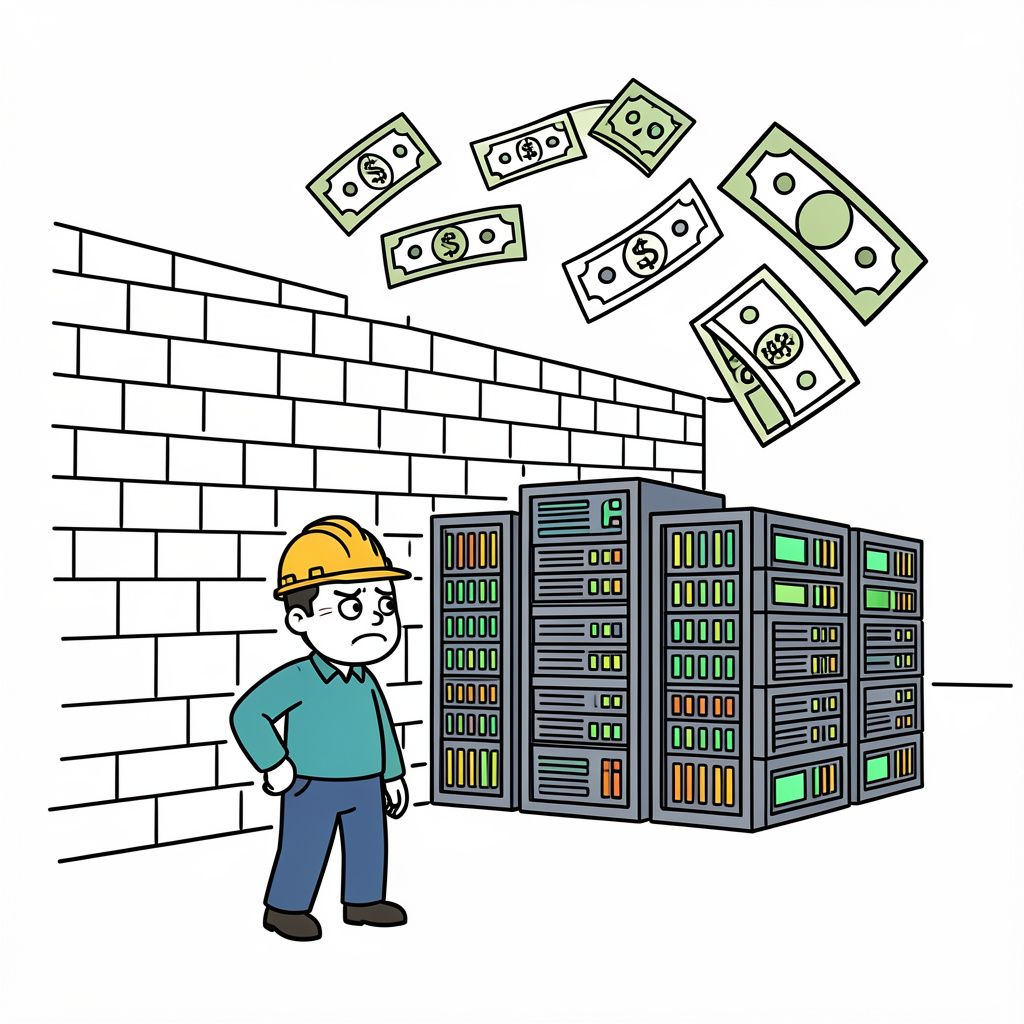
With thirty percent of planned American data centers delayed, chipmakers face an unexpected bottleneck: billions of dollars in advanced processors are ready, yet physical buildings to house them remain unbuilt.
A Growing Infrastructure Gap
As of November 2026, the U.S. artificial intelligence (AI) ecosystem faces a critical bottleneck: approximately 30% of planned data center capacity intended for completion by 2028 is at risk of significant delay according to UBS research cited in a November 6, 2026 report [1]. This logistical gap threatens to disrupt the deployment timelines of advanced AI infrastructure, particularly for semiconductor manufacturers like Nvidia (NASDAQ: NVDA), whose data center revenue surged to $89.023 billion in Q2 of fiscal 2027—a 117.023% year-over-year increase [1]. The company’s forward guidance anticipates third-quarter fiscal 2027 revenue of $108.0 billion, plus or minus 2% [1]. However, the absence of operational facilities to house these chips could undermine revenue projections and investor confidence in the AI supply chain.
The Physical Bottlenecks Behind the Crisis
The delays stem from two interconnected challenges: a shortage of ready-to-use physical infrastructure and grid interconnection constraints. UBS estimates that without accelerated construction timelines, the shortfall in data center capacity could create a structural imbalance in the AI hardware ecosystem [1]. This infrastructure deficit has already begun to influence market sentiment, with Equinix and Digital Realty experiencing minimal volatility while Eaton Corporation saw a 21% stock decline amid investor preference for landlords with pre-approved, powered sites [1]. Nvidia, despite securing $279.00 billion in supply commitments for advanced memory chips such as those planned for the Vera Rubin generation, faces the paradox of having hardware ready for deployment while lacking the facilities to deploy them [1].
Alternative Pathways: Repurposing Existing Structures
In response to these constraints, Nvidia is exploring unconventional solutions to bypass the construction bottleneck. Reports indicate the company is in advanced discussions with Apollo Global Management, the parent company of telecommunications provider Brightspeed, to retrofit over 130 former telephone exchange buildings into small-scale AI data centers across 20 U.S. states [3][4]. These retrofitted facilities could provide up to 1 gigawatt (GW) of compute capacity, a critical addition given the scale of Nvidia’s chip supply commitments [3][4]. The repurposing strategy aligns with Nvidia’s broader effort to diversify its infrastructure footprint beyond traditional hyperscale data centers, which have faced increasing local opposition due to concerns over energy consumption and land use [3][4].
Regional Policy and the Future of AI Infrastructure
The timeline for resolving these infrastructure challenges is complicated by regional policy dynamics. While some states like Texas have moved to ensure completion of already-permitted data centers, with Governor-elect Gina Hinojosa stating that permitted facilities in Texas will finish construction through 2028 [5], other regions face regulatory headwinds. Ballot measures in 2026’s midterm elections resulted in all but one of 41 data center-related propositions being rejected, reflecting community resistance to large-scale AI infrastructure [5]. This patchwork of regulatory environments could force companies to reconsider project locations, with analysts noting that roadblocks in one state may lead to redirection of capital to more accommodating regions [5]. For example, Alphabet’s recent $17 billion investment in a Wyoming data center, partially powered by a 702-megawatt Bloom Energy fuel-cell project, underscores the strategic shift toward energy-efficient and politically expedient locations [5].
Market Reactions and Long-Term Implications
The convergence of infrastructure delays, policy uncertainty, and supply chain commitments has already impacted market valuations. Nvidia’s stock declined by 9% following the midterm election results, pushing its forward price-to-earnings (P/E) ratio to a three-year low of 15x [5]. This volatility reflects broader investor unease regarding the scalability of AI infrastructure, despite consensus revenue estimates projecting Nvidia’s revenue to reach $692 billion for the fiscal year ending January 2028 and $903 billion by January 2029 [5]. Long-term, the resolution of these bottlenecks will depend not only on construction acceleration but also on federal and state-level coordination to streamline permitting and energy allocation. Industry observers emphasize that while retrofitting existing structures offers a stopgap, it cannot fully substitute for the large-scale, high-capacity data centers required to meet surging AI demand [1][3][4].