40,000 Evacuated as Orange County Faces Catastrophic Chemical Tank Threat
Orange County, Saturday, 23 May 2026.
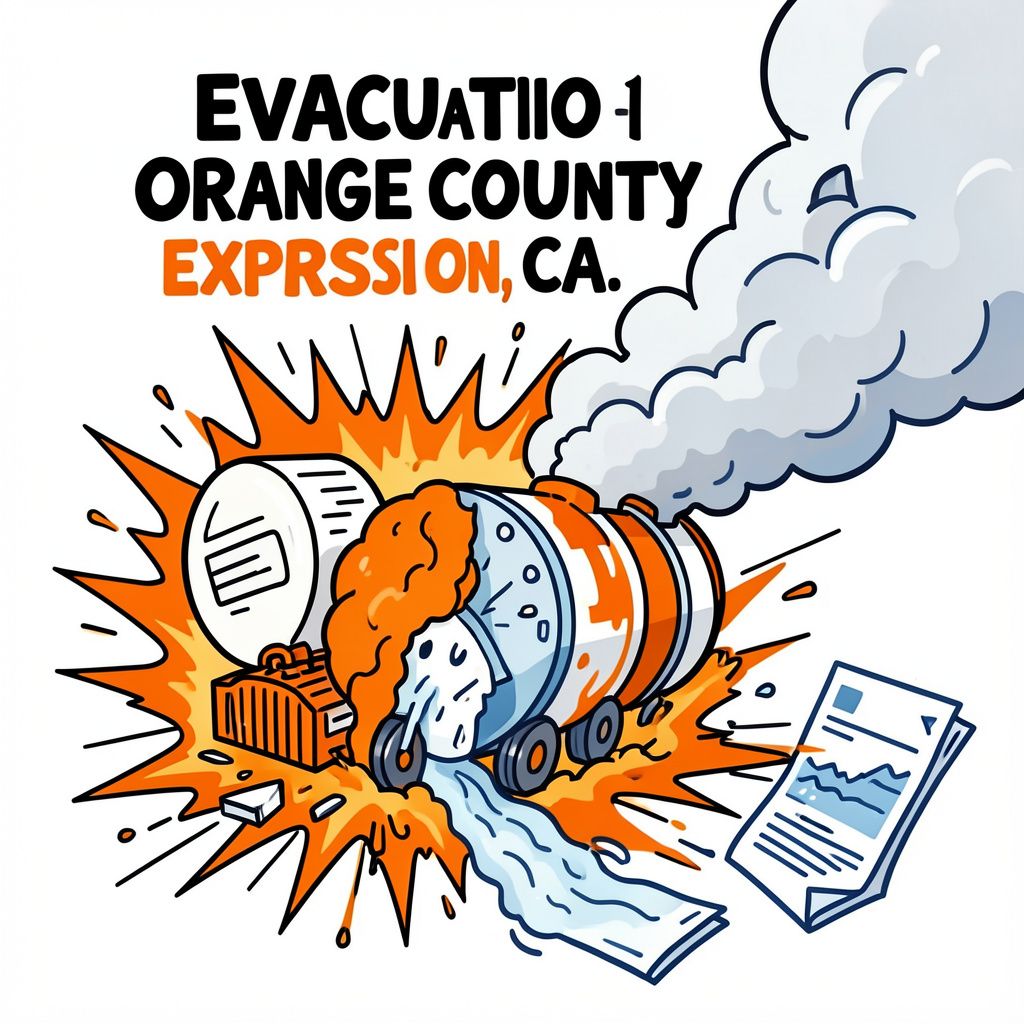
Over 40,000 California residents face mandatory evacuation as crews scramble to stabilize a failing 26,500-liter chemical tank that authorities warn will either catastrophically leak toxic vapor or completely explode.
The Industrial Crisis at GKN Aerospace
The crisis centers on a GKN Aerospace facility located in Garden Grove, California, where a storage tank containing 26.5 cubic meters of methyl methacrylate began showing signs of critical failure on Thursday, May 21, 2026 [1][2]. The chemical is a crucial precursor used in the manufacturing of hardened plastic components for the aerospace industry [2]. Initial evacuation orders were issued Thursday when the tank visibly bulged due to internal heating, but the situation escalated drastically on Friday, May 22, after emergency crews discovered damaged valves on the containment vessel [2]. Craig Covey, a division chief with the Orange County Fire Authority, starkly outlined the severity of the threat, stating the tank is “actively in crisis” and that authorities are preparing for two grim outcomes: a catastrophic leak or a massive explosion [1][2].
Economic Disruption and Supply Chain Risks
Beyond the immediate threat to public safety, the incident at GKN Aerospace highlights significant vulnerabilities within regional supply chains and local commerce [GPT]. Methyl methacrylate is highly volatile, and its handling requires strict temperature controls; the optimal storage temperature for this chemical is 10 °C [2]. The disruption at a specialized aerospace manufacturing site not only stalls localized production but also ripples through the broader aerospace supply chain, which relies heavily on these hardened plastic components [2]. Local businesses within the evacuation zone have been forced into sudden closures, paralyzing daily commerce across a significant swath of North Orange County [2][alert! ‘Specific economic loss figures for local businesses are not yet available’].
Containment Efforts and Health Hazards
First responders have deployed extensive environmental and structural countermeasures to mitigate the fallout of a potential structural failure. Emergency crews have constructed robust sandbag barriers around the GKN Aerospace facility to prevent any spilled methyl methacrylate from contaminating local storm drains, creeks, or the nearby Pacific Ocean [1]. Simultaneously, thermal management has become the primary operational focus. By the evening of Friday, May 22, cooling efforts successfully reduced the tank’s internal temperature to approximately 16.1 °C, edging closer to its safe threshold [2]. Fire Authority crews coordinated with national experts throughout Friday night, developing strategic interventions to stabilize the damaged valves and prevent an explosion [2].
Awaiting the Verdict
As dawn breaks on Saturday, May 23, 2026, the region remains in a state of suspended animation. Emergency crews maintained a full night shift through Friday evening, working continuously to implement newly devised stabilization strategies [2]. Authorities have promised a comprehensive update on the tank’s structural integrity and temperature metrics for this morning [2]. Until the vessel is permanently secured, the 40,000 displaced residents—and the local economy that supports them—remain in a precarious holding pattern, waiting to see whether the crisis will end in a controlled resolution or a devastating industrial disaster [1][2].