Oil Prices Hit Four-Year Highs as the United States Makes Export History
New York, Thursday, 30 April 2026.
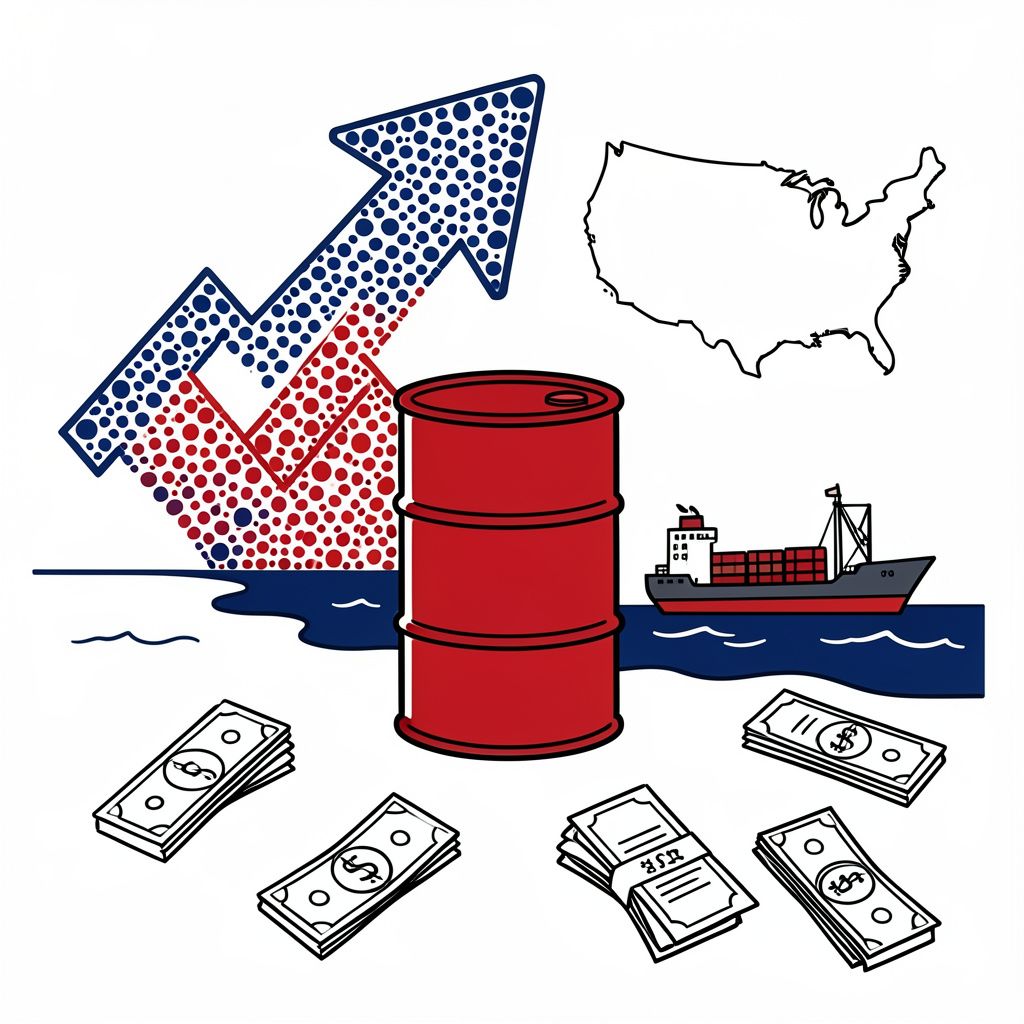
Escalating geopolitical conflict has driven crude oil past $126 per barrel, prompting the United States to become a net oil exporter for the first time since World War II.
A Market on Edge: The Geopolitical Catalyst
Building upon the precarious foundation established when U.S. President Donald Trump rejected Iran’s peace proposal—a move that signaled an extended naval blockade and initially pushed Brent crude above $111 [1]—global energy markets have now reached a fever pitch. Early on Thursday, April 30, 2026, the global oil benchmark Brent crude touched an intraday high of $126.41 per barrel, marking its loftiest valuation since March 9, 2022 [2]. This dramatic surge represents a staggering 78.671% increase from the $70.75 per barrel price recorded just before the conflict between the United States, Israel, and Iran erupted in late February 2026 [4]. The latest spike was largely catalyzed by reports from Axios indicating that President Trump is receiving briefings on potential military strikes against Iran, aimed at forcing a return to nuclear negotiations [2]. According to ING Bank strategists Warren Patterson and Ewa Manthey, the breakdown in diplomacy and the continued closure of the Strait of Hormuz have left the market “losing hope for any quick resumption in oil flows” [5].
Unprecedented Shifts in U.S. Energy Exports
The shockwaves from the Middle East are fundamentally reshaping American energy trade. In a historic pivot, the United States has become a net exporter of crude oil on a weekly basis for the first time since World War II [3]. The U.S. Energy Information Administration (EIA) reported on Wednesday, April 29, that net imports of crude fell by 1.97 million barrels per day (bpd) to a negative 688,000 bpd [3]. The last time the United States achieved net exporter status was annually in 1943 and monthly in 1944 [3]. Total U.S. crude exports skyrocketed by 1.64 million bpd from the previous week to hit a record 6.44 million bpd, while total exports of crude oil and petroleum products reached an unprecedented 14.18 million bpd [3].
The Venezuelan Crude Factor
Domestically, the diversion of oil to overseas markets is compounding pain at the pump. The average U.S. gasoline price has climbed to $4.17 per gallon, up $0.15 from the previous week and a stark $1.02 increase compared to April 2025 [4]. Furthermore, U.S. gasoline futures have jumped over 5% to $3.74, the highest price seen since 2022, alongside an 11th consecutive week of draws that left gasoline stocks at 222.3 million barrels [3]. Seeking alternative supply lines, energy giants are looking south. Chevron is currently importing Venezuelan crude, with tankers delivering 400,000 barrels to its Pascagoula, Mississippi refinery [4]. Chevron is processing approximately 100,000 barrels of this heavy crude per day, a supply expected to last the facility about four days [4].
Broader Economic Ripples and Central Bank Caution
The sheer scale of the energy crisis is casting a long shadow over the broader macroeconomy. On Wednesday, April 29, 2026, the Federal Reserve opted to hold interest rates steady, a policy decision that provided further support for the U.S. dollar [5]. The currency markets experienced notable volatility; after surging to its highest level in nearly two years and closing at 160.44 Japanese yen on April 27, the dollar fell slightly to 160.02 yen the following day [5]. Meanwhile, the euro edged up to $1.1686 from $1.1675 [5].