Data Center Construction Drives US Economic Growth as Traditional Building Falls
Washington, Monday, 12 October 2026.
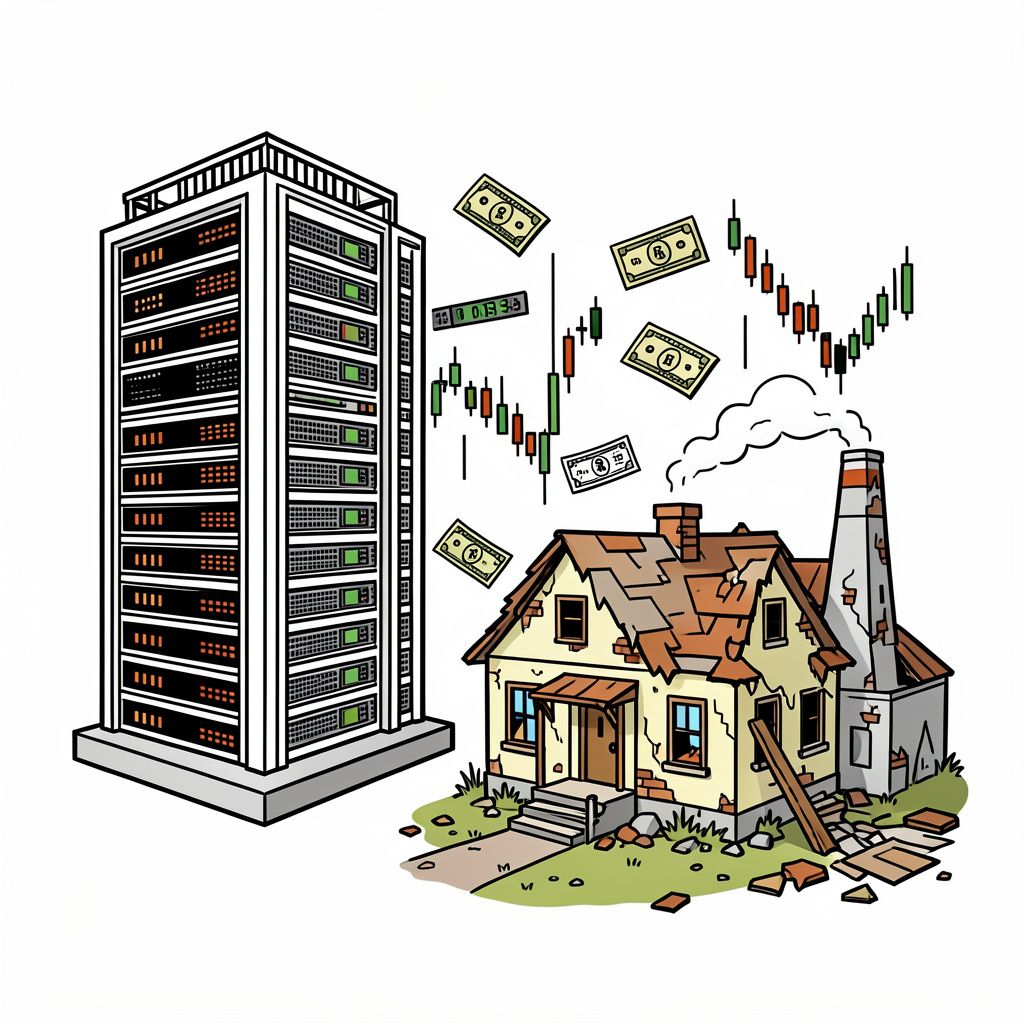
Data center construction surged 64.5 percent between August 2025 and 2026, acting as the sole engine of US expansion while traditional sectors, including manufacturing and residential building, sharply contracted.
Data Center Construction Drives US Economic Growth as Traditional Building Falls
Data center construction surged 64.5 percent between August 2025 and August 2026, acting as the sole engine of United States expansion while traditional sectors sharply contracted [1]. This growth trajectory is based on analysis of key economic metrics surrounding artificial intelligence in 2026, highlighting a divergent trend where technology infrastructure offsets broad stagnation across commercial and residential real estate [2]. The period marks a significant shift in macroeconomic activity, relying heavily on technology infrastructure investments to sustain overall economic momentum [1].
Sector Disparity and Infrastructure Demand
While data center development exploded, traditional categories regressed significantly during the same timeframe [2]. New energy infrastructure grew by 4.1 percent to keep pace with electricity demand required to power the AI boom, but other sectors faced declines [1]. Multi-family home building fell by 5.6 percent, and healthcare and commercial retail construction both tumbled by 10.1 percent [1]. Educational construction dropped by 12.6 percent, while manufacturing shrunk nearly 24 percent from 2025 to 2026 [1].
Construction as an Economic Indicator
Construction spending serves as a key indicator of economic stability, making these disparities critical for understanding broader financial health [3]. The concentration of growth in a single niche sector suggests potential vulnerabilities if the underlying demand driver fluctuates [1]. Analysts note that against all odds, the US economy continues to grow at a record-setting pace, yet the health of this growth is predicated almost entirely on the AI boom [2].
Labor Market Implications and Capital Allocation
Investment in data centers creates approximately 1% of the jobs generated by equivalent capital investment in other industries, leading to significant crowding out of other capital uses [4]. A representative 200 MW AI training campus costs roughly $8.2 billion yet employs only 50 to 150 workers once operational [4]. In contrast, deploying $8 billion in a non-AI sector supports over 10,000 jobs, compared to only approximately 100 jobs in the data center sector [4]. The job creation ratio can be expressed as 1 percent relative to alternative investments [4].
Economic Risks and Future Outlook
If the AI data center boom ends, construction workers and banks will pay the price as much of America’s recent growth has been carried by this sector [5]. Even a plateau in AI building would idle crews and impact financial institutions exposed to these projects [5]. Investors are growing increasingly skeptical over the sustainability of AI spending, suggesting data center spending could tumble back down to Earth [1]. Projections estimate hyperscalers will spend over $10 trillion on data centers through 2032, potentially resulting in 10 million fewer jobs compared to alternative economic investments [4].