South Korea Stocks Drop Sharply as Tech Shares Fall and Energy Costs Rise
Seoul, Monday, 12 October 2026.
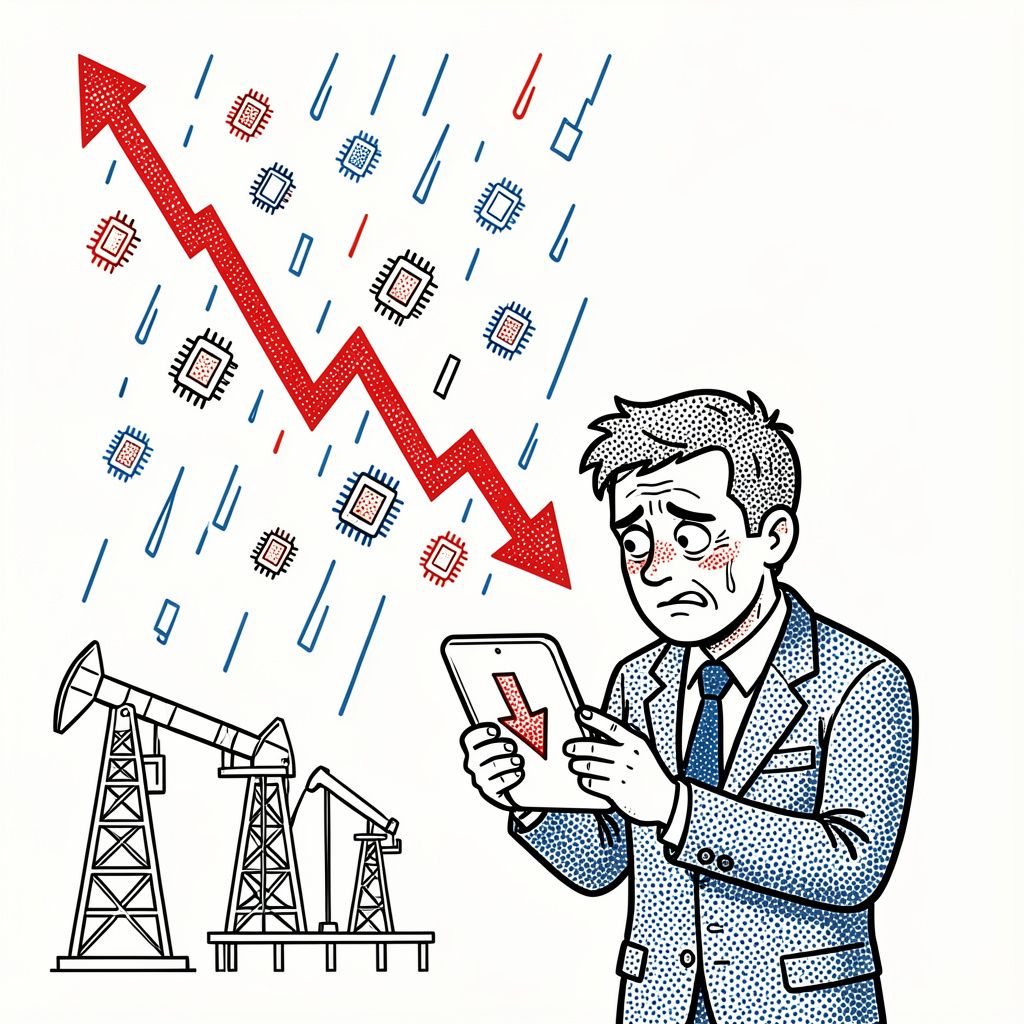
The KOSPI index plunged 3.65 percent on October 12, 2026, driven by chipmaker sell-offs and Middle East tensions, despite Samsung’s record quarterly operating profit forecast of 107.4 trillion won.
Benchmark Index Plummets
On October 12, 2026, the benchmark Korea Composite Stock Price Index (KOSPI) closed at 6,384.24, marking a significant decline of 241.69 points or 3.65 percent [1][3]. This drop represents the largest daily decline since September 2, 2026, extending the market’s losing streak to four consecutive sessions [3]. The index breached multiple support levels, including 7,000, 6,500, and 6,400, shedding 619.50 points or 8.845 percent of its value since October 6, 2026 [3]. Trade volume was recorded at 313 million shares worth 21.33 trillion won, with decliners outnumbering advancers by a ratio of more than 4 to 1 [1].
Technology Sector and AI Concerns
Technology stocks led the market decline, with semiconductor giants Samsung Electronics and SK hynix falling 4.39 percent and 4.52 percent respectively [1]. This sell-off occurred despite Samsung Electronics forecasting a record quarterly operating profit of 107.4 trillion won driven by AI-related memory shortages [4]. Investors appear concerned about an artificial intelligence bubble following reports on October 8, 2026, that OpenAI’s annual revenue was $20 billion lower than previously expected [3]. Analysts note that while global AI spending is rising, Korean semiconductor stocks face scrutiny over relative valuations and profit growth expectations [3].
Geopolitical and Inflationary Pressures
External factors exacerbated the downturn, specifically escalating tensions in the Middle East following renewed Houthi attacks on Saudi Arabia’s main airport over the weekend [1]. Oil prices rose in response, adding to inflationary pressures and complicating Federal Reserve efforts to control inflation [1]. Additionally, North Korea launched multiple ballistic missiles on October 12, 2026, contributing to regional instability [5]. A broader regional conflict could disrupt energy supplies, further impacting global supply chains and financial markets [1].
Investor Behavior and Future Outlook
Foreign investors and institutions were net sellers, offloading 2.5139 trillion won and 152.3 billion won worth of stocks respectively on October 12, 2026 [7]. Conversely, individual investors bought a net 2.92 trillion won, attempting to counterbalance the institutional exodus [7]. This divergence highlights the tension between foreign risk aversion and domestic retail confidence [7]. Between October 6, 2026, and October 8, 2026, foreign investors had already executed net sales of over 6 trillion won, signaling a trend of outflows leading into the holiday break [8].