Germany Launches Rare Earth Recycling Facility to Secure Western Supply Chains
Pforzheim, Tuesday, 28 April 2026.
A newly inaugurated German plant uses hydrogen to recycle rare earth magnets from e-waste, drastically reducing reliance on Chinese monopolies and accelerating U.S. manufacturing expansion.
A Technological Leap in Magnet Recycling
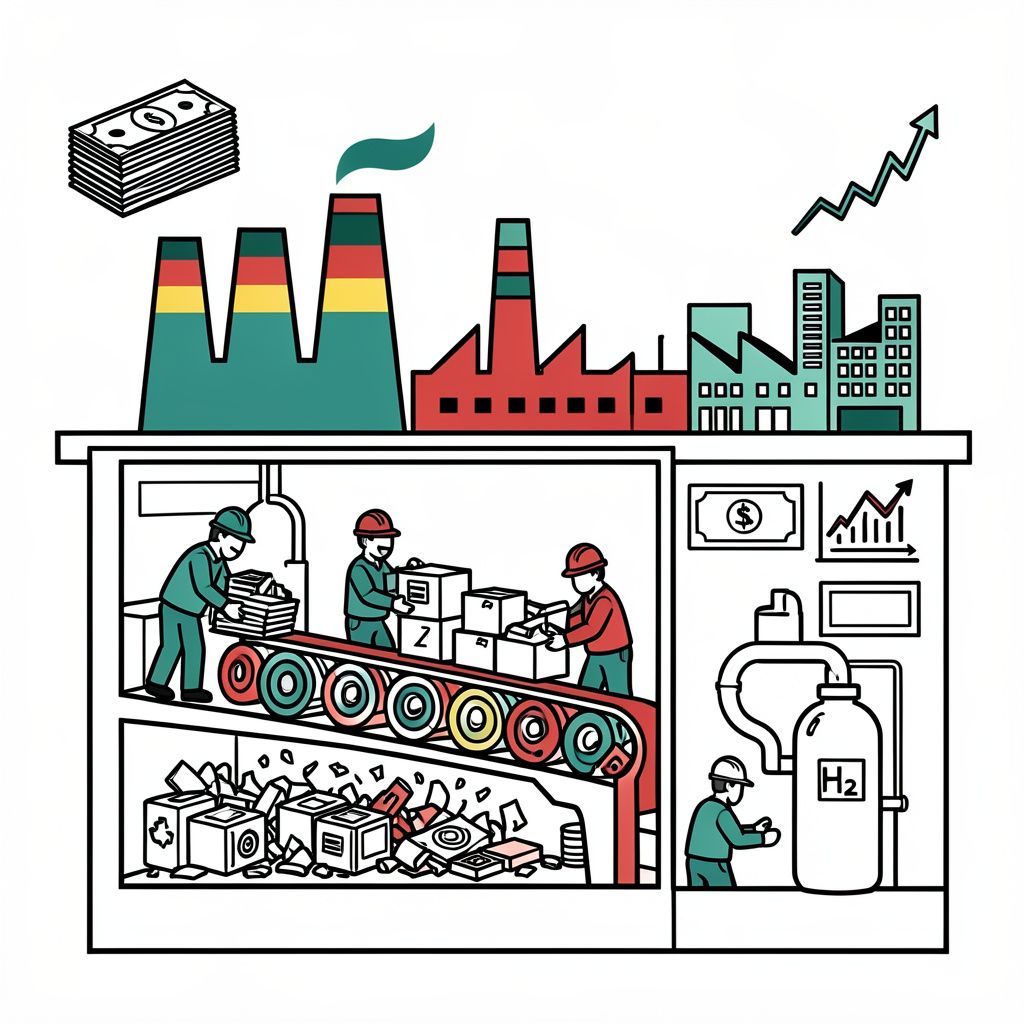
On Tuesday, April 28, 2026, the German Federal Ministry for Economic Affairs and Energy officially inaugurated HyProMag’s new rare earth magnet recycling facility in Pforzheim, Baden-Württemberg [1][2]. Hosted by Parliamentary State Secretary Stefan Rouenhoff, the event marks the launch of the European Union’s first commercial-scale plant of its kind [1][6]. The facility relies on a patented process known as Hydrogen Processing of Magnet Scrap (HPMS), developed over two decades at the University of Birmingham [1][6]. By exposing magnet-bearing components to hydrogen gas at room temperature and relatively low pressure, the highly reactive neodymium breaks down into a demagnetized powder [7]. This allows the alloy to be easily separated and reformed into new high-performance neodymium-iron-boron (NdFeB) magnets without the need for traditional, energy-intensive metal production steps [6][7].
Breaking the Supply Chain Monopoly
The geopolitical urgency of the Pforzheim facility cannot be overstated [GPT]. Following China’s tightening of export controls on critical minerals in 2025, Western industries have faced mounting pressure to secure independent supply chains [5]. China has historically maintained a de facto monopoly on both the mining and manufacturing of rare earth elements, leaving European and American manufacturers highly vulnerable to supply shocks [5]. The new German plant is designed to mitigate this risk by processing materials already circulating within Europe, thereby decoupling critical mineral security from daily political volatility [5].
Scaling Up Production and European Security
The operational roadmap for the Pforzheim facility outlines an aggressive expansion. While initial production begins at a minimum capacity of approximately 100 metric tons per annum (tpa) of NdFeB products, output is projected to reach 350 tpa by 2027 [1][6]. By 2028, the company plans to scale up to 750 tpa [6][7]. This represents a planned capacity increase of 650 percent over the next two years. The project’s commercialization has been bolstered by significant public backing, including financing from the European Regional Development Fund, the Baden-Württemberg Ministry for Economy, Labour and Tourism, and UK Research and Innovation [6]. Notably, the initiative is also listed among the 17 flagship projects of the 2025 German-British friendship treaty [6].
Catalyzing the United States Expansion
For the American market, the successful launch of the German plant acts as a vital proof of concept. The facility is HyProMag’s second commercial-scale operation—following a UK plant opened in January 2026—and serves to directly de-risk the company’s ambitious rollout in the United States [1][6]. CoTec Holdings Corp., which owns an effective 60.3 percent interest in HyProMag USA alongside joint venture partner Maginito Limited, views the German operations as the technical foundation for its American manufacturing platform [1].
Sources
- www.newswire.com
- www.faz.net
- background.tagesspiegel.de
- www.it-boltwise.de
- www.tagesschau.de
- www.recyclingmagazin.de
- www.ardsounds.de