Looming 2032 Social Security Shortfall Threatens Retirees With a $500 Monthly Income Drop
Washington, Friday, 5 June 2026.
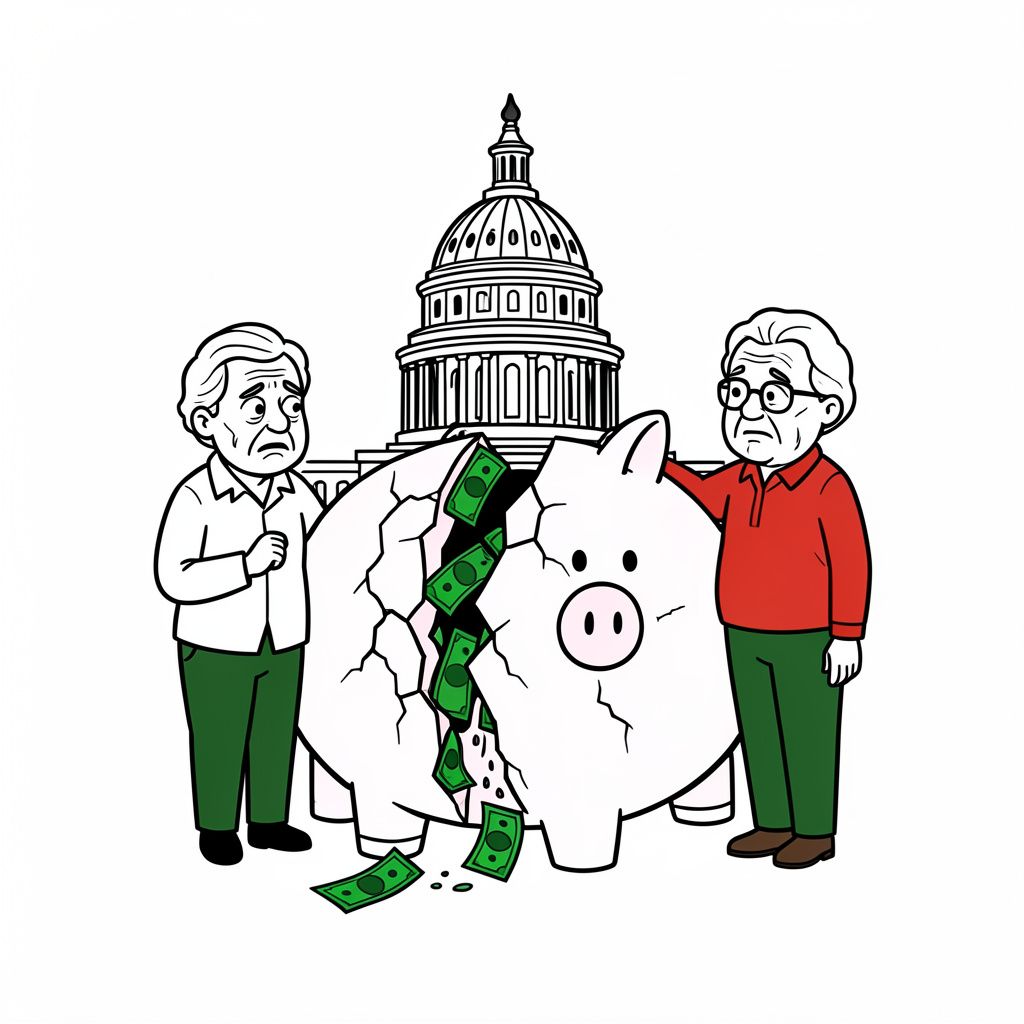
Without congressional action, the Social Security trust fund will deplete by 2032, triggering an automatic 24% benefit reduction that could cost millions of retirees $500 a month.
The Mechanics of the Approaching Fiscal Cliff
The foundation of the United States’ largest entitlement program has been structurally imbalanced for over a decade. Since 2010, the cost of the Social Security retirement program has outpaced its cash income, forcing the system to draw down on its trust fund reserves to meet obligations [3]. This demographic pressure is primarily driven by an aging population and a shrinking ratio of active workers paying into the system compared to the number of retirees drawing from it [2]. While experts have warned of this unsustainable trajectory since 1984 [3], recent legislative shifts have accelerated the timeline. In its 2025 report, the Social Security Administration advanced the projected insolvency date of the Old-Age and Survivors Insurance (OASI) trust fund from 2033 to the end of 2032, citing the taxation effects of the One Big Beautiful Bill Act [4].
Mapping the State-Level Economic Shockwaves
The macroeconomic implications of a 24% reduction in benefits are staggering. Nationwide, the cuts would drain approximately $345 billion from the economy in a single year, representing roughly 1.1% of the national Gross Domestic Product (GDP) [3][7]. The CRFB projects that the total benefit cuts would exceed 1% of GDP in 40 states, with severe economic impacts concentrated in states like West Virginia, Mississippi, and Vermont [3]. In absolute nominal terms, heavily populated states would experience massive capital outflows. Retirees in California alone would lose an estimated $33.4 billion annually, while those in Florida and Texas would see reductions of $26.6 billion and $23.7 billion, respectively [3][7].
The Threat to Household Financial Stability
To contextualize the severity of a $500 monthly reduction, one must examine the daily financial realities of American seniors. According to the 2024 Consumer Expenditure Survey, households led by someone over the age of 65 spent an average of $438 per month on food at home, a figure that adjusts to $461 per month in 2026 when accounting for inflation [3]—representing a 5.251 percent increase in food costs over that two-year span. Consequently, a $500 cut essentially wipes out the entire monthly grocery budget for the average retiree [GPT]. The reliance on these fixed incomes is profound; a 2025 survey by the Senior Citizens League revealed that 73% of retirees depend on Social Security for more than half of their income, and a staggering 39% rely on it entirely [4].
Legislative Gridlock and Potential Remedies
With less than seven years remaining until the projected insolvency [2][5][6], the window for a gradual, painless fix has effectively closed. The CRFB has strongly urged policymakers to enact changes swiftly to protect against these scenarios, warning that no state will be spared from the potentially devastating effects [1][2][4][6][7]. Historically, Congress has utilized a combination of tax adjustments and benefit modifications to stabilize the program. During the last major Social Security overhaul in 1983, the federal government gradually raised the full retirement age from 65 to 67 to prevent the program from failing to pay full benefits [5].
Sources
- thehill.com
- www.kcrg.com
- www.crfb.org
- www.cbsnews.com
- www.newsnationnow.com
- www.cnbc.com
- fortune.com