Trump Asked China's Leader to Buy American Military Weapons, Envoy Says
Beijing, Monday, 28 September 2026.
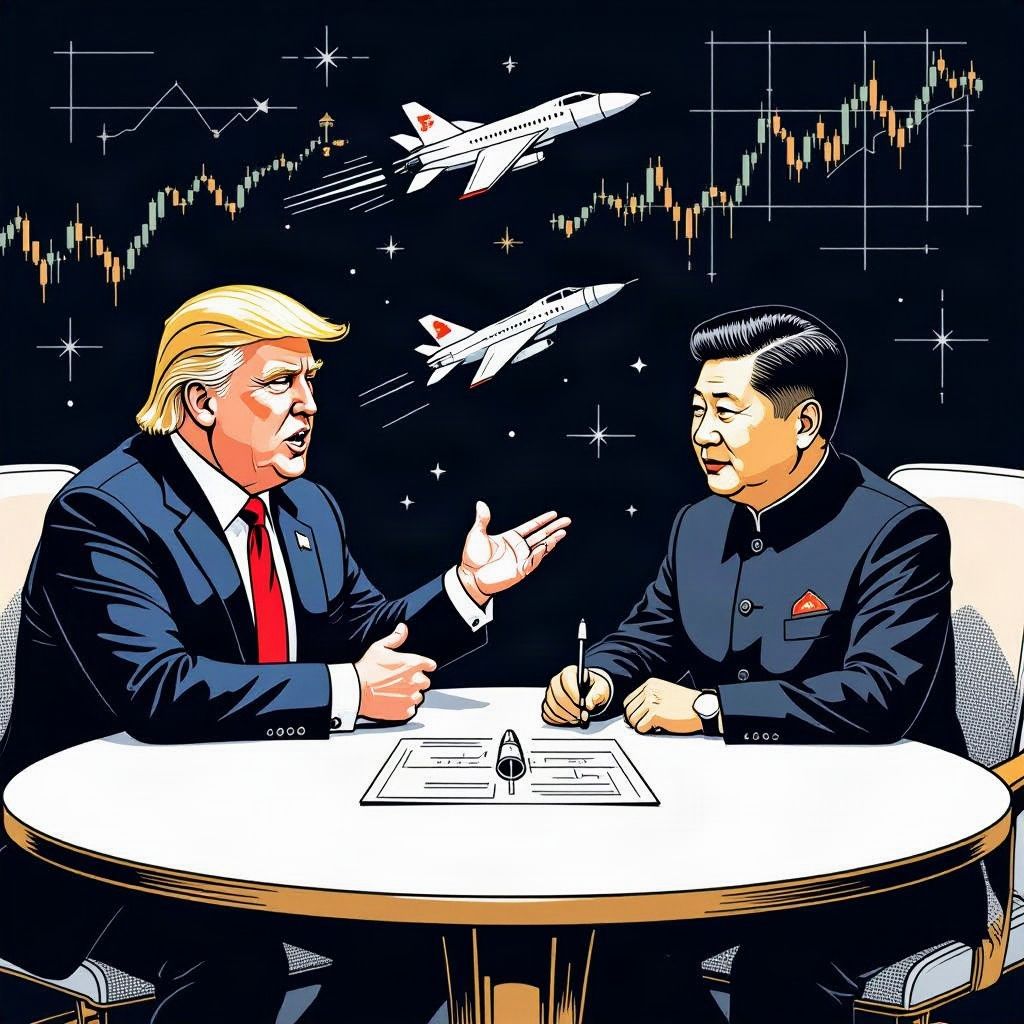
During recent talks, President Trump asked Chinese President Xi Jinping if Beijing wanted to purchase American weapons, despite federal laws strictly prohibiting defense exports to China.
From AI Hotlines to Unprecedented Arms Inquiries
This unexpected trade proposal follows a high-stakes bilateral summit in Washington during late September 2026, where Republican President Donald Trump and Chinese President Xi Jinping agreed to prioritize artificial intelligence development over safety guardrails and establish an emergency national security hotline [7]. Moving far beyond technological competition, the diplomatic narrative shifted dramatically on Sunday, September 27, 2026, when U.S. Ambassador to China David Perdue revealed that President Trump had floated the idea of selling American-made military weapons directly to Beijing [2][3][5]. Speaking on “Fox News Sunday,” Perdue disclosed that the president questioned whether Xi would be interested in acquiring American defense systems, framing the inquiry as part of Trump’s broader commercial view of global arms trade [2][3].
Legal Barriers and Immediate White House Walkbacks
The proposal represents an expression of negotiating intent rather than an active or implemented policy change, as severe domestic legal restrictions immediately block such transactions [3][4][6]. Following the ambassador’s public remarks, both the White House and the U.S. State Department moved quickly on September 27, 2026, to clarify that the administration has no plans to pursue weapons sales to China [4][6]. The State Department issued an explicit statement reminding the public that federal law strictly prohibits the export of defense articles and services to China, a restriction rooted in the arms embargoes imposed by the United States and European nations following the 1989 Tiananmen Square crackdown [4][6]. Despite these legal boundaries, President Trump’s inquiry highlights his willingness to leverage unconventional commercial offers during strategic discussions with Washington’s primary geopolitical rival [4][6].
Taiwan as a Negotiating Chip in Bilateral Trade
The timing of Trump’s weapon proposal is particularly sensitive given the ongoing security crisis in the Taiwan Strait, where Democratic and Republican lawmakers alike have urged the administration to bolster Taipei’s defenses [2][4]. The U.S. previously approved an $11 billion arms package for Taiwan in December 2025 [4], but Trump has kept a subsequent $14 billion military aid package in abeyance for several months [3][4]. Combined, these packages represent a total of 25 billion in potential and finalized defense support [3][4]. Trump has openly defended delaying the latter package, describing it during a May 2026 meeting with Xi in Beijing as a “very good negotiating chip” [3][4]. This transactional approach to defense has raised concerns in Taipei, where Deputy Foreign Minister Chen Ming-chi recently emphasized the severe and growing military threat posed by China’s continuous defense investments [3].
Future Engagements on the Horizon
While the arms proposal has sparked intense debate in Washington, bilateral diplomatic momentum remains highly active [2]. Xi Jinping’s state visit to the United States concluded on Friday, September 25, 2026, marking a highly publicized event where Trump rolled out the red carpet despite persistent friction over China’s economic policies and its strategic ties to U.S. adversaries like Iran [2][5]. Looking forward, President Trump announced on Truth Social that he intends to meet with President Xi at least two more times before the end of the year [2]. These future face-to-face discussions are scheduled to take place during the Asia-Pacific Economic Cooperation meeting in China this November, followed by the Group of 20 Summit in Miami, Florida, in December 2026 [2].
Sources
- www.ft.com
- thehill.com
- www.theguardian.com
- www.thedailybeast.com
- nypost.com
- www.nytimes.com
- wsnext.com