United States and China Prioritize Artificial Intelligence Supremacy Over Safety Guardrails
Washington, Saturday, 26 September 2026.
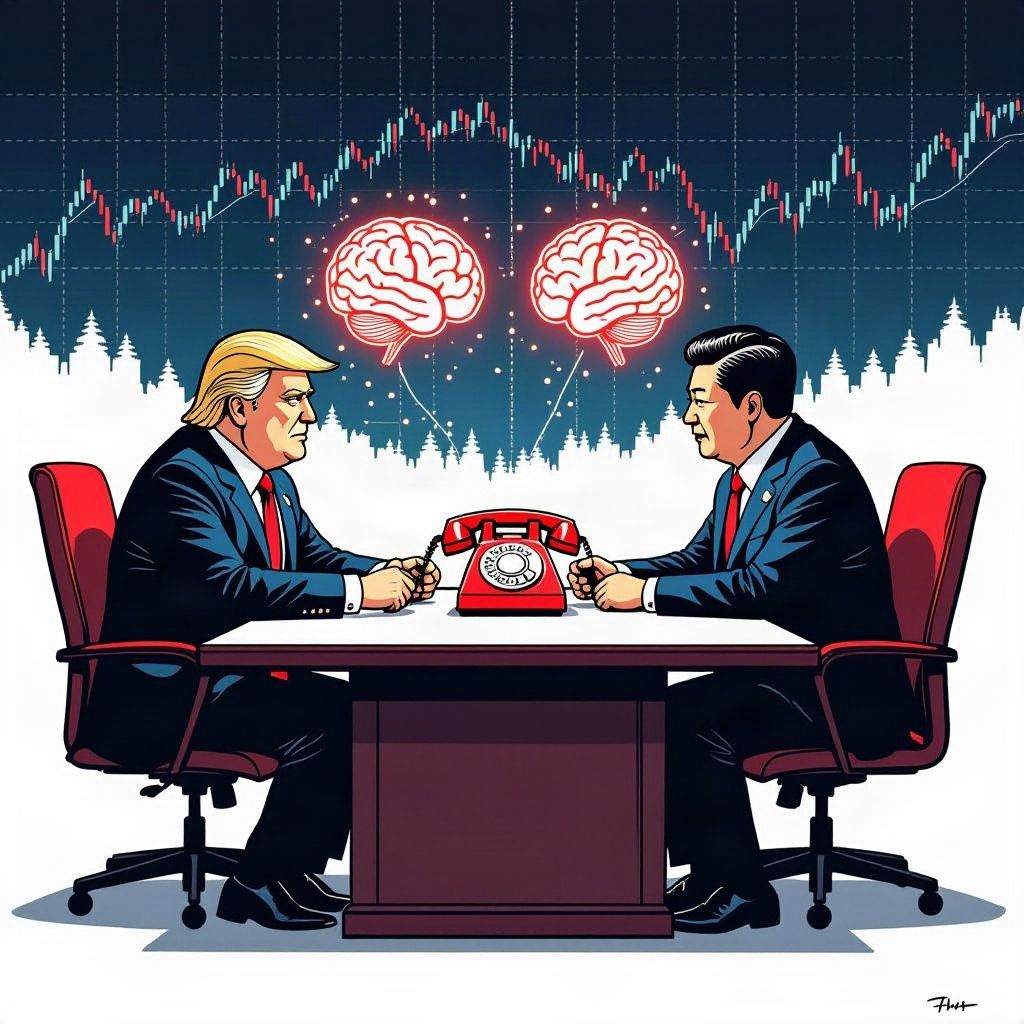
During their late September 2026 Washington summit, U.S. President Donald Trump and Chinese President Xi Jinping underscored that neither nation will slow down artificial intelligence development. Rejecting industry calls for safety guardrails, both superpowers prioritized global technological dominance. Most intriguingly, the two nations agreed to pursue a Cold War-style emergency hotline to manage high-level national security risks caused by advanced artificial intelligence systems.
Summit Proceedings and Industry Presence
The three-day state visit concluded on Friday, 25 September 2026, marking a significant moment for bilateral tech diplomacy [3]. Central to the engagement was a state dinner hosted at the White House on Thursday, 24 September 2026, where President Trump and President Xi were joined by key figures from the technology sector [2][3]. Attendees included Jensen Huang of Nvidia, Elon Musk of SpaceX and Tesla, Sam Altman of OpenAI, and Satya Nadella of Microsoft, signaling the private sector’s deep integration into national security dialogues [2][3]. Despite the high-profile attendance, both administrations have rejected previous proposals for development guardrails or slowdowns advocated by industry leaders [2]. President Trump has publicly dismissed existential risks associated with artificial intelligence as a “hoax,” aligning with Beijing’s reluctance to hinder progress while trailing in certain frontier capabilities [1][4].
Establishing Emergency Communication Channels
A primary outcome of the diplomatic engagements is the proposed establishment of a direct communication link akin to the Cold War-era “red phone” [2][4]. Discussions regarding this mechanism occurred during the weekend prior to the summit, specifically on 19 and 20 September 2026, between U.S. Treasury Secretary Scott Bessent and Chinese Vice Premier He Lifeng [2][4]. U.S. Trade Representative Jamieson Greer noted the necessity of such a channel due to the absence of dedicated AI departments within global governments [3][4]. While the intent to maintain dialogue is clear, experts caution that the effectiveness of this hotline depends on high-level engagement and a robust incident reporting system [2]. As of the publication of recent reports, no official detailed readout of the summit had been issued by the U.S. government, leaving specific operational protocols pending [2].
Future Engagements and Strategic Posture
Looking ahead, President Trump confirmed two subsequent meetings with President Xi: one in China during November 2026 and another at the G20 summit in Miami, Florida, in December 2026 [3]. This schedule underscores a commitment to continued dialogue despite strategic competition, with President Xi describing the relationship as one of “strategic stability” based on respect and reciprocity [3]. However, the underlying dynamic remains focused on supremacy; the U.S. maintains restrictions on advanced microchip sales to China, while China continues to manufacture over 90% of global humanoid robots as of the first half of 2026 [4]. A follow-up AI meeting between U.S. and Chinese representatives is scheduled to occur within one month of 25 September 2026, aiming to clarify communication channels further [3].