China’s Tower of Power: The Concrete Giant Redefining Renewable Energy Storage
Shanghai, Sunday, 21 June 2026.
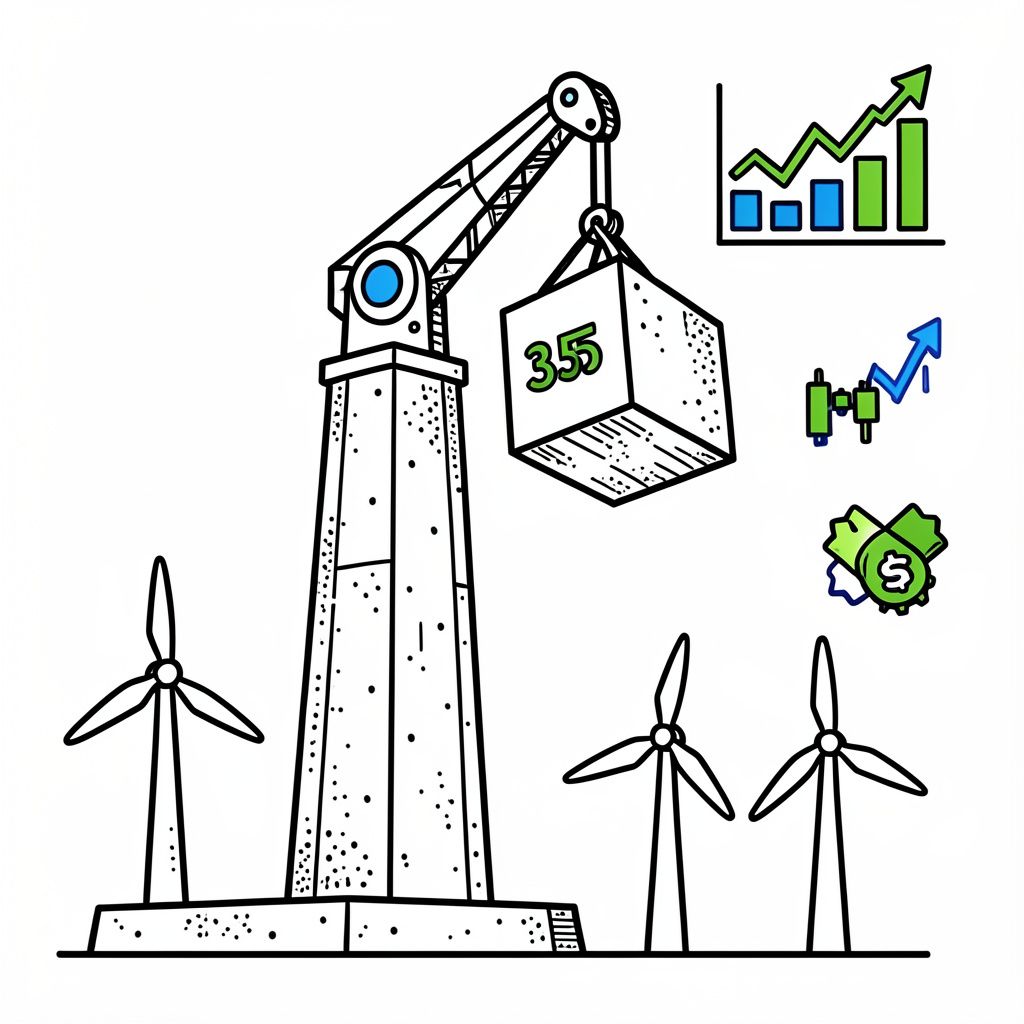
China has activated the world’s first commercial gravity-based energy storage tower near Shanghai, a 148-meter concrete giant that could revolutionize renewable energy. Unlike lithium-ion batteries, this system uses 35-ton blocks to store excess wind power, releasing it on demand with 80% efficiency. Operational since June 2026, it offers a scalable, long-lasting alternative to traditional storage—no rare materials, no degradation, and a 35-year lifespan. With plans to expand across China, this innovation marks a pivotal shift in how we harness and store clean energy.
The Mechanics of Gravity: How a 40-Story Tower Stores Wind Power
The 148-meter concrete tower operational since June 2026 in Rudong, Jiangsu province, represents a paradigm shift in energy storage technology. Unlike conventional lithium-ion batteries that rely on chemical reactions, this gravity-based system employs mechanical energy conversion through 35-ton blocks made from recycled concrete and industrial aggregate [1]. When wind farms generate surplus electricity, the system uses this power to lift the blocks via mechanical arms and cables to the top of the tower. During periods of high demand or low wind generation, the blocks are released, descending through generators to produce electricity with an 80% round-trip efficiency [2]. This process eliminates the need for rare earth minerals and avoids the degradation issues inherent in battery storage systems [3].
Technical Specifications: A Deep Dive into the World’s First Commercial Gravity Battery
The Rudong facility boasts impressive technical specifications that position it as a viable alternative to traditional storage methods. With a rated power capacity of 25 megawatts and energy storage capacity of 100 megawatt-hours, the system can deliver full output for approximately four hours [1]. The 39-story structure, resembling an unfinished apartment block with no windows, houses the mechanical infrastructure necessary for block stacking and destacking [4]. Each 35-ton block is precisely engineered from recycled materials, contributing to the system’s sustainability profile [2]. The tower’s operational mechanism achieves a round-trip efficiency of 80%, comparable to pumped hydro storage and superior to compressed-air and thermal storage systems [5]. Notably, the system’s lifespan is estimated at 35 years with minimal performance degradation, significantly outlasting lithium-ion batteries that typically degrade after 10-15 years [3].
Economic and Environmental Advantages: Why Gravity Storage Could Outlast Lithium
The economic implications of gravity-based energy storage extend far beyond its technical capabilities. While the capital expenditure (CAPEX) for the Rudong facility was approximately $1,200-$1,500 per kilowatt, the system’s 35-year lifespan and minimal operational costs present a compelling long-term value proposition [1]. In contrast, lithium-ion batteries require replacement every 10-15 years and depend on volatile supply chains for critical minerals [3]. The Rudong system’s use of recycled concrete and industrial aggregate not only reduces material costs but also addresses waste management challenges [2]. Furthermore, the system’s 80% round-trip efficiency translates to significant cost savings over its operational lifetime, with a targeted levelized cost of energy (LCOE) below $0.08 per kilowatt-hour by 2028 [1]. These economic advantages are particularly relevant in regions with high renewable energy penetration, where storage solutions must balance cost, efficiency, and durability.
Grid Integration and Real-World Performance: Connecting Wind Power to Shanghai’s Energy Needs
Since its grid interconnection in December 2023, the Rudong gravity storage tower has demonstrated its ability to enhance grid stability and reduce wind power curtailment. The system is connected to Shanghai’s 500 kV ring network via 220 kV substations, enabling seamless integration with the city’s renewable energy infrastructure [1]. Real-time monitoring through IoT sensors and AI-based predictive dispatch systems ensures optimal performance, allowing the tower to respond to demand fluctuations within seconds [6]. Early operational data indicates a 20-30% reduction in wind power curtailment in the Shanghai region, with the potential to supply 24/7 renewable energy to approximately 500,000 households [1]. The system’s ability to store energy for multi-day periods (up to 168 hours) addresses the intermittency challenges of wind power, particularly during Dunkelflaute events—periods of low wind and solar generation [5]. This capability positions gravity storage as a critical component in China’s transition to a renewable-dominated energy grid.