Federal Reserve Rate Hikes Add Ninety-Five Billion Dollars Yearly to National Debt
Washington, Wednesday, 21 October 2026.
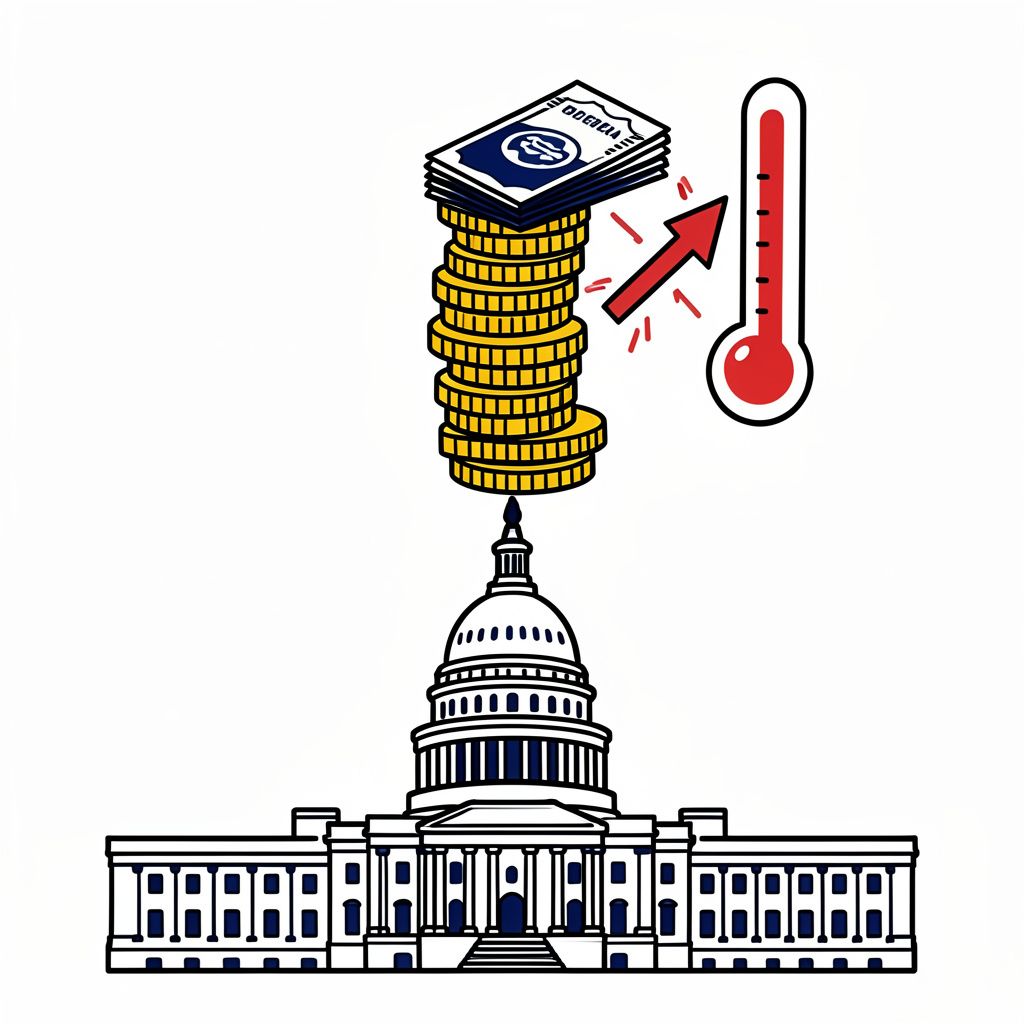
Every single percentage point increase in central bank interest rates adds $95 billion annually to U.S. debt interest, threatening a fiscal spiral as national debt crosses $40 trillion.
Federal Reserve Rate Hikes Add Ninety-Five Billion Dollars Yearly to National Debt
Every single percentage point increase in central bank interest rates adds $95 billion annually to U.S. debt interest, threatening a fiscal spiral as national debt crosses $40 trillion [1][4]. Bank of America analysts estimate that interest expenses rise by $95 billion a year for every 100 basis points of Federal Reserve rate hikes, intensifying the fiscal stakes of current monetary policy [1][4]. As of the week of October 18–20, 2026, the United States’ gross national debt exceeded $40 trillion for the first time, marking a doubling of the debt in less than 10 years [3]. Treasury payments on the $40 trillion national debt topped $2 trillion in fiscal 2026, reflecting the compounding burden of elevated yields on the debt stock [1][4].
White House Pressure and Federal Reserve Dynamics
The Biden-Trump administration is actively pressuring Federal Reserve Chairman Kevin Warsh to lower interest rates, arguing that current high rates hinder the housing market and inflate federal financing costs [4]. This pressure comes as Bank of America analysts warn that even if primary deficits remain largely unchanged, the growing interest burden materially increases the government’s financing needs [1]. On the weekend of October 17-18, 2026, Moody’s Chief Economist Mark Zandi reported that global investors are demanding higher rates to compensate for mounting U.S. fiscal risks [1][4]. Zandi noted that the 10-year Treasury yield increased by approximately 1 percentage point in 2026, among the biggest increases of any major economy [1].
Congressional Budget Office Projections
Congressional Budget Office (CBO) analysis forecasts that if interest rates are 150 basis points higher than current projections from 2026 to 2036, U.S. deficits will increase by $6 trillion, including $4.9 trillion in additional net interest costs [1][4]. Based on the Bank of America estimate of $95 billion per 100 basis points, a 1.5% hike would theoretically add 142.5 billion annually, compounding over the decade [1][4]. Furthermore, the CBO analysis projects that a 50 basis point increase in interest rates would add $1.9 trillion to current debt projections, with $1.6 trillion attributed to net interest costs [1][4]. These projections highlight how higher yields compound into materially greater interest expense and Treasury financing needs over time [1].
Impact on Consumers and Economy
Increased federal debt is exerting upward pressure on interest rates by forcing the government to issue higher volumes of Treasury bonds, which may increase borrowing costs for consumers and businesses [3]. The Penn Wharton Budget Model predicted on July 8, 2025, that President Donald Trump’s “One Big Beautiful Bill,” signed into law on July 4, 2025, would cause average U.S. wages to be 3.4% lower over the next 30 years due to increased debt [3]. In the fiscal year that ended in September, the U.S. government spent $1.05 trillion on net interest, up from $970 billion the year before, representing a 8.247 percent increase [5]. Bank of America analysts warn that a debt spiral starts when interest costs exceed nominal growth, a threshold the U.S. risks approaching as elevated yields feed through to the debt stock [1][4].