Amazon Expands Into Autonomous Security Patrols for Homes and Businesses
Seattle, Tuesday, 10 November 2026.
Amazon’s Ring launched autonomous indoor flying drones and patrol robots designed to replace fixed cameras, using cloud artificial intelligence to investigate disturbances and deter intruders with sirens.
Ring Unveils Autonomous Security Ecosystem
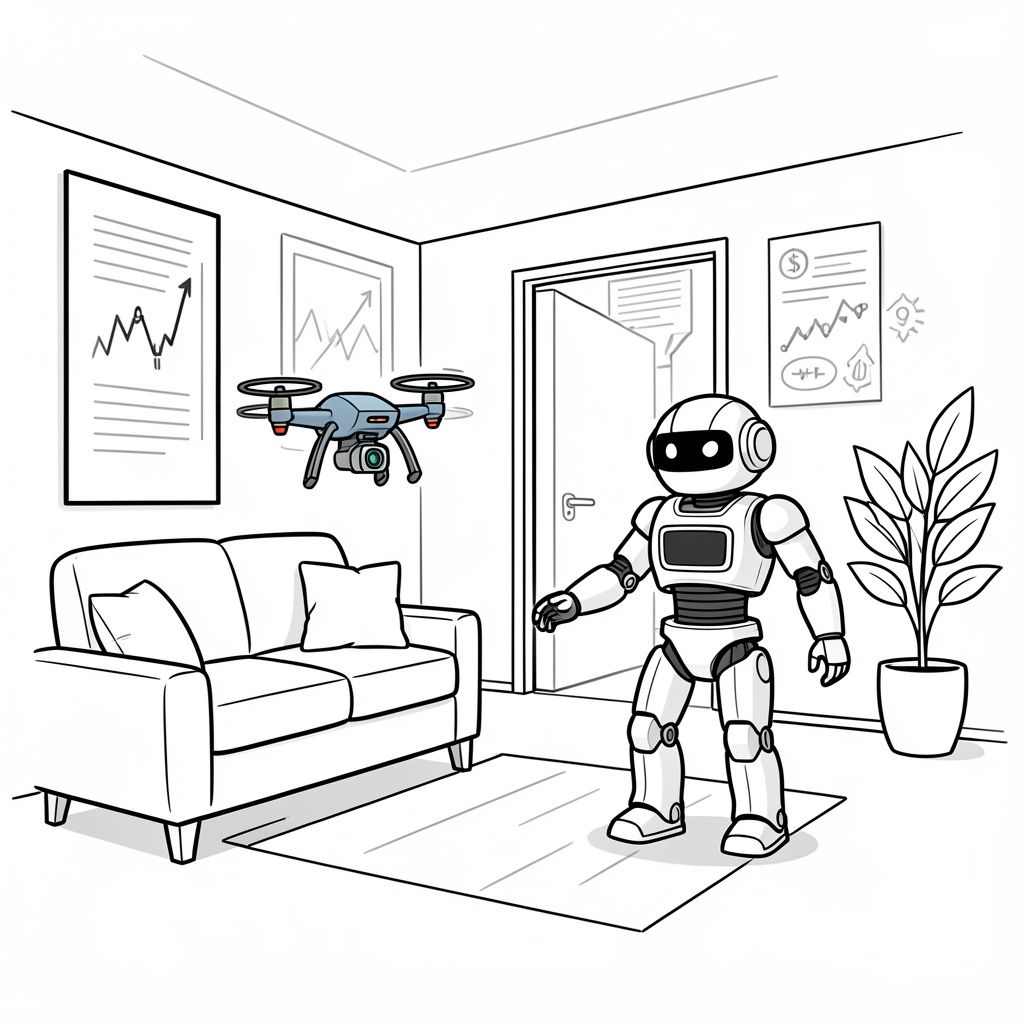
On November 9, 2026, Amazon’s Ring subsidiary launched Ring Robotics, a new autonomous security category featuring two flagship products: the Ring Drone Cam and the Ring Rover Cam [1][3][5]. The Ring Drone Cam, priced at $249.99, is an indoor flying security camera designed to autonomously patrol homes by executing pre-set flight paths while capturing 2K video with dual LED lights for nighttime surveillance [1][3][5]. Its counterpart, the Ring Rover Cam, is a business-focused security robot retailing at $999.99, equipped with a 4K camera, extendable periscope mast, and a siren audible from over 10 feet away to deter intruders [1][3][5]. Both devices are engineered to replace static security cameras by providing mobile, proactive monitoring powered by Ring’s proprietary AI Pilot system, which integrates on-device sensors with cloud-based processing for real-time navigation and obstacle avoidance [1][3][5].
Evolution of Ring’s Security Robotics
The development of Ring’s autonomous security devices traces back to 2016, when the company first explored drone concepts under founder Jamie Siminoff [4][7]. This initiative culminated in the 2020 debut of the Always Home Cam at CES, a lithium-powered indoor drone with LIDAR sensors for mapping and navigation; however, it never reached consumers [2][4][7]. Subsequent iterations faced delays due to weight, safety, and computational challenges, leading to a simplified Ring Drone Cam that replaces LIDAR with cloud-based AI Pilot for mapping and stair-climbing capabilities [4][7]. The Ring Rover Cam, in contrast, builds upon Amazon’s 2021 Astro consumer robot, repurposing its mobility and security features for enterprise use after the Astro for Business product was discontinued in 2024 [3][7][8]. Siminoff emphasized the shift from static cameras to dynamic security solutions, stating, ‘The honest answer wasn’t more cameras; it meant reimagining what a security device could be’ [1][3][5].
Privacy and Technical Safeguards
Privacy concerns have dogged Ring’s security innovations since its 2018 acquisition by Amazon, particularly regarding partnerships with law enforcement and data-sharing practices [1][3][6]. To address these issues, Ring Robotics incorporates multiple privacy-centric features, including the Ring Drone’s camera shutter when docked and the Ring Rover’s Sleep Mode, which retracts its periscope and disables the microphone [1][5]. Both devices employ ‘Throw Away the Key’ encryption for stored footage and LED indicators to signify active recording [1][5]. The Ring Drone Cam remains subject to Federal Communications Commission approval, with a U.S. launch date set for January 27, 2027, while the Ring Rover Cam is scheduled for December 16, 2026 [1][3][5]. Siminoff acknowledged public apprehension, noting, ‘People like indoor cameras, but they don’t necessarily want them everywhere around their home’ [2][3].
Market Implications and Future Trajectory
The launch of Ring Robotics represents a strategic pivot for Amazon’s home security division, aiming to capture a share of the $12.5 billion U.S. home security market by offering autonomous alternatives to traditional fixed cameras [alert! ‘market size from 2025 data’] [1][3]. Industry analysts view the move as a response to rising demand for proactive surveillance solutions, particularly among small and medium-sized businesses seeking cost-effective security without full-time personnel [GPT]. The Ring Drone Cam’s $249.99 price point undercuts competitors like indoor security robot startups, which often retail above $1,000, while the Ring Rover Cam’s $999.99 tag positions it as a mid-tier enterprise solution [4][7]. Shipping deadlines for both products are pending regulatory clearance and production scaling, with preorders currently open for the Ring Rover Cam [1][3][5]. As Ring positions autonomous security as a new product category, the company’s ability to balance innovation with privacy concerns will likely determine long-term adoption [1][3][5].
Sources
- www.cnbc.com
- www.aboutamazon.com
- www.engadget.com
- www.geekwire.com
- www.aboutamazon.com
- www.cnbc.com
- www.instagram.com
- www.cnbc.com