Federal Task Force Unlocks 250 Million Dollars to Protect Major Sports Events from Drone Threats
Washington, Tuesday, 10 November 2026.
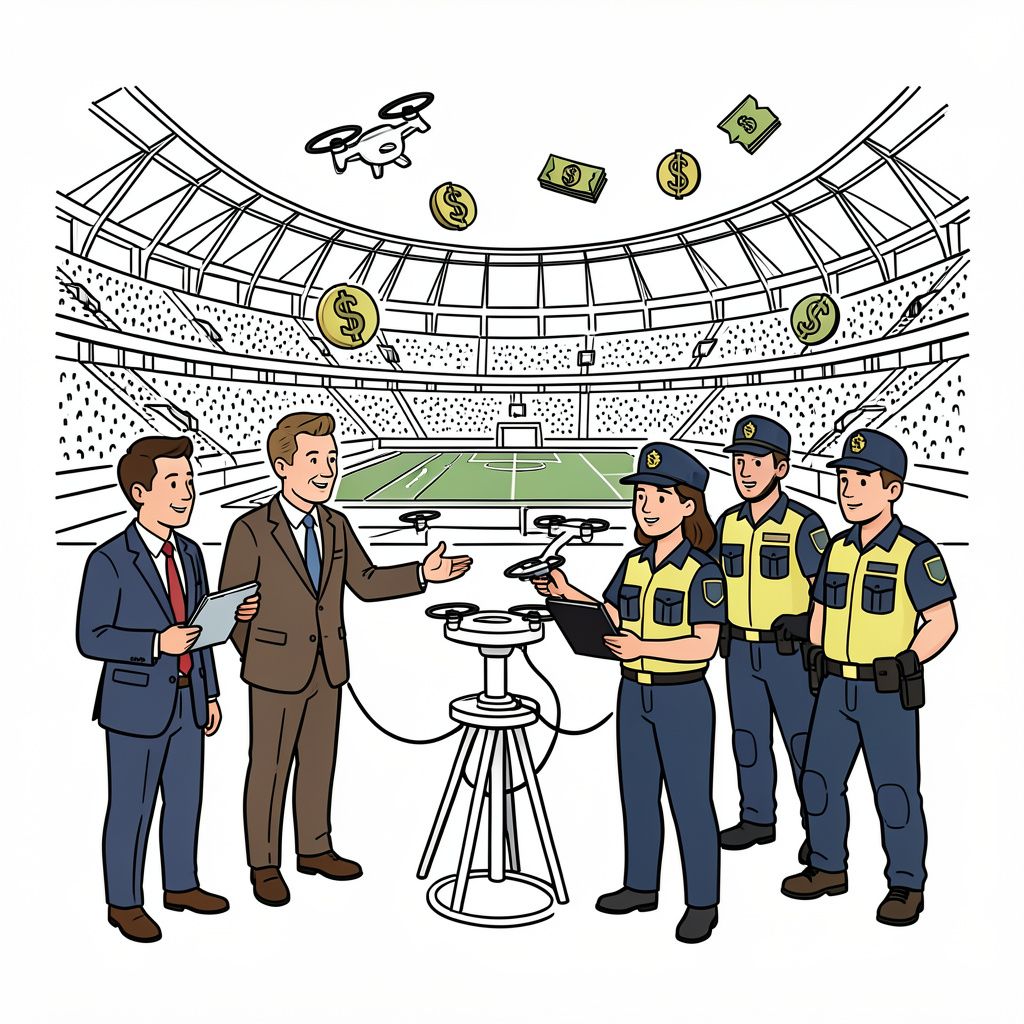
Federal leaders and industry partners are deploying $250 million across all 56 U.S. states and territories, leveraging fast-tracked safety approvals to safeguard major venues ahead of the 2028 Olympic Games.
A Unified Front: Federal-Private Partnership Takes Center Stage
On 10 November 2026, the White House Olympics Task Force convened a high-level security forum near Washington, D.C., bringing together federal, state, and local authorities alongside industry leaders from DRONERESPONDERS and the Commercial Drone Alliance to finalize airspace defense strategies for the LA28 Olympic Games [1]. The forum served as a critical platform for reviewing operational lessons from the 2026 FIFA World Cup and coordinating the deployment of $250 million in FY 2027 Counter-Unmanned Aircraft Systems (C-UAS) grant funding across all 56 U.S. states and territories [1][2][3]. This initiative underscores a broader federal push to integrate counter-drone technologies into national security frameworks, with the White House Task Force on the 2028 Summer Olympics playing a pivotal role in orchestrating these efforts through Executive Order 14328 [1]. The collaboration reflects a strategic alignment between public safety priorities and commercial innovation, positioning the U.S. as a leader in airspace security ahead of high-profile international events.
From Lessons to Funding: The Economic Ripple Effect
The allocation of $250 million in FY 2027 C-UAS grants is not merely a security measure but a significant economic stimulus for the counter-drone industry, which has expanded rapidly in response to evolving threats [1][2]. Established under the Working Families Tax Cut Act by President Donald J. Trump, the C-UAS Grant Program provides $500 million over two fiscal years, with the FY 2026 allocation of $250 million already awarded to 11 states hosting FIFA World Cup 2026 matches and the National Capital Region [1]. The remaining $250 million for FY 2027 is earmarked for nationwide deployment, including protection for the LA28 Olympic Games and other critical infrastructure [1][2][5]. This funding injects capital into local economies through procurement, hiring, and technology adoption, while also fostering public-private partnerships that could redefine the commercial drone sector. For instance, the Commercial Drone Alliance highlighted the forum as a ‘pivotal moment for our industry,’ emphasizing the long-term benefits of sustained collaboration between government and private enterprises [1].
Fast-Tracking Safety: The Regulatory Acceleration
Parallel to the grant funding initiative, the Trump administration has prioritized the rapid deployment of counter-drone systems through a memorandum of understanding (MOU) signed on 2 November 2026 by the Departments of Transportation, Defense, Homeland Security, Energy, and Justice [2][3][6]. This agreement, led by the White House Task Force to Restore American Airspace Sovereignty, establishes a consistent process for evaluating and deploying C-UAS technologies without compromising aviation safety [2][3][5]. The Federal Aviation Administration (FAA) has already approved over 1,000 counter-drone coordination requests with the Pentagon and DHS, with safety reviews for previously evaluated systems now potentially completed in just 24 hours [2][3][6]. This regulatory acceleration addresses critical gaps exposed during the 2026 FIFA World Cup preparations, where uncoordinated drone interventions temporarily halted flights at El Paso International Airport, demonstrating the need for streamlined interagency coordination [2][4][5].
Border Security and Beyond: The Broader Drone Threat Landscape
The urgency of these measures is underscored by escalating drone incursions along the U.S.-Mexico border, where the Pentagon reports over 1,000 monthly crossings, often linked to cartels using drones for surveillance and drug trafficking [2][4][6]. In October 2026, the FAA imposed a temporary flight restriction barring unauthorized drones up to 121.9 meters (400 feet) above ground level along the entire border, extending 1.9 kilometers (1.2 miles) into U.S. territory [2][4]. This action followed an incident in February 2026, where a Pentagon high-energy laser deployed by Customs and Border Protection without an FAA safety review led to an eight-hour shutdown of El Paso International Airport and subsequent airspace restrictions near Fort Hancock, Texas [2][4][6]. The federal response now integrates these lessons, with agencies collaborating to deploy next-generation defenses, including high-energy lasers, alongside civilian aviation operations [2][3][6]. As Defense Secretary Pete Hegseth noted, these technologies ‘can be deployed rapidly and safely,’ reflecting a proactive stance against both external and domestic drone threats [6].
Future-Proofing Airspace: Long-Term Investment and Innovation
The FY 2027 C-UAS grant funding and interagency MOU represent more than immediate security measures; they signal a long-term investment in airspace sovereignty and technological innovation. The Commercial Drone Alliance’s observation that this is a ‘pivotal moment for our industry’ highlights the potential for sustained growth in counter-drone technologies, which are increasingly vital for safeguarding public events, critical infrastructure, and national security [1][5]. The FAA’s role in providing technical requirements and safety assessments ensures that these advancements do not compromise aviation safety, while the broader federal framework encourages collaboration across agencies and private sectors [3][5][6]. With the 2028 Olympic Games and other high-profile events on the horizon, the U.S. is positioning itself at the forefront of airspace defense, balancing rapid deployment with rigorous safety standards. As Lisa Ellman, CEO of the Commercial Drone Alliance, emphasized, the goal is to ‘build airspace security that lasts well past the closing ceremonies,’ ensuring that the investments made today yield dividends for years to come [1].
Sources
- www.einpresswire.com
- www.sofx.com
- rmb.reuters.com
- www.usnews.com
- www.unmannedairspace.info
- defensescoop.com
- dronelife.com