Running Game Failure Leaves New Orleans Saints Dependent on Quarterback
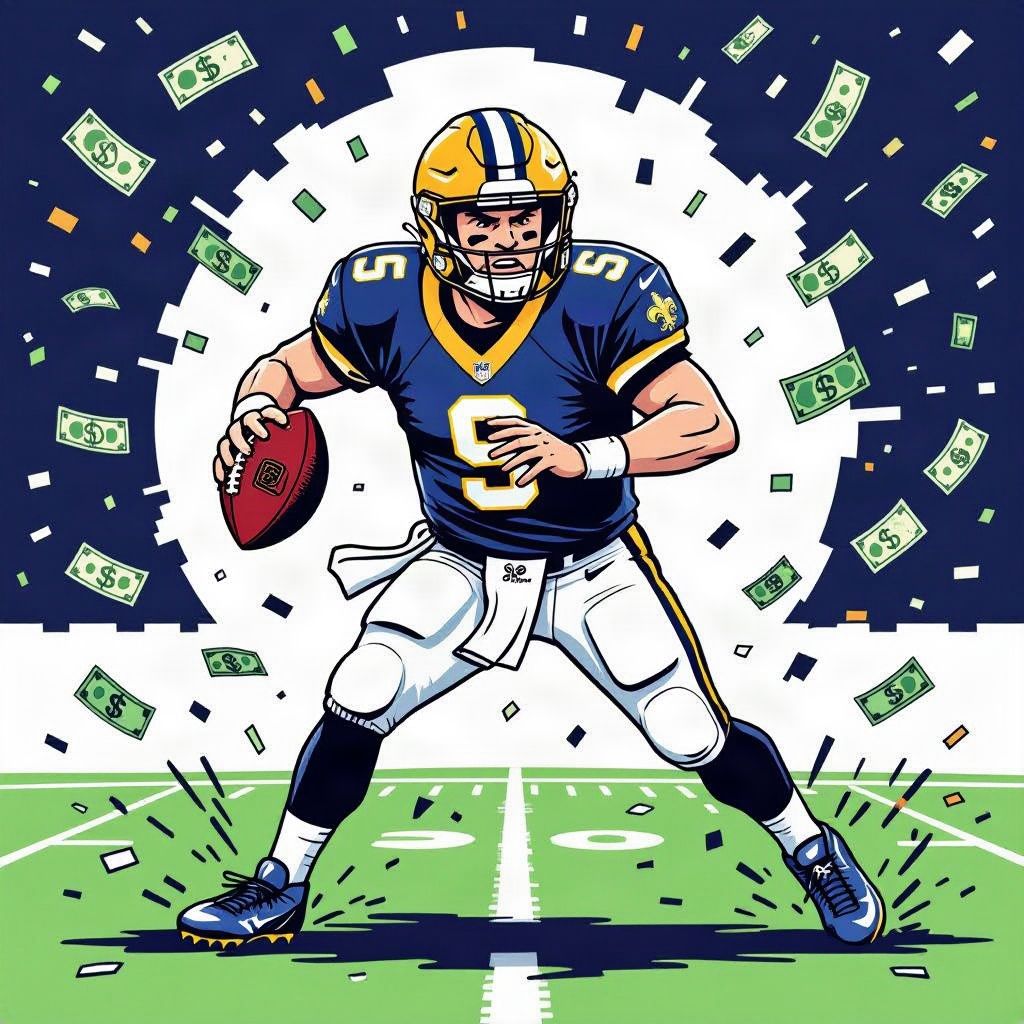
Chicago, Sunday, 22 November 2026.
Struggling at 3-6, New Orleans remarkably features quarterback Tyler Shough as their leading rusher with merely 171 meters, reflecting an unbalanced offense failing to support its passer.
A Quarterback as the Leading Rusher
The New Orleans Saints’ offensive woes have reached a new low in the 2026 NFL season, with quarterback Tyler Shough unexpectedly leading the team in rushing yards at just 187 yards [1]. This unusual statistic underscores the franchise’s inability to develop a reliable ground attack, leaving Shough exposed under center as the Saints navigate their 3-6 campaign. The lack of a complementary running game has placed undue pressure on the second-year quarterback, forcing him to account for more yardage than any of his offensive teammates. As the Saints prepare to face the Chicago Bears at Soldier Field on Sunday, November 22, 2026, the absence of a consistent rushing attack has become a glaring vulnerability that opponents are increasingly exploiting [2][3].
The Saints’ Running Back Conundrum
The Saints’ leading rusher isn’t just an anomaly—it’s a symptom of a broader organizational failure. While Shough has managed 187 yards on the ground, the team’s actual running backs have combined for a meager total, with Alvin Kamara leading the group at just 161 yards [1]. The lack of a standout back is evident, as the Saints have cycled through five different rushers this season, none of whom have established themselves as a consistent threat [1]. For context, Shough’s rushing total alone surpasses the combined yardage of the team’s running back corps, a statistic that highlights the franchise’s offensive stagnation [1]. The Saints’ rushing attack, averaging only 90.1 yards per game, ranks among the league’s worst, further exposing the team’s one-dimensional offensive identity [6].
Quarterback Under the Microscope
Tyler Shough’s struggles extend beyond the rushing yard anomaly. With a 66.8% completion rate and 2,173 passing yards through nine starts in 2026, Shough’s second-year performance has drawn criticism from national analysts, including Robert Mays of The Athletic and Ben Solak of ESPN, who question whether he is regressing [3]. His passer rating of 90.8 and reduced intermediate throw frequency (from 22.6% to 16%) suggest a regression in decision-making and execution [3]. Shough’s frustration is palpable, as evidenced by his post-game comments after a Week 10 loss to the Carolina Panthers, where he admitted to ‘a lack of execution in some of those critical moments’ [5]. The Saints’ inability to generate early offense has become a recurring theme, with Shough noting, ‘You can’t go into a game, a first quarter, a first half, and not put any points on the board, and expect to play clean, winning football’ [5].
Chicago Bears’ Defensive Edge
The Bears, meanwhile, enter the matchup as the NFC North’s top team at 7-2, bolstered by the recent acquisition of defensive tackle Jeffery Simmons from the Tennessee Titans [2]. Simmons, who underwent knee precautionary measures earlier in the week, has been cleared to play and is expected to make a significant impact against the Saints’ struggling offense [2]. His presence has already reshaped Chicago’s defensive scheme, forcing opposing offensive lines to account for his presence and creating one-on-one matchups that have benefited teammates [2]. Simmons’ ability to command attention has allowed the Bears to deploy more flexible defensive strategies, including the use of four-man pass rushes with greater confidence [2]. This tactical advantage could be decisive against an offense that has struggled to generate consistent production, whether through the air or on the ground.
Commercial and Market Implications
The Saints’ offensive struggles extend beyond the field, with commercial momentum in the broader sports entertainment market hanging in the balance. A franchise that has historically relied on its high-powered offense is now grappling with a lack of offensive identity, which could dampen fan engagement and sponsorship appeal [GPT]. The team’s inability to develop a reliable rushing attack not only hampers its on-field performance but also risks eroding its marketability, particularly in a city where football is a cornerstone of local culture. For the Bears, a victory in this matchup could further solidify their position as a contender, while the Saints’ continued struggles may force front-office decisions to address their offensive deficiencies in the offseason [2][3].