US Energy Policy Shifts as $1.2 Billion Settlement Replaces Offshore Wind with Fossil Fuels
Washington, Thursday, 27 August 2026.
The Trump administration’s $4 billion offshore wind buyout program has eliminated 21 gigawatts of planned clean energy capacity, diverting capital into traditional fossil fuel investments.
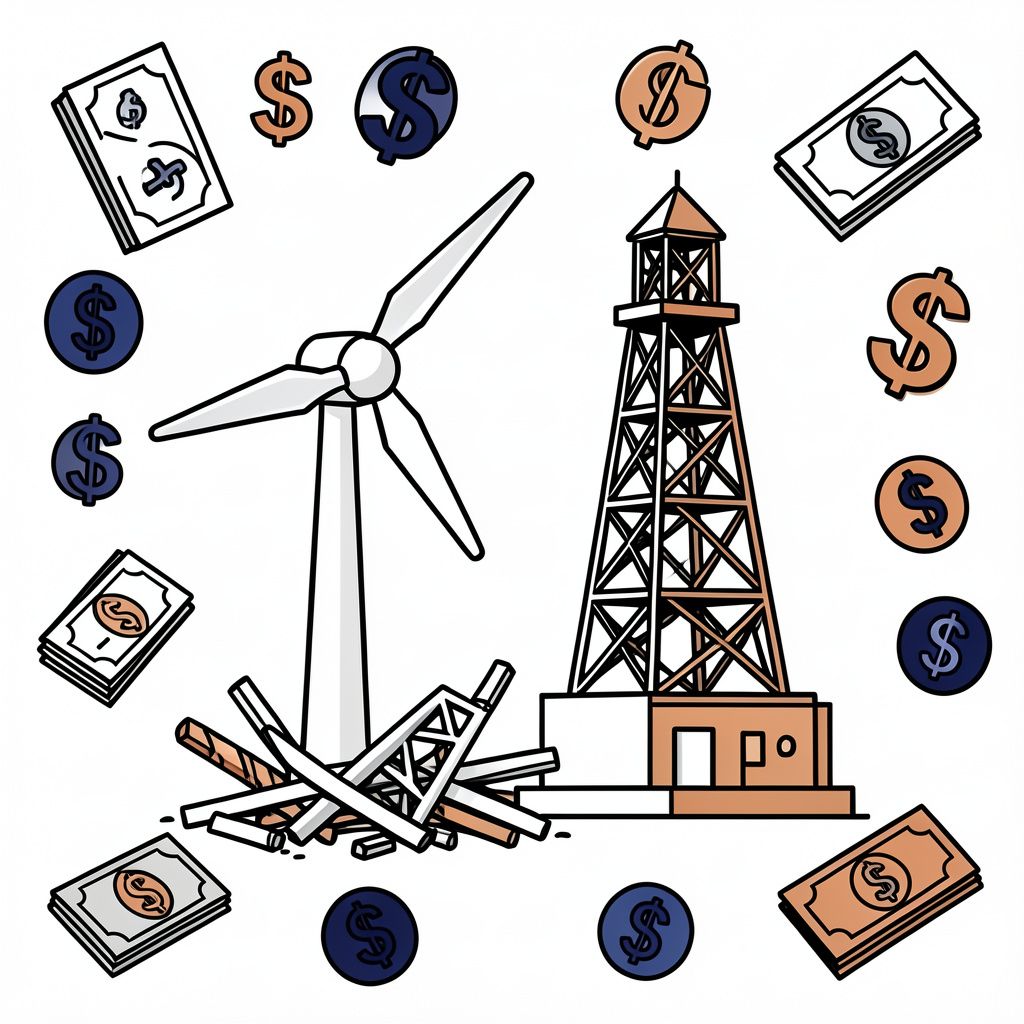
Federal Capital Redirected from Wind to Fossil Fuels
The Trump administration’s energy policy has undergone a significant transformation, marked by the cancellation of major offshore wind initiatives in favor of fossil fuel investments. On 6 August 2026, German energy giant RWE agreed to a settlement worth $1.2 billion from a federal fund, contingent on surrendering offshore wind leases in New York, California, and Louisiana [1][3]. This reallocation of capital underscores a broader federal strategy to redirect subsidies from renewable energy developers toward traditional oil and gas sectors, signaling increased regulatory uncertainty for clean energy investors [1][4]. The deal directly benefits a firm controlled by a prominent campaign donor, marking a sharp policy pivot in domestic energy infrastructure funding [1].
Scale of Offshore Wind Buyouts
This specific deal is part of a larger $4 billion payout program committed by the administration to developers to surrender rights in federally managed waters [4][5]. By mid-August 2026, these buyouts had eliminated an estimated 21 gigawatts of potential offshore wind capacity, equivalent to the power needs of over 15 million average U.S. homes [4]. The RWE settlement alone accounts for 30 percent of the total committed payout, highlighting the scale of individual transactions within the broader policy shift [1][4]. The Blue Green Alliance estimates these buybacks have cost the United States 85,679 jobs [3][5].
Legal Challenges and Political Timeline
The administration’s opposition to offshore wind began shortly after President Donald Trump’s inauguration on 20 January 2025, when a presidential memorandum paused permitting and leasing [3][5]. Although a federal judge ruled on 9 December 2025 that subsequent stop-work orders were arbitrary and capricious, the administration shifted tactics to target leased but unpermitted projects [3][5]. On 22 December 2025, the administration paused leases for five wind farms under construction off the East Coast, including the Coastal Virginia Offshore Wind project [5]. Five separate court cases concluded that the stop-work orders were contrary to law, noting the Department of Defense had previously approved these projects [3].
Economic Impact and Grid Demand
Economic analyses suggest these actions have had a chilling effect on the industry, complicating the ability of states like New Jersey and New York to meet aggressive carbon reduction targets [4]. Grid operators like PJM project power demand will exceed available supply by 7.8 gigawatts by 2033, creating a potential shortfall as renewable sources are delayed [4]. Experts note that meeting aggressive carbon reduction targets in Eastern states is borderline impossible without offshore wind contributions [4]. New York extended its emissions goal deadlines and relaxed greenhouse gas accounting regulations in March 2026 in response to these constraints [4].
Future Outlook and Strategic Exceptions
Despite the broader crackdown, some marine energy projects have secured approvals, such as the PacWave South wave energy testing site in Oregon, which received federal approval in Summer 2025 [2]. However, operational delays persist; while the facility is open as of 27 August 2026, no wave energy devices have been deployed due to funding difficulties [2]. Advocates have initiated Project 2029, a policy roadmap intended for a future administration to revive offshore wind support, anticipating potential changes in early 2029 [4]. Meanwhile, projects like Empire Wind remain under development with a 2027 operational target, though their status remains uncertain amidst the regulatory headwinds [alert! ‘project status unconfirmed as of August 2026’][4]. The Humboldt Bay Harbor District continues permitting efforts, aiming to have a project ready for a potential new federal administration in 2029 [3].