AI Infrastructure Boom Drives Rural Land Prices Higher Amid Growing Local Opposition
Washington, Sunday, 6 September 2026.
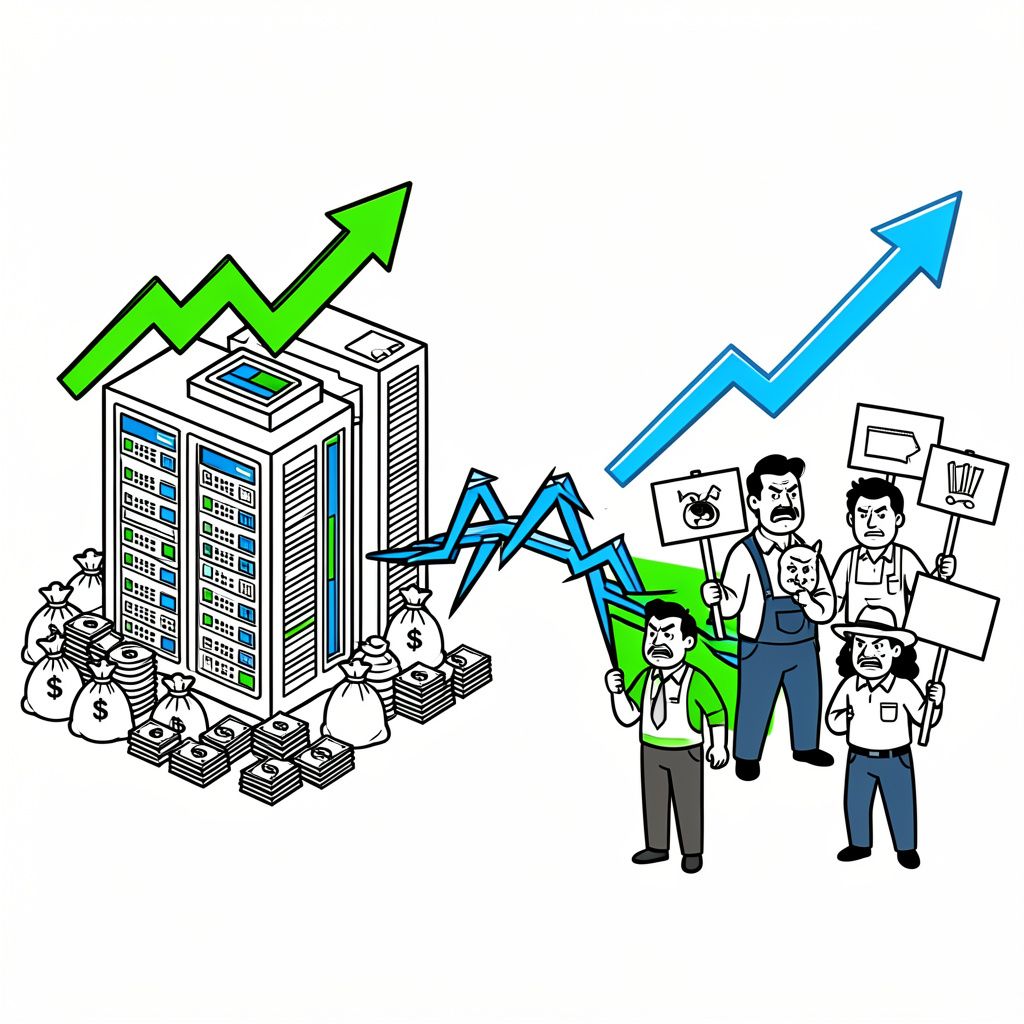
U.S. data center land spending reached $6 billion in early 2026, up 79% year-over-year. However, emerging state moratoriums and grid concerns now pose material risks to future expansion.
Rural Real Estate Transformation
The rapid expansion of artificial intelligence infrastructure is fundamentally reshaping rural real estate markets across the United States, with developers paying premium prices for large parcels of farmland to accommodate massive computing facilities. U.S. land purchases for future data centers totaled approximately $6 billion in the first half of 2026, marking a 79% increase year-over-year [1][2][5]. According to Avison Young, data centers now account for 27% of U.S. development sites in 2026, ranking as the second-highest category behind apartment buildings and outperforming industrial, office, retail, and mixed-use sectors [1][2][5]. This surge indicates a significant shift in capital allocation towards digital infrastructure, driven by the escalating demand for AI processing power.
Rural Real Estate Transformation
Property values in key regions have skyrocketed due to this demand, particularly for sites with reliable access to regional power grids. In 2025, site costs for properties with regional power grid access in Northern Virginia and the Northeast exceeded $8 million per acre, according to CBRE data [1][2][5]. By comparison, the National Association of Home Builders reported a 2025 median land price of $125,000 per acre in Loudoun County, Virginia [2][5]. The disparity in land valuation is stark, with data center offers exceeding median residential land prices by 6300 percent in some instances [2][5]. While property sales offer significant payouts for some landholders, the influx of massive computing facilities is sparking growing community pushback over power grid strain, water usage, and land-use changes [1][5].
Regulatory and Community Pushback
The influx of development has triggered localized political and regulatory hurdles that present a critical bottleneck for future data center deployment strategies. As of September 1, 2026, investment bank Mizuho reported that nine U.S. states currently have pending moratoriums on new data center developments, adding to New York’s statewide moratorium on hyperscale data centers issued in July 2026 for a duration of up to one year [1][2][5]. In Cass County, Nebraska, officials approved a 12-month moratorium affecting plans for a 1,300-plus-acre site [2][5]. Tensions have escalated in some communities; in Saline Township, Michigan, local officials faced death threats regarding “The Barn,” a multibillion-dollar data center project being built for Oracle and OpenAI, leading to resignations and a recall effort against board members [1][5]. Similarly, cities and towns in Massachusetts are scrambling to update their zoning rules amid rising tensions, with disputes expected to play out in the courts and on Beacon Hill in coming years [3].
Broader Economic Implications
Beyond real estate, the AI buildout is influencing broader economic sectors including logistics and energy. Data center construction is boosting the trucking industry, particularly in flatbed and heavy haul sectors, as components like HVAC systems, tubing, wiring, and semiconductors require specialized transport [6]. However, experts warn of an extraordinary drop off in truck traffic once construction is completed, as operational data centers require significantly less logistics support than warehouses [6]. In the energy sector, data-center load growth was cited as the primary driver for $23.1 billion in additional capacity-market revenues through 2028 in the PJM wholesale power region [2][5]. Furthermore, American reliance on China for key components used to power data centers is coming under increasing scrutiny, raising the prospect of higher costs and worsening supply chain shortages for the AI buildout [8].
Broader Economic Implications
Financial analysts and political actors are increasingly viewing local opposition as a material risk to future growth. Financial analysts, including Wells Fargo and Morgan Stanley, have flagged local political backlash against data centers as a material risk to future growth, stock values, and capital expenditures, specifically citing the upcoming midterm elections in November 2026 [1][2][7]. AI data centers have become a bipartisan political issue, with opposition fueled by concerns over high electricity bills, job loss, and environmental impact [7]. A Pew Research Center report published on August 18, 2026, found over 50% of Americans are more concerned than excited about AI, up from 37% in 2021 [7]. As developers seek control of substations, power rights, infrastructure, and surrounding properties, the complexity of these acquisitions continues to expand beyond simple land deals [4].
Sources
- www.cnbc.com
- superpowerdaily.com
- www.law360.com
- www.datacenters.com
- ua.news
- www.cnbc.com
- www.cnbc.com
- www.linkedin.com