Kazakhstan’s $10 Billion AI Gamble: Can a Nation Built on Oil Become Eurasia’s Next Tech Powerhouse?
Astana, Thursday, 18 June 2026.
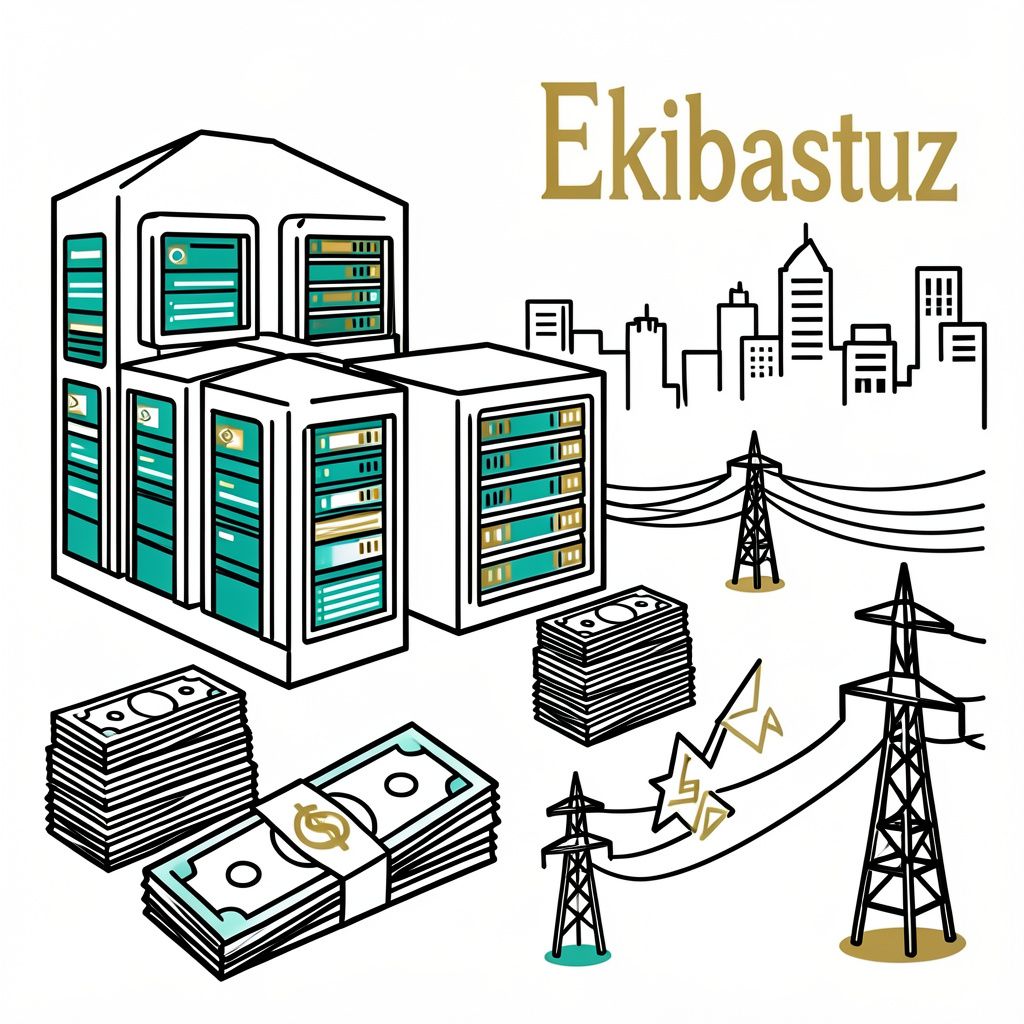
Kazakhstan just placed the largest bet in Central Asia’s history—$10 billion—to build a Nvidia-powered AI data center hub by 2027. The project, dubbed ‘Data Center Valley,’ aims to generate $3 billion in annual export revenue, positioning the oil-rich nation as Eurasia’s next digital epicenter. The twist? It’s not just about tech; it’s about transforming Ekibastuz’s energy surplus into a new export: computing power.
The Energy-to-Compute Pivot: Kazakhstan’s $10 Billion Wager
On 12 June 2026, Kazakhstan’s Prime Minister Olzhas Bektenov stood beside Nvidia’s Rev Lebaredian and Firebird’s co-founders in Astana to sign a $10 billion package of agreements that will transform Ekibastuz, a city synonymous with coal-fired power, into Eurasia’s first 1-gigawatt AI campus [1][2]. The project, christened ‘Data Center Valley,’ is not merely an infrastructure play; it is a deliberate pivot from exporting kilowatt-hours to exporting petaflops. Ekibastuz’s existing 300 MW of surplus capacity—originally built to serve Soviet-era aluminium smelters—will be repurposed to feed 100,000 Nvidia GPUs, including the latest GB300 and Vera Rubin chips, by 2027 [3]. The arithmetic is stark: 100 000 GPUs × 700 W/GPU ÷ 1 000 000 yields 70 MW of continuous load, a figure that will climb to 1 000 000 000 W once the campus reaches full build-out [3].
Phase One: A $5 Billion Down Payment on the Future
The first $5 billion tranche, of which Kazakhtelecom is committing $1 billion, is earmarked for a 125 MW facility slated for commercial launch in 2027 [1][4]. Kazakhtelecom’s role extends beyond capital; the state-owned operator is responsible for the ‘essential foundations’—connectivity, power conditioning, and engineering solutions that will convert Ekibastuz’s 500 kV grid into a stable, low-latency backbone for hyperscale computing [4]. Firebird, the Armenian-American startup that signed the accords, brings a track record of speed: its flagship AI Factory in Armenia broke ground in December 2025 and is on track to go live in July 2026, a six-month sprint that Kazakh officials hope to replicate [3].
The $3 Billion Export Promise: Can Kazakhstan Beat the Odds?
Deputy Prime Minister Zhaslan Madiyev has publicly forecast $3 billion in annual export revenue from Phase One alone, a figure that implies 3 000 000 000 ÷ 125 000 000 W = $24 per watt-year of capacity sold [1]. Benchmarking against established markets, Singapore’s data centers command $18–$22 per watt-year, while Northern Virginia—the world’s largest market—averages $20 [GPT]. Kazakhstan’s premium pricing rests on two assumptions: first, that its sub-40 ms latency to Moscow, Istanbul, and Delhi will attract latency-sensitive workloads such as algorithmic trading and real-time inference; second, that its 2.5¢/kWh industrial tariff—half the cost of Virginia’s 5¢/kWh—will remain stable despite the country’s history of energy price volatility [alert! ‘tariff stability not guaranteed beyond 2028’] [1].
Regulatory Runway: Central Asia’s First AI Law Enters Force
Kazakhstan’s regulatory framework has moved in lockstep with the Data Center Valley project. In January 2026, the country enacted Central Asia’s first comprehensive AI law, adopting a risk-based classification system that mirrors the EU AI Act [5]. The law creates a ‘regulatory sandbox’ for high-impact AI systems, allowing Data Center Valley tenants to deploy models without full certification for up to 18 months—a provision that could accelerate adoption but also raises concerns about algorithmic accountability [5]. Concurrently, the Ministry of Artificial Intelligence and Digital Development has launched the AI-Sana program, which has already introduced foundational AI courses to 650,000 students and aims to upskill 100,000 workers by 2027 [5].
The Geopolitical Chessboard: Why Nvidia and Firebird Chose Kazakhstan
Nvidia’s participation is supplier-driven rather than capital-driven; the company is not investing cash but is committing scarce GPU allocations to the project [3]. This calculus reflects Kazakhstan’s unique position on the new ‘sovereign AI’ map: energy-rich, capital-light states are offering power and land in exchange for chips and know-how, a quid pro quo that has become standard in the post-IRA global data-center rush [3]. Firebird’s Armenian heritage adds a layer of intrigue. The startup’s prior success in Armenia—a country that has positioned itself as a neutral AI hub between Russia and the West—suggests that Kazakhstan may be attempting to replicate Yerevan’s ‘third-way’ strategy [6].
The Stakes: Beyond $3 Billion in Exports
For Kazakhstan, the stakes extend far beyond the projected $3 billion in annual export revenue. The country’s oil production, which peaked at 90.3 million tonnes in 2022, is forecast to decline to 82.5 million tonnes by 2030, a (82.5 - 90.3) ÷ 90.3 × 100 = -8.6% contraction that threatens the fiscal base [7]. Data Center Valley is positioned as the cornerstone of a broader economic diversification strategy, with President Kassym-Jomart Tokayev declaring 2026 the ‘Year of Digitalization and Artificial Intelligence’ and setting a target of 25% non-resource GDP growth by 2030 [5]. If successful, the project could redefine Kazakhstan’s role in the global economy: from a commodity exporter to a net exporter of intelligence.
Sources
- oilprice.com
- www.bloomberg.com
- thenextweb.com
- www.linkedin.com
- thediplomat.com
- www.reddit.com
- www.eia.gov