Fed’s Inflation Fight: Tough Talk Without a Clear Plan Leaves Markets Guessing
Washington D.C., Saturday, 20 June 2026.
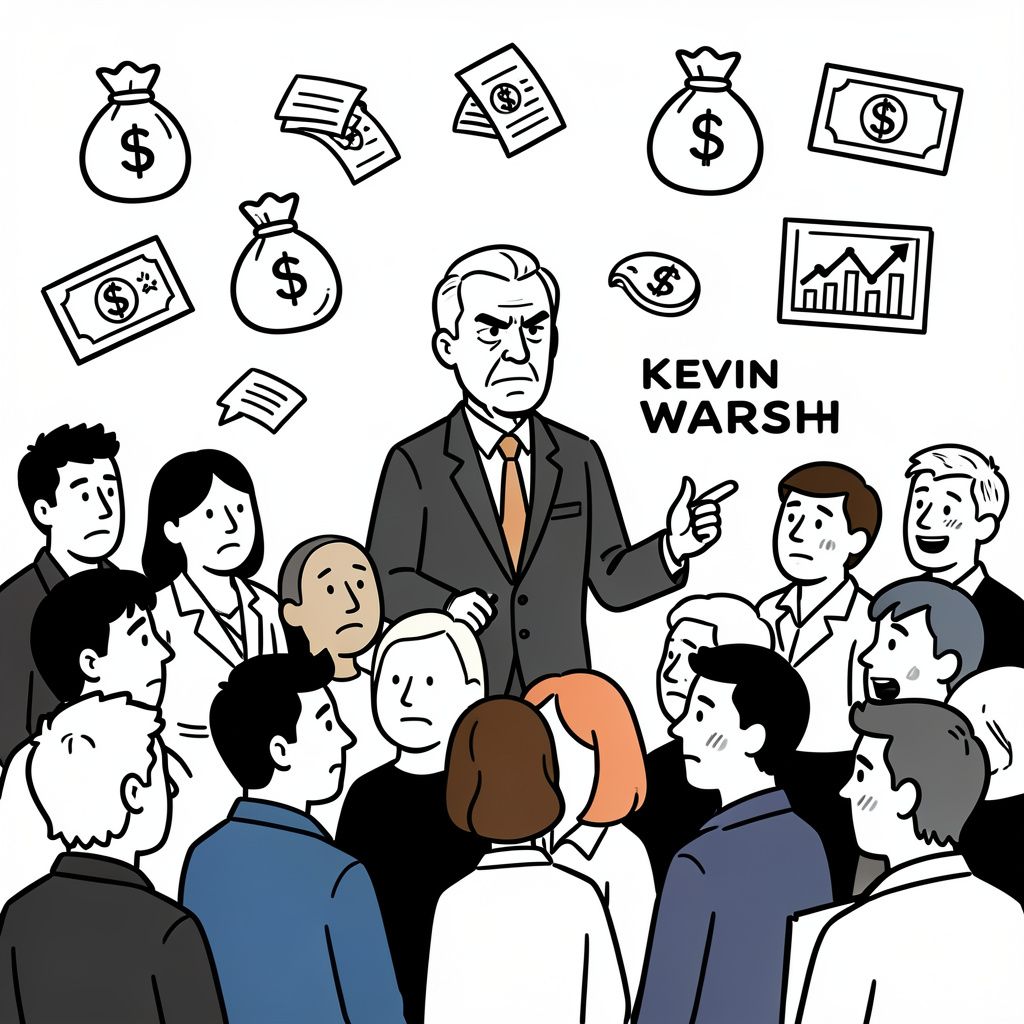
The Federal Reserve’s new chair, Kevin Warsh, has taken a firm stance on inflation, vowing to bring it down to 2%—yet the central bank’s latest decision to hold rates steady has left markets in the dark. With inflation at a three-year high of 4.2% and no clear roadmap for rate hikes, businesses and investors face growing uncertainty. While nearly half of Fed officials expect a rate increase by year-end, Warsh’s refusal to provide forward guidance has sparked criticism. The Fed’s ambiguity risks stalling corporate investments and consumer spending, even as energy prices surge and global peers offer clearer signals. Will tough talk translate into action, or is the Fed gambling on inflation cooling without further intervention?
The Fed’s Hawkish Stance: A Rhetorical Commitment Without a Roadmap
On June 17, 2026, the Federal Reserve, under its new chair Kevin Warsh, maintained the federal funds rate at 3.5% to 3.75%, a decision that underscored its hawkish stance on inflation but lacked a concrete policy roadmap [1][2]. Despite inflation reaching a three-year high of 4.2% as of June 9, 2026, the Federal Open Market Committee (FOMC) opted to keep rates steady, citing ‘elevated uncertainty’ tied to geopolitical tensions, including the conflict in the Middle East [3]. The FOMC’s statement reaffirmed its commitment to its dual mandate of maximum employment and price stability, emphasizing that ‘inflation remains elevated relative to the Committee’s 2% goal’ [3]. However, the Fed’s refusal to provide explicit forward guidance or submit its quarterly ‘dot plot’ projections—typically used to signal future rate movements—has left markets and economists grappling with ambiguity [1][4].
Inflation Projections and Market Expectations: A Disconnect Emerges
The Fed’s Summary of Economic Projections (SEP), released alongside the June 17 decision, revealed a stark upward revision in inflation forecasts. The median projection for Personal Consumption Expenditures (PCE) inflation in 2026 surged to 3.6%, up from 2.7% in March 2026, while core PCE inflation (excluding energy and food) was pegged at 3.3% [5]. Despite these elevated figures, the FOMC’s median projection for the federal funds rate by the end of 2026 stands at 3.8%, implying only a modest 0.25 percentage point increase from current levels [5]. This disconnect between inflation projections and rate expectations has fueled skepticism. Nearly half of FOMC members—nine out of 19—indicated support for at least one rate hike within the next year, yet Warsh’s decision to withhold the dot plot has obscured the Fed’s internal consensus [6]. Markets, as measured by the CME Group’s FedWatch tool, currently price in a 99% probability of unchanged rates in the near term, with a 25-basis-point hike anticipated by September 2026 [2].
Criticism Mounts Over Lack of Transparency
The Fed’s ambiguity has drawn sharp criticism from economists and market analysts. Claudia Sahm, chief economist at New Century Advisors, argued that the central bank’s failure to explain its steady-rate decision or provide projections undermines its credibility. ‘They don’t have a crystal ball, but I really do expect them to explain what they’re doing right now, and show their work,’ Sahm stated [1]. Jacob Robbins, assistant professor of economics at the University of Illinois at Chicago, echoed these concerns, questioning the logic of maintaining rates while inflation exceeds the 2% target. ‘The fact that inflation is above target, and you have this huge commitment to stable prices… Why not raise the interest rate now? And I don’t think that there’s a great answer to that, because the two are at odds,’ Robbins noted [1]. The Fed’s decision to remove its ‘easing bias’ from the June policy statement—described by Warsh as ‘shorter’ and ‘simpler’—has further fueled perceptions of a communication gap [6].
Economic Risks: The Cost of Uncertainty
The Fed’s lack of clarity poses tangible risks to the U.S. economy. Corporate investment decisions, which rely heavily on predictable monetary policy, may stall as businesses adopt a wait-and-see approach [1][7]. Consumer spending, already pressured by elevated energy prices—up 23.5% in May 2026—could weaken further if households perceive the Fed as indecisive [2]. The FOMC’s own projections reflect heightened uncertainty, with 17 of 19 participants rating risks to PCE inflation as ‘weighted to the upside’ and 10 of 19 describing GDP growth risks as ‘broadly balanced’ [5]. This environment contrasts sharply with other major central banks, such as the European Central Bank and the Bank of England, which have begun providing more explicit forward guidance in response to shifting global economic trends [GPT].
Geopolitical Factors and Supply Shocks: A Wildcard in the Fed’s Calculus
The Fed’s cautious approach may be influenced by geopolitical developments, particularly the U.S.-Iran peace deal signed on June 17, 2026. Economists, including Luke Tilley of Wilmington Trust, suggest that the agreement could ease war-related inflationary pressures without necessitating further rate hikes [1]. However, the Fed’s statement acknowledged that ‘supply shocks’—particularly in the energy sector—continue to drive price increases, complicating its inflation fight [3]. The central bank’s projections for 2027 and 2028 reflect an expectation that inflation will gradually align with its 2% target, with median PCE inflation forecasts of 2.3% and 2.0%, respectively [5]. Yet, the Fed’s ability to achieve this trajectory without additional rate hikes remains uncertain, particularly if energy prices remain volatile or labor market tightness persists [5].
Market Reactions and the Road Ahead
Financial markets reacted swiftly to the Fed’s June 17 decision, with the S&P 500 falling 0.9% to 7,441 points, while the Dow Jones Industrial Average and Nasdaq declined by 0.7% and 1%, respectively [6]. The U.S. dollar, often sensitive to Fed policy shifts, showed mixed reactions, reflecting the market’s struggle to interpret the central bank’s intentions [7]. Analysts warn that the Fed’s ambiguity could exacerbate volatility in the latter half of 2026, particularly if inflation fails to cool as projected. ‘Today’s meeting confirms that the Fed’s recent hawkish shift was not just about higher energy prices,’ noted Kay Haigh of Goldman Sachs Asset Management. ‘Half of the members of the FOMC expect rate hikes as soon as this year’ [8]. With the Fed’s credibility on the line, the coming months will test whether its tough talk on inflation translates into decisive action—or if the central bank’s gamble on patience will pay off.
Sources
- www.investopedia.com
- www.aljazeera.com
- www.federalreserve.gov
- www.federalreserve.gov
- www.federalreserve.gov
- www.cbsnews.com
- www.stonex.com
- www.investopedia.com