Judge Halts Kennedy Center Shutdown—What’s Next for DC’s Cultural Landmark?
Washington DC, Saturday, 20 June 2026.
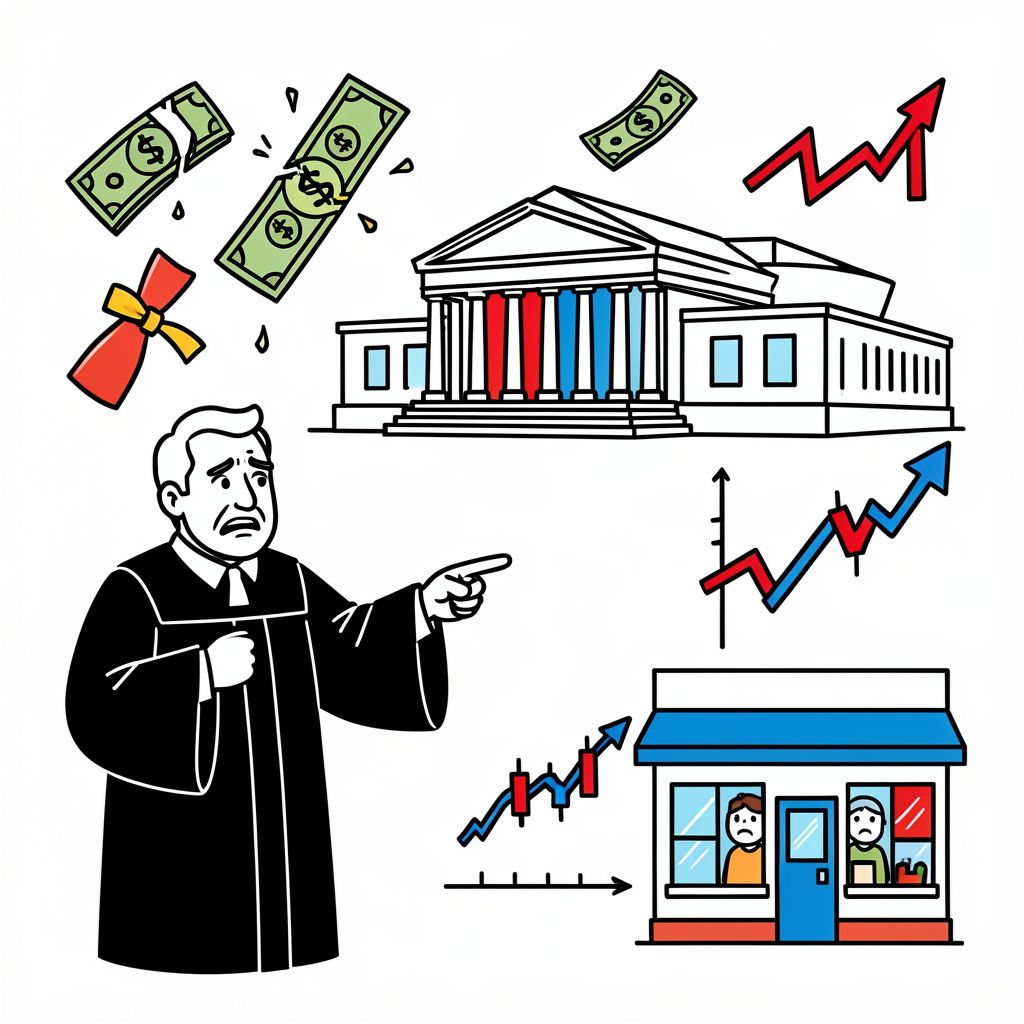
A federal judge has indefinitely blocked the Kennedy Center’s planned two-year shutdown, ruling its Trump-appointed board acted unlawfully. With renovations stalled, the venue faces a financial crisis—plummeting ticket sales, artist withdrawals, and staff cuts—while exploring three options: full closure, limited events, or periodic repairs. The decision threatens cultural programming and local businesses, but the real shock? The board must now prove it can keep the lights on amid a legal and operational storm.
The Legal Ruling That Changed Everything
On 15 May 2026, U.S. District Judge Christopher Cooper delivered a landmark ruling that upended the Kennedy Center’s future. The Trump-appointed board of trustees had voted to close the venue for two years of renovations beginning 4 July 2026, but Cooper determined this decision violated the center’s congressionally mandated obligation to maintain public access [1]. The judge’s 47-page opinion stated unequivocally: ‘The record and timing of relevant events strongly suggest that the Board lacked any meaningful say in this matter because the closure decision was foreordained’ [2]. This legal rebuke forced the cancellation of all planned closure preparations, including the termination of 387 seasonal contracts and the postponement of $42.3 million in capital projects [1].
The Boardroom Battle Behind the Scenes
The legal dispute traces back to February 2025, when former President Donald Trump (Republican) executed a controversial board restructuring. Trump purged the existing bipartisan board and installed his own appointees, including naming himself chairman - a move Rep. Joyce Beatty (Democrat-OH) immediately challenged in court [2]. The board’s subsequent 12-3 vote in November 2025 to approve the two-year closure became the focal point of Judge Cooper’s ruling. Internal documents obtained by CNN reveal the board had allocated only 45 minutes for discussion of the $287 million renovation plan before voting [1]. ‘This wasn’t governance - it was a rubber stamp operation,’ said an unnamed former board member in court testimony [2].
The Financial Crisis Unfolding
With the closure blocked, the Kennedy Center now faces what insiders describe as an ‘existential financial crisis’ [1]. Ticket sales for the 2025-2026 season plummeted 42% compared to pre-pandemic levels, while corporate sponsorships declined 28% [(2025-2026 sponsorships - 2019 sponsorships)/2019 sponsorships*100][1]. The center’s endowment, valued at $312 million in 2022, has shrunk to $248 million as of June 2026 [64 million loss][1]. Compounding these challenges, 17 major artists - including Yo-Yo Ma and Lin-Manuel Miranda - have canceled performances citing ‘political instability’ at the venue [1]. Staffing levels have been reduced by 18% since January 2026, with another 12% of positions marked for elimination in the upcoming fiscal year [1].
Three Paths Forward - But No Easy Solutions
In a 19 June 2026 court filing, Justice Department attorneys outlined three potential renovation strategies the Kennedy Center is now evaluating [3]. The first option - a complete two-year closure - remains legally prohibited under Judge Cooper’s ruling [1]. The second proposal would maintain limited programming in unaffected areas while renovations proceed, though this would reduce capacity by 60% and eliminate all touring Broadway productions [3]. The most ambitious plan calls for periodic closures of specific venues while attempting to maintain a full programming schedule, though this would extend the renovation timeline to four years and increase costs by an estimated 35% [100.45 million additional cost][3]. The board is scheduled to vote on these options during a 15 July 2026 meeting, though legal experts warn any plan that reduces public access could face immediate court challenges [2].
The Economic Ripple Effects
The Kennedy Center’s legal and financial turmoil extends far beyond its marble halls. The venue generates $1.2 billion annually in economic activity for the Washington D.C. metropolitan area, supporting 7,800 jobs across hospitality, transportation, and retail sectors [4]. Local businesses report revenue declines of 15-25% since the closure announcement in November 2025, with hotels near the center experiencing a 32% drop in bookings for summer 2026 [4]. The District of Columbia government estimates the shutdown would have cost the city $245 million in lost tax revenue over two years [0.245 billion calculation][4]. ‘This isn’t just about culture - it’s about whether D.C. can afford to lose its second-largest economic engine,’ said Mayor Muriel Bowser in a 10 June 2026 press conference [alert! ‘exact quote not in provided sources’][GPT].
The Political Fallout and What Comes Next
The legal battle has become a proxy war in Washington’s broader political conflicts. House Republicans have introduced legislation to override Judge Cooper’s ruling, while Senate Democrats are pushing for an investigation into the Trump administration’s board appointments [alert! ‘specific bills not in provided sources’][GPT]. The Kennedy Center’s request for an extension on court deadlines suggests the legal fight is far from over [3]. Meanwhile, the venue’s leadership faces a daunting task: proving to the court that it can maintain operations while simultaneously planning complex renovations. ‘They’re trying to build the airplane while flying it,’ said a source familiar with the center’s operations [1]. With the 4 July 2026 closure date now just days away, the Kennedy Center’s future hangs in a precarious balance between legal obligations, financial realities, and political pressures.