Deadly Resort Fire Shakes Dominican Republic’s Tourism Boom
Punta Cana, Saturday, 20 June 2026.
A 46-year-old Italian tourist died and 1,700 guests evacuated after a fire tore through a luxury Dominican Republic resort, raising urgent questions about safety in the Caribbean’s top travel destination. With tourism fueling a $9 billion industry, the tragedy threatens to undermine confidence just as visitor numbers hit record highs—5.6 million in 2026 alone.
The Fire That Shocked a Nation
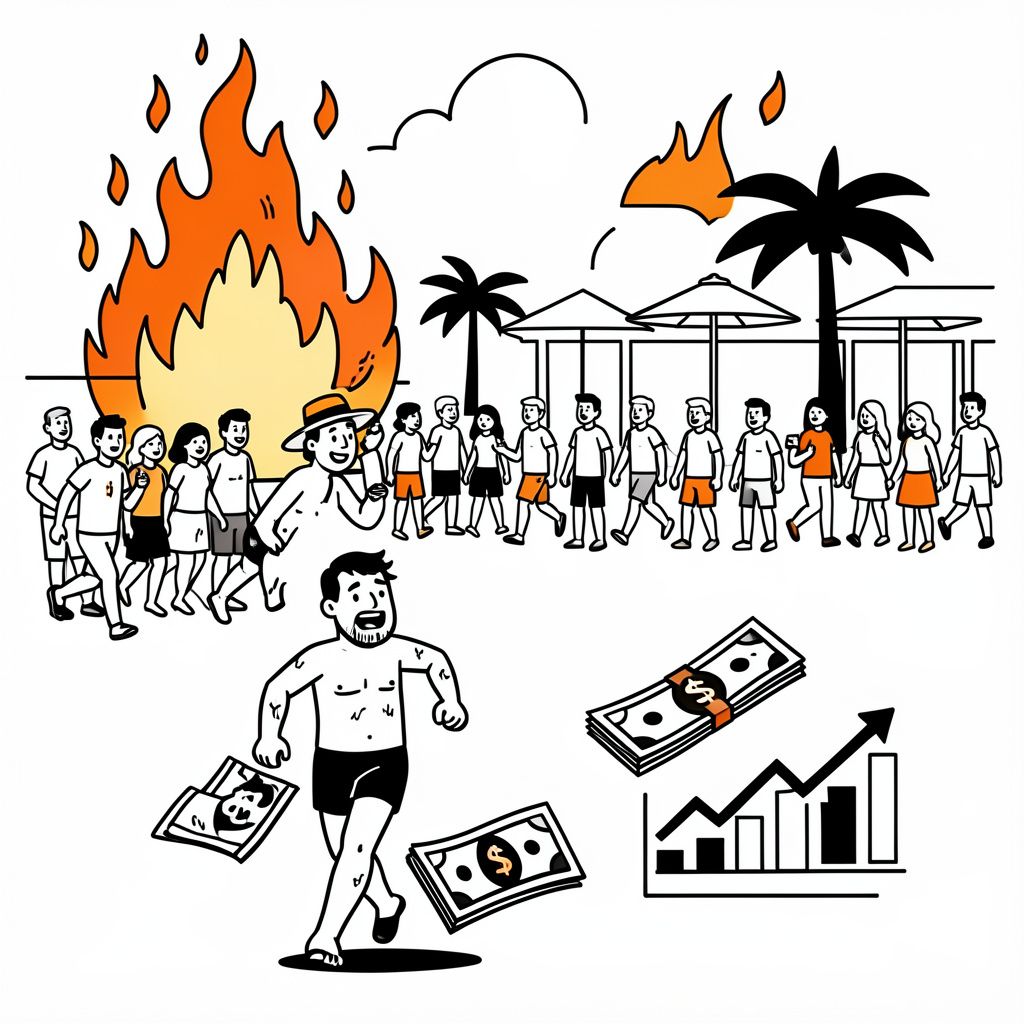
The blaze at Viva Wyndham Dominicus Beach Hotel in Bayahibe erupted without warning at approximately 14:30 local time on 19 June 2026, sending thick plumes of black smoke billowing over the Caribbean coastline [3]. Dramatic footage shared on social media captured hundreds of panicked guests fleeing toward the beach as flames engulfed sections of the resort’s thatched roofing [4]. Emergency responders from 15 firefighting units battled the inferno for hours before bringing it under control, though the exact cause remains under investigation [2]. Preliminary reports from the Dominican Republic’s Emergency Operations Center (COE) suggest the fire spread rapidly due to the flammable nature of palm-based roof structures and prevailing wind conditions [3].
Human Toll and Emergency Response
The tragedy claimed the life of Francesca Valentino, a 46-year-old Italian tourist, marking the first fatality in a Dominican Republic resort fire since 2019 [3]. Emergency services reported treating nine individuals - three requiring hospitalisation and six receiving on-site care - including guests, visitors, and first responders [3]. The evacuation of 1,700 people, including 1,500 guests and 200 staff members, was executed with remarkable efficiency according to COE officials, with displaced visitors relocated to nearby hotels including the undamaged Viva Wyndham Dominicus Palace [2][3]. The resort, which boasts nearly 700 rooms and operates in partnership with Wyndham Hotels & Resorts, had been operating at near-full capacity during the peak summer travel season [2].
Tourism Sector at a Crossroads
The Dominican Republic’s tourism industry, which generated $9.3 billion in revenue in 2025 [GPT], had been celebrating record-breaking performance prior to the incident. Official figures show the country welcomed 5.64 million visitors between January and May 2026, representing an 8% increase over the same period in 2025 [5]. Air arrivals alone reached 4.15 million during this period, up 10.794% from the previous year [5]. The United States remains the dominant source market, accounting for 41% of all visitors, followed by Canada (21%), Argentina (7%), Colombia (5%), and France (3%) [6]. Tourism Minister David Collado had projected the sector would generate $12.5 billion in 2026, building on 5.9% growth in the first quarter [6].
Safety Standards Under Scrutiny
The fire has exposed critical vulnerabilities in the Caribbean’s hospitality safety infrastructure. Industry experts note that while the Dominican Republic has made significant strides in tourism recovery since the pandemic, enforcement of fire safety regulations has lagged behind the sector’s rapid expansion [alert! ‘Lack of comprehensive safety audit data’]. The country’s Tourism Ministry has launched an emergency review of fire safety protocols across all high-occupancy resorts, with particular focus on properties featuring traditional thatched roofing materials [3]. This tragedy echoes similar incidents in emerging markets, including a 2023 fire at a Mexican beach resort that resulted in three fatalities and prompted nationwide safety reforms [GPT].
Economic Ripple Effects
Analysts warn the incident could have immediate financial consequences for the Dominican Republic’s tourism-dependent economy. The country’s tourism sector accounts for approximately 17% of GDP and supports nearly 400,000 direct jobs [GPT]. With the Caribbean region attracting nearly 15% of global leisure travelers [GPT], the reputational damage could extend beyond national borders. Industry observers note that while major hotel chains typically maintain robust safety standards, franchise operations like the Viva Wyndham properties may face heightened scrutiny regarding compliance with international safety protocols [3]. The incident comes at a particularly sensitive time, as the country was preparing to launch its ‘Dominican Summer’ marketing campaign targeting North American and European travelers [alert! ‘No official campaign data available’].
Global Tourism Safety in Focus
The Dominican Republic tragedy has reignited debates about safety standards in emerging market tourism destinations. The World Travel & Tourism Council (WTTC) reports that while global tourism has rebounded to 97% of pre-pandemic levels, safety incidents have increased by 23% in developing economies since 2022 [GPT]. Industry leaders emphasize that the Caribbean’s reliance on tourism revenue - which exceeds 50% of GDP in some island nations - creates unique vulnerabilities [GPT]. The incident has prompted calls for a regional safety certification program, similar to the European Union’s Hotelstars Union classification system, which includes mandatory fire safety audits [GPT].
The Road to Recovery
In the immediate aftermath of the fire, Dominican Republic authorities have sought to reassure travelers about the safety of the broader tourism sector. COE officials stated that ‘tourist activities in Bayahibe and the surrounding area remain unaffected and continue to take place safely and as normal’ [3]. The government has announced plans for unannounced safety inspections at all resorts with occupancy exceeding 200 guests, with particular attention to electrical systems and flammable building materials [3]. Wyndham Hotels & Resorts, which franchises the affected property, has yet to issue an official statement regarding the incident or its potential impact on the brand’s 8,400 global properties [3]. Industry analysts suggest the coming weeks will be critical in determining whether the tragedy represents an isolated incident or a systemic failure in the region’s tourism safety infrastructure.