White House Initiates Sweeping Import Probes to Replace Blocked Tariffs
Washington, Tuesday, 28 April 2026.
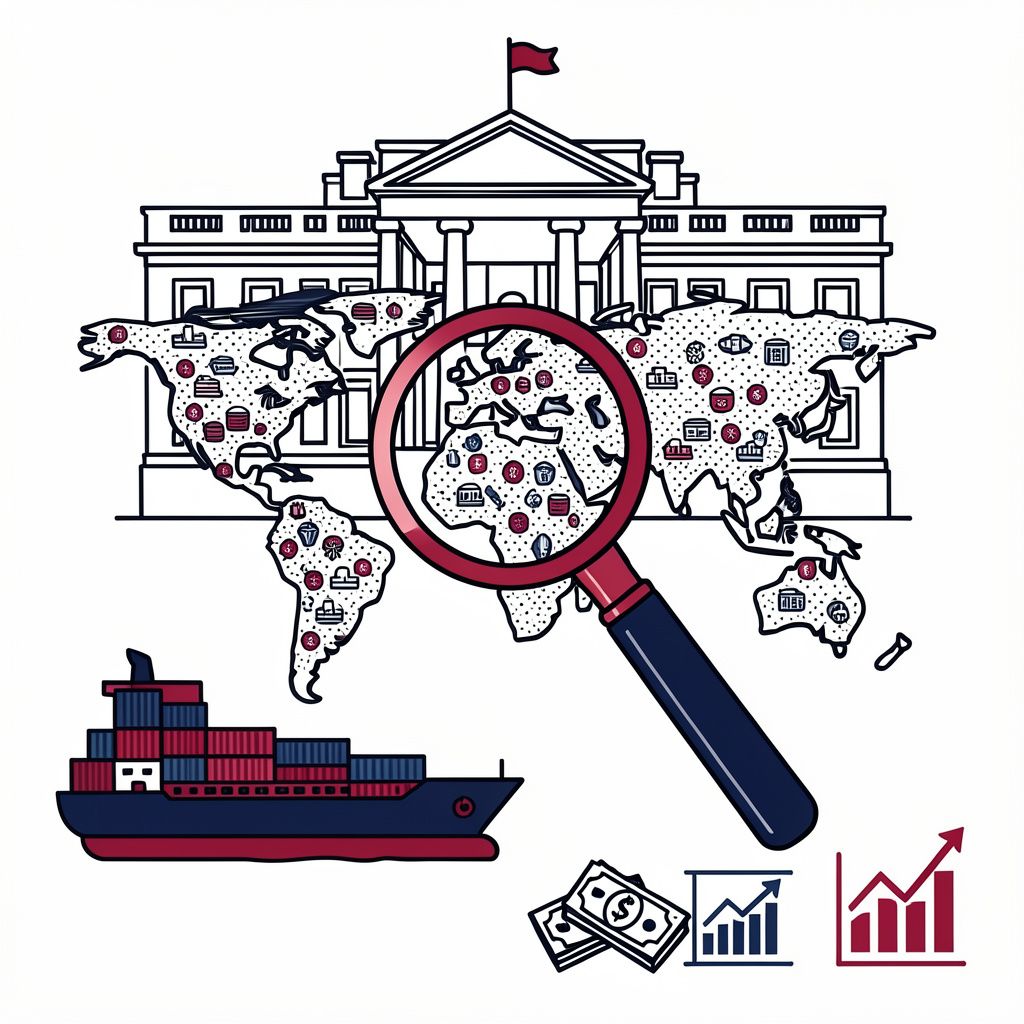
After a Supreme Court rejection, the administration is investigating 60 economies accounting for 99% of U.S. imports, seeking a new legal avenue for durable trade taxes.
Navigating the Post-IEEPA Legal Landscape
Following the Supreme Court’s February 20, 2026, ruling that struck down President Donald Trump’s use of the International Emergency Economic Powers Act (IEEPA) to impose sweeping trade taxes, the administration has been forced into a strategic pivot [1]. The financial ramifications of the court’s decision are profound: the federal government is legally obligated to refund the $166 billion generated by the IEEPA tariffs prior to the ruling, and it loses out on a projected $1.6 trillion in revenue over the next decade [1]. Legal experts note that IEEPA had offered the President unprecedented unilateral control. Scott Lincicome of the Cato Institute described it as a “blank slate” and a “tariff switch in the Oval Office” that could be flipped at will [1]. Stripped of this tool, the administration immediately implemented a stopgap measure. On February 22, 2026, the government imposed temporary 10% tariffs using Section 122 of the Trade Act of 1974 [1]. However, this executive mechanism is strictly time-limited to 150 days, meaning these temporary tariffs will expire on July 24, 2026, unless Congress votes to extend them [1].
The Section 301 Strategy
To establish a more durable protectionist framework before the July deadline, the Trump administration is now pursuing investigations under Section 301 of the Trade Act of 1974 [1]. Unlike Section 122, Section 301 has no statutory cap on the size of the tariffs, and the duties can remain in place for four years with the possibility of extension [1]. Treasury Secretary Scott Bessent has explicitly stated that the government intends to use these new import taxes to replace the revenues lost from the original, court-rejected tariffs [1]. As of today, April 28, and continuing through tomorrow, the Office of the U.S. Trade Representative (USTR) is conducting hearings to investigate whether 60 economies permit products made with forced labor [1]. These economies account for a staggering 99% of all U.S. imports [1]. U.S. Trade Representative Jamieson Greer, who is overseeing the probes, argued that American firms have long been forced to compete against foreign producers benefiting from the “artificial cost advantage gained from the scourge of forced labor” [1].
Targeting Overproduction and Future Tariffs
The administration’s trade scrutiny will expand further next week. Starting the week of May 4, 2026, the USTR will hold follow-up hearings examining whether 16 major trading partners—including China, Japan, and the European Union—are overproducing goods [1]. According to the Tax Foundation, these 16 economies account for 70% of U.S. imports [1]. While Greer has maintained that he will not prejudge the investigations, trade lawyers and policy analysts suggest the outcome is highly predictable [1]. Cato’s Lincicome remarked that if the Treasury Secretary and the President are to be believed, “the cake is already baked” regarding the eventual implementation of these taxes [1]. However, any new duties resulting from these probes will likely face intense judicial scrutiny [alert! ‘The final implementation and scope of these tariffs depend on the outcome of the USTR investigations and almost certain legal challenges from impacted industries’] [1].
Strategic Exemptions in the Agricultural Sector
While pursuing broad tariffs on manufactured goods, the Trump administration is simultaneously carving out strategic exemptions to protect domestic supply chains, particularly in agriculture. When the temporary Section 122 tariffs were rolled out in February, President Trump explicitly exempted fertilizers that cannot be produced domestically in sufficient quantities, with the White House citing “the needs of the U.S. economy” [2]. Furthering this supply-side relief, Trump issued a Jones Act waiver on April 24, 2026, to facilitate the maritime transport of fuel and fertilizer [2]. The administration is also reportedly considering the full rescission of Biden-era countervailing duties (CVDs) on phosphate fertilizers from Morocco and Russia [2]. Since the Commerce Department opened CVD investigations in 2020, the Producer Price Index for phosphatic fertilizer manufacturing doubled by March 2026, and the duties increased phosphorus fertilizer costs by an estimated $6.9 billion between 2021 and 2025 [2]. The trade shifts have been severe: imports from Morocco and Russia declined by $380 million, while imports from other nations increased by $765 million, representing a net import shift of 385 million [2]. In 2018 and 2019, Morocco accounted for over half of U.S. phosphate fertilizer imports, but by 2025, that share had collapsed to less than 1% [2]. With a statutorily required five-year review of these CVDs initiated on March 2, 2026, and legislative efforts like an amendment from Representative Mariannette Miller-Meeks (R-IA) introduced on April 21, 2026, the administration appears poised to dismantle these specific trade barriers to lower agricultural input costs [2].