Donald Trump's Political Agenda Overshadows the 2026 World Cup
Washington, Wednesday, 10 June 2026.
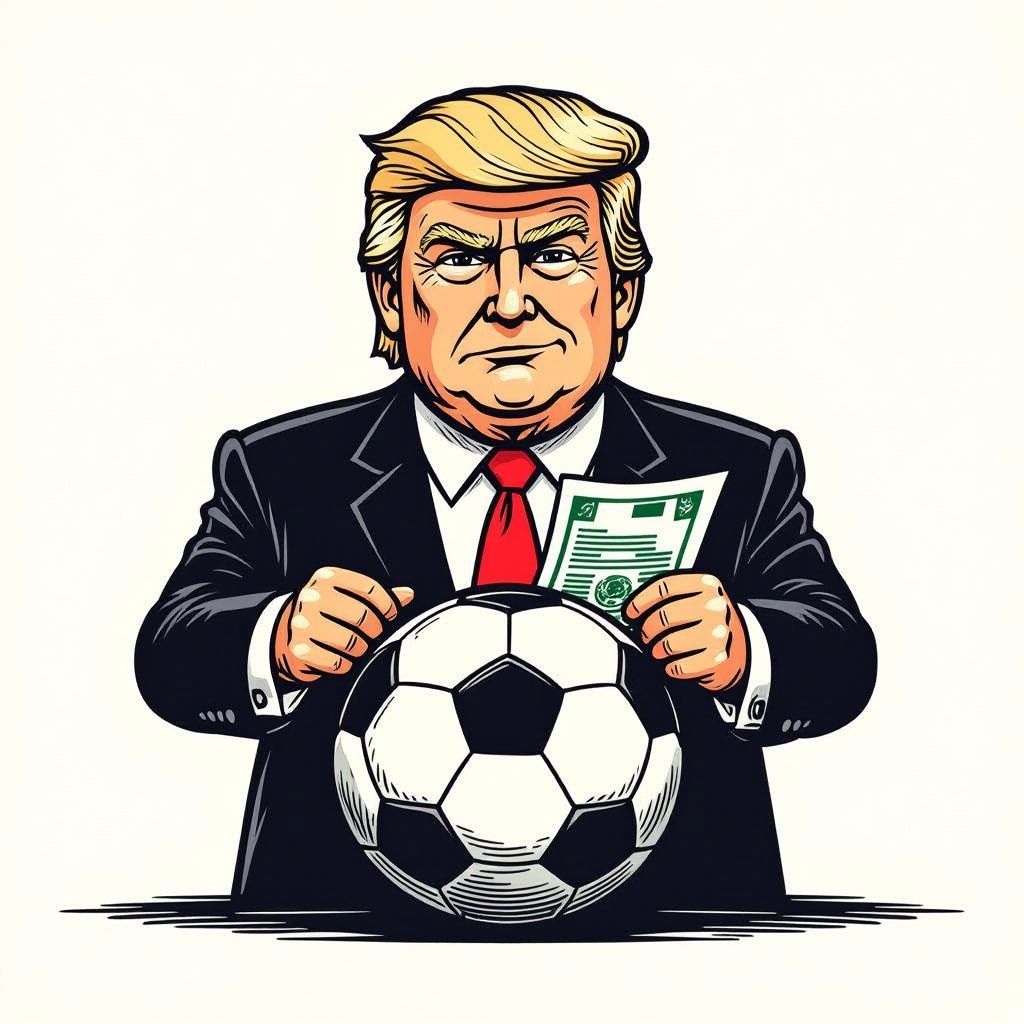
As the 2026 World Cup begins, President Trump’s hardline policies—highlighted by canceled Iranian ticket allocations following US military strikes—threaten to overshadow the global economic and sporting event.
A Politicized Pitch and Diplomatic Hurdles
The 2026 FIFA World Cup, co-hosted by the United States, Canada, and Mexico, officially commences tomorrow, June 11, 2026, with an opening match between Mexico and South Africa in Mexico City [5][6]. However, the atmosphere surrounding the monumental tournament is heavily clouded by the hardline policies of Republican US President Donald Trump [1][2]. On June 9, 2026, Iran reported that its ticket allocation for three group-stage matches in the United States had been canceled in the wake of recent US military strikes against the nation [1]. Because Iran is entering the tournament during an active war with the US co-host, the Iranian national team has established its base camp in Mexico and will be forced to commute across the border for its matches [6].
FIFA’s Cozy Relationship with Washington
Despite the diplomatic friction, FIFA President Gianni Infantino has actively cultivated a close alliance with President Trump [1]. This alignment was cemented when Infantino awarded Trump the inaugural “FIFA Peace Prize” on December 5, 2025, and subsequently attended Trump’s Gaza peace summit [1]. Infantino has publicly defended this strategy, stating that a close relationship with the president is “absolutely crucial for the success of a World Cup” [1]. However, critics argue that FIFA’s silence on visa denials and aggressive immigration enforcement compromises the organization’s neutrality [1][3]. Former Australian soccer player and advocate Craig Foster took to social media on June 8, 2026, to condemn the situation, asserting that Trump has molded the World Cup into a “Gaudy, ostentatious, arrogant and narcissistic” reflection of his own image [3].
Logistical Gridlock and Economic Realities
Beyond the political theater, the sheer scale of the 2026 World Cup presents daunting logistical challenges. The tournament will feature 104 matches spread across 16 cities in North America [5][6]. Eight of these matches, including the highly anticipated final on July 19, 2026, will be held at MetLife Stadium in the New York-New Jersey region [4][5][6]. This means the venue will host approximately 7.692 percent of the entire tournament’s matches. Local residents are already expressing severe concerns that the influx of international fans will result in paralyzing traffic gridlock, potentially overshadowing the economic benefits and local celebrations [4].
The Spectacle of Sports and Statecraft
As the tournament unfolds, the world will witness a jarring juxtaposition of global pop culture and geopolitical tension. The opening days are packed with star-studded ceremonies, featuring performances by Shakira and Burna Boy in Mexico City, Alanis Morissette in Toronto, and Katy Perry in Los Angeles [5]. The final match will even feature the tournament’s first-ever halftime show, headlined by Madonna and BTS [5]. Yet, the shadow of political exploitation looms large. Just as Trump and FBI Director Kash Patel joined the US hockey team’s victory celebrations at the Winter Olympics in February 2026, political figures historically use such mega-events to project power [1]. As international tourists navigate high costs, traffic, and stringent border controls, the 2026 World Cup stands as a complex testament to an era where the beautiful game cannot escape the gravity of United States politics [1][4][GPT].