Trump Leverages $14 Billion Taiwan Arms Deal as Negotiating Chip with China
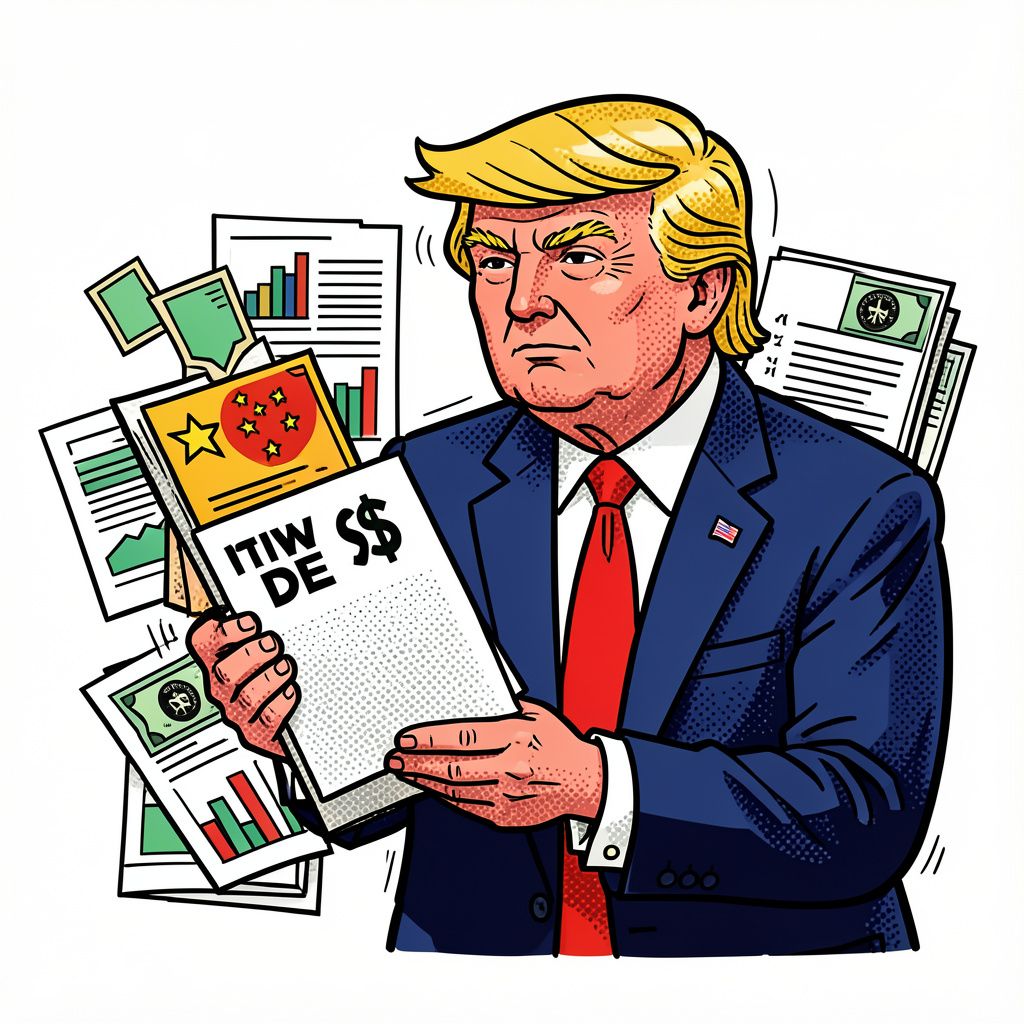
Washington, D.C., Sunday, 17 May 2026.
By declaring a pending $14 billion Taiwan arms deal a ‘negotiating chip’ with Beijing, President Trump introduces significant geopolitical risk and casts doubt on U.S. security commitments.
A Transactional Shift in U.S.-Taiwan Relations
During a high-stakes summit in Beijing that concluded on Friday, May 15, 2026 [7], President Donald Trump explicitly linked U.S. security assistance for Taiwan to trade concessions from China [1][3]. Speaking to reporters, Trump confirmed he is holding a major weapons package in abeyance, describing it as a “very good negotiating chip” [1]. The administration is reportedly seeking increased Chinese purchases of American exports, specifically airplanes, beef, ethanol, sorghum, and soybeans [1]. This transactional approach marks a stark departure from traditional U.S. foreign policy, which has historically treated the defense of the self-governing island as a non-negotiable cornerstone of regional stability [GPT].
Breaking Precedent and the ‘Six Assurances’
To leverage these arms sales, Trump has signaled a willingness to bypass long-standing diplomatic protocols. Most notably, he dismissed the 1982 “Six Assurances,” a foundational policy framework in which the United States explicitly agreed not to consult with the People’s Republic of China regarding arms sales to Taiwan [4][5]. When questioned about discussing the arms deal with Chinese President Xi Jinping, Trump rhetorically asked if he should ignore the topic because of an “agreement wrote in 1982,” confirming that the two leaders discussed the sales in “great detail” [3][5]. David Sacks, a former political-military expert at the U.S. diplomatic outpost in Taiwan, noted that such horse-trading and consultation with Beijing represents a profound break with precedent [3].
Taiwan’s Anxious Response and Regional Implications
In Taipei, the response has been a mix of diplomatic tact and underlying anxiety. On May 16, 2026, Taiwan’s Ministry of Foreign Affairs and presidential spokesperson Karen Kuo released statements emphasizing that U.S. arms sales are a legally mandated security commitment under the 1979 Taiwan Relations Act [2][6][7]. Kuo highlighted that these sales serve as a vital mutual deterrent against regional threats [2]. The urgency of this deterrence was underscored on May 14 and 15, 2026, when China’s military maintained active pressure around Taiwan while Trump and Xi were meeting in Beijing [2]. Despite the uncertainty, Taiwan noted that comments from U.S. Secretary of State Marco Rubio, who insisted that U.S. policy remains unchanged, provided some reassurance [5][7].
Broader Geopolitical Stakes: Nuclear Caps and Global Oil
The delay in Taiwan’s arms package is intrinsically linked to a broader, highly complex matrix of global negotiations between Washington and Beijing. During the summit, Trump and Xi discussed a potential trilateral nuclear agreement that would include the United States, China, and Russia [4]. While the U.S. and Russia each possess over 5,000 nuclear warheads, China’s arsenal is currently estimated at over 600, though the Pentagon projects it will exceed 1,000 by 2030 [4].