Unprecedented Weather Pattern Threatens Global Markets and Food Supplies
Washington, Thursday, 12 November 2026.
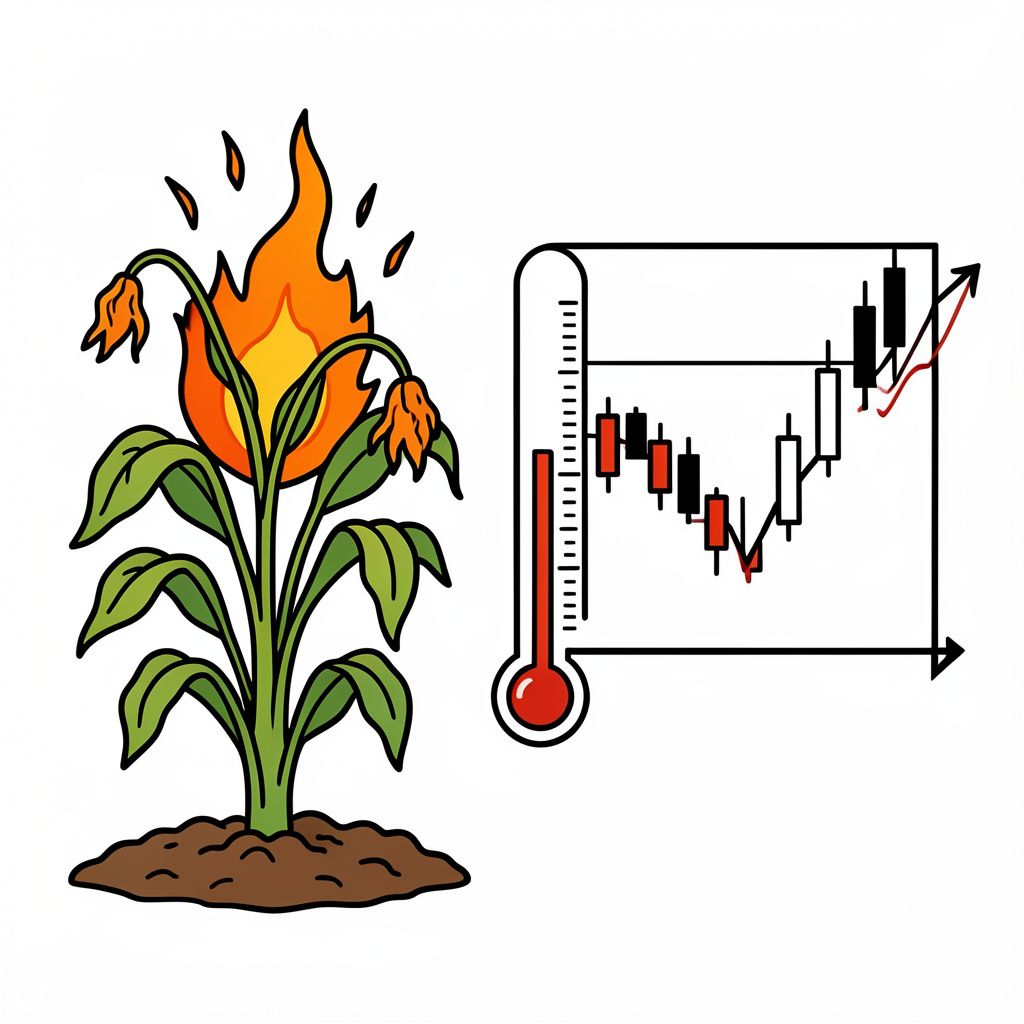
A record-breaking Pacific warming pattern is driving temperatures past critical thresholds, triggering unprecedented emergency declarations and threatening trillions of dollars in worldwide economic losses and supply disruptions.
Breaching Critical Climate Thresholds
As of 10 November 2026, the Copernicus Climate Change Service (C3S) has documented the current El Niño as one of the strongest on record, potentially the strongest in living memory or the past 1,000 years [1]. The Pacific Ocean is releasing a massive pulse of heat, causing global temperatures to skyrocket and break records prior to the event’s expected peak [1]. Sea surface temperatures in the tropical central Pacific Niño 3.4 region reached approximately 3.4 degrees Celsius above normal in late October 2026, with models projecting ocean temperatures in the Pacific core to reach 4 degrees Celsius above normal by the end of 2026, surpassing the historical heat record set by the 1877 El Niño [1].
Global Temperature Surpasses 1.5°C Threshold
Climate projections indicate that global average temperatures are set to breach the critical 1.5 degrees Celsius above preindustrial levels in 2026, reaching 1.52°C, and are expected to climb to 1.74°C in 2027 [1]. Daniel Swain, a climate scientist at the University of California Agriculture and Natural Resources, warns that this year may mark the first time global temperatures do not dip below 1.5°C on average [1]. Zeke Hausfather, a climate scientist at Stripe and Berkeley Earth, described the event as being ‘literally and figuratively out of uncharted waters,’ noting that this El Niño is growing faster than any other recorded event [1].
Economic and Agricultural Disruptions Intensify
The economic fallout from this super El Niño is already manifesting across critical sectors. Peru’s anchovy industry, the world’s largest single-species fishery, is experiencing severe disruptions due to shifting ocean temperatures and currents, which directly threaten global fishmeal and fish oil markets [2]. The global economy could face trillions of dollars in losses as a result of these disruptions, compounding existing pressures on food systems [2]. Historical data underscores the magnitude of potential losses: global income losses reached US$4.1 trillion during the 1982–83 El Niño and US$5.7 trillion during the 1997–98 El Niño [4].
Regional Climate Impacts and Supply Chain Vulnerabilities
Regional climate anomalies linked to this super El Niño are creating cascading supply chain disruptions. In the United States, the National Oceanic and Atmospheric Administration (NOAA) predicts a warmer North and wetter South for the winter of 2026–27, with the southern U.S. facing a 70 to 80 percent chance of above-average precipitation in regions like southeast Georgia and north Florida [3]. California, already grappling with extreme weather, has declared a state of emergency to prepare for coastal flooding, erosion, and monster storms driven by an oceanic Kelvin wave [3]. Meanwhile, the South Central U.S. is bracing for increased precipitation, flash flooding, and landslides through spring 2027, with states like Louisiana, Oklahoma, and Texas likely to experience wetter-than-normal conditions [5].
Global Health and Food Security Crisis
The World Health Organization (WHO) has classified the anticipated health impacts of the 2026–27 Super El Niño as a global health emergency, marking the first time the UN agency has issued such a declaration for an El Niño event [6]. The WHO’s Strategic Preparedness and Response Plan has been elevated to a Grade 3 response, requiring ‘major to maximal’ efforts to address the crisis [6]. The Climate Impact Lab at the University of Chicago projects 451,000 extra heat-related deaths primarily in low- and middle-income countries due to this El Niño [4]. Food insecurity is escalating in regions like Somalia, where 57 percent of the population is undernourished or experiencing severe food insecurity, and South Sudan, where 63 percent face similar conditions [4].
Inflationary Pressures and Market Volatility Loom
The combination of disrupted agricultural production, energy demand shifts, and logistical bottlenecks is expected to fuel significant inflationary pressures across both developed and emerging markets. The UN Food and Agriculture Organization (FAO) and World Food Programme have warned that the current El Niño threatens regions with high food insecurity, with anticipatory assistance planned for 8.8 million people [4]. Agricultural commodities such as maize, soybeans, and wheat are particularly vulnerable, with South African maize output projected to drop by around 40 percent during the 2026–27 El Niño [4]. These disruptions are occurring against a backdrop of existing global food system strains caused by conflicts in Ukraine and Iran, as well as fertilizer shortages [4].
Long-Term Economic and Environmental Consequences
The long-term economic consequences of this super El Niño could extend well beyond 2027, particularly if global temperatures fail to return below the 1.5°C threshold. Historical El Niño events have been linked to pandemics, including the 1889–90 Russian influenza and the 1918–19 Spanish flu, due to their role in disrupting ecosystems and increasing human vulnerability to disease [4]. The 1876–78 El Niño, for instance, caused widespread droughts and major famines across Asia, Africa, and the Americas, resulting in millions of deaths [4]. The current event’s intensity and global reach suggest that its economic and environmental impacts may be similarly profound, with ripple effects on trade, migration, and geopolitical stability.
Sources
- www.scientificamerican.com
- www.npr.org
- grist.org
- www.nature.com
- www.usgs.gov
- gizmodo.com
- www.reddit.com