Clean Energy Group Uses Pro-Trump Ads to Oust Anti-Solar Republicans
Washington, Saturday, 29 August 2026.
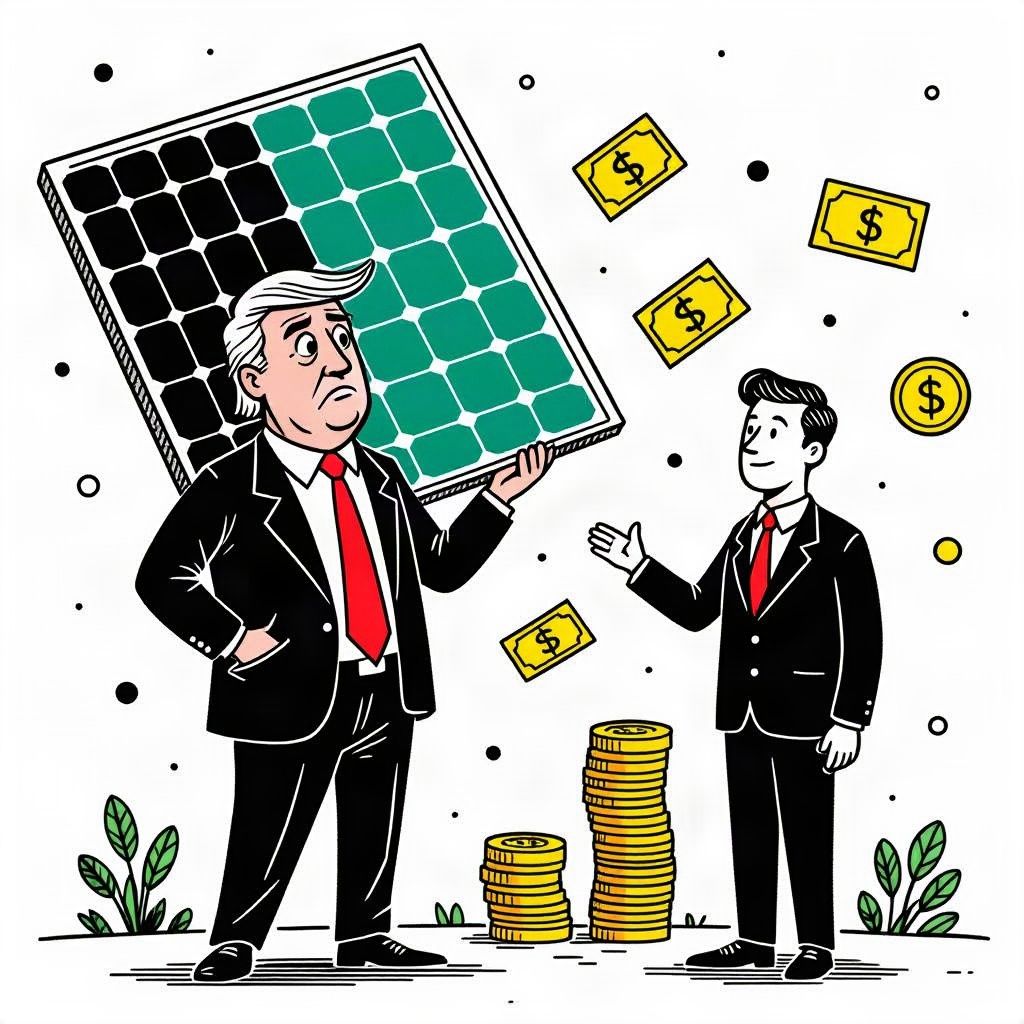
A clean energy political action committee has secured its fifth Republican primary win by deploying an unusual tactic: spending millions on aggressive ad campaigns that frame anti-renewable incumbents as disloyal to Donald Trump.
The South Carolina Primary Upset
On Tuesday, 25 August 2026, Darline Graham secured a victory in the South Carolina Republican Senate primary, defeating incumbent Representative Ralph Norman [1][2]. This outcome marks the fifth Republican primary win achieved by the Invest in Tomorrow Coalition (ITC), a super PAC funded by solar entrepreneurs and venture capitalists [1]. The ITC allocated approximately $1 million specifically to support Graham’s campaign against Norman [1]. Representative Norman, who previously served as co-chair of the Congressional Solar Caucus founded in 2018, had increasingly distanced himself from his pro-solar record starting in 2024 [1]. This shift followed community opposition to a Silfab Solar manufacturing plant located within his district [1]. During the summer of 2025, Norman sought the repeal of Biden-era renewable energy tax credits and conditioned his vote for the “One Big Beautiful Bill Act” on a promise from President Trump to accelerate the phase-out of wind and solar subsidies [1].
The “Revenge Tour” Strategy
The ITC describes its aggressive campaign strategy as a “Revenge Tour,” designed to demonstrate to candidates seeking to restrict clean energy initiatives that the industry will fight back [1]. Political advertisements deployed by the coalition during the South Carolina race included messages such as “Ralph Norman is a MAGA traitor” and “Trump doesn’t want him. Why would we?” [1]. Tom Matzzie, chief executive of CleanChoice Energy and chair of the ITC, stated that in a Republican primary, a candidate’s fidelity to Trump is one of the most important topics [1]. The coalition’s spending extends beyond South Carolina, having previously spent $2 million in Tennessee’s 5th district primary earlier in 2026 to defeat incumbent Representative Andy Ogles [1]. Additionally, the group spent $1.7 million to defeat Representative Chip Roy in a state attorney general runoff in late May 2026 [1]. Combined known expenditures for these three primary efforts total 4.700 million dollars [1]. Funding for these activities was bolstered in late June 2026, when billionaire Chris Larsen contributed $5 million to the ITC, following three prior contributions of $250,000 each [1].
Industry Headwinds and Policy Shifts
The political maneuvering occurs amidst significant volatility in the renewable energy sector, driven by new tariffs and expired tax credits [4]. Wood Mackenzie projects that new U.S. residential solar generating capacity will decline by 21% in 2026 compared to 2025 [4]. This contraction is attributed to tariffs on imported photovoltaic components and the phase-out of federal rooftop solar tax credits initiated by President Donald Trump [4]. On 26 August 2026, President Trump issued an executive order declaring a national emergency to restrict the purchase and installation of foreign-made grid equipment deemed a risk to U.S. power supply [3]. Furthermore, new tariffs on imported solar components from Canada took effect between 19 August 2026 and 26 August 2026, exacerbating industry volatility [4]. GAI Energy, a solar installation firm in Flora, Indiana, reported that these escalating tariffs have exacerbated current market challenges [4]. Co-owner Chris Rohaly described the period as a “madhouse,” noting significant mistrust in the industry and market [4].
Outlook for Midterms
Looking ahead, the ITC intends to expand its involvement into the 2026 general election cycle to support allies in winnable races [1]. Tom Matzzie indicated that there are people out there who distinguish themselves in races that are winnable for their challenger, and the group plans to get involved in those races [1]. This strategy aligns with broader campaign finance trends where specialized groups target specific vulnerabilities rather than attempting to shift the entire electoral landscape [5]. Political Wire reported that the Invest in Tomorrow Coalition PAC plans to spend at least $1 million to defeat Representative Ralph Norman in the South Carolina GOP Senate runoff, a race that concluded on 25 August 2026 [5]. Edward Maibach, founding director of the Center for Climate Change Communication at George Mason University, noted that the fossil fuel industry is the strongest political voice in America and the world [1]. He suggested that the only way the clean energy industry can fight back is to fight fire with fire [1]. As the midterm elections approach, the effectiveness of this targeted lobbying spending will serve as a key indicator of the renewable energy sector’s evolving political influence [1][5].
Sources
- insideclimatenews.org
- insideclimatenews.org
- www.linkedin.com
- insideclimatenews.org
- politicalwire.com