U.S. Defense and Tech Sectors Fuel Trillion-Dollar Growth Through 2035
Washington D.C., Monday, 22 June 2026.
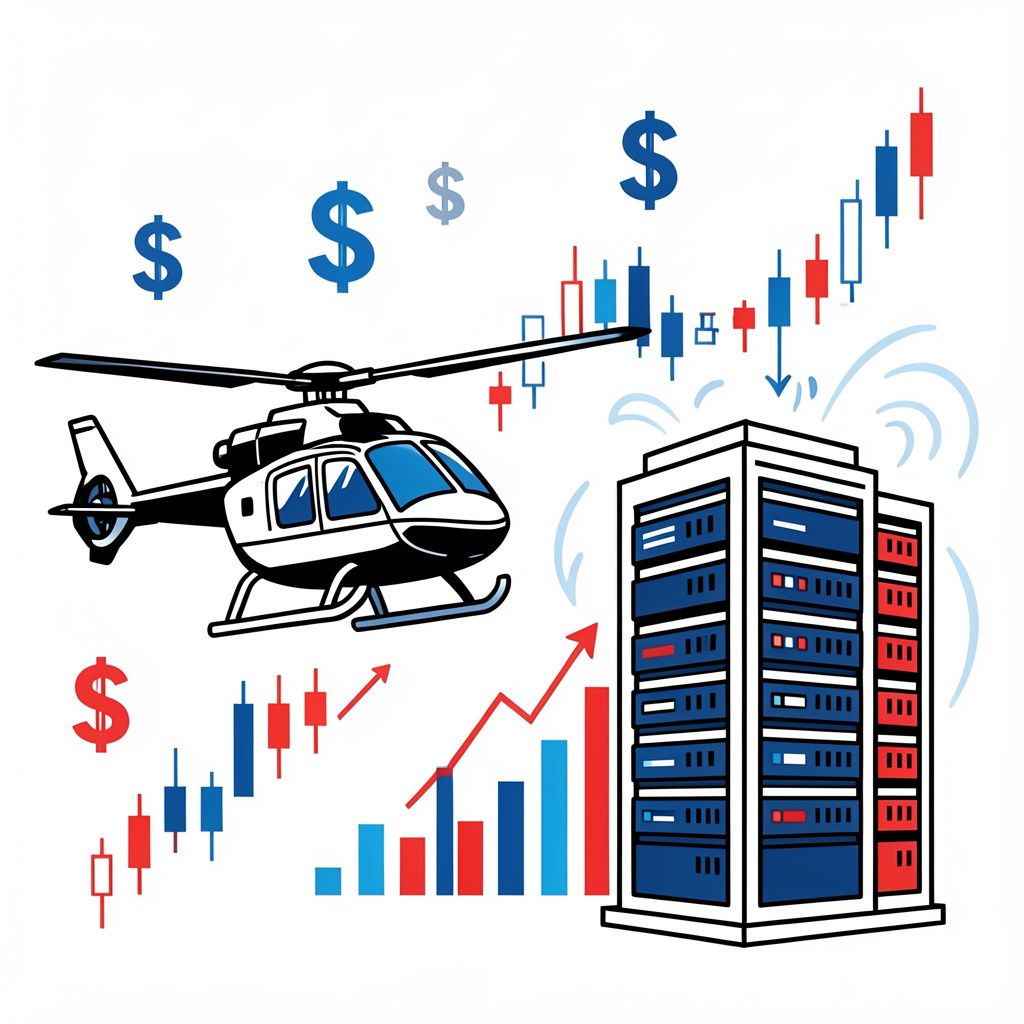
The U.S. is set to dominate two explosive markets: defense modernization and AI-driven data centers. By 2035, military helicopter spending will surge to $14.73 billion, while data center colocation—a backbone of AI and cloud computing—will skyrocket to $92.46 billion. This dual growth reflects America’s push for both national security and digital leadership. The most striking fact? AI hyperscalers like Microsoft and Google are pouring over $200 billion annually into data centers, reshaping global infrastructure. Meanwhile, defense contractors are racing to deploy next-gen helicopters and autonomous systems amid rising global tensions. This isn’t just growth—it’s a strategic realignment of U.S. economic and military power.
Military Helicopters: The Backbone of Modern Defense
The U.S. military helicopter market is poised for steady expansion, projected to grow from USD 12.00 billion in 2025 to USD 14.73 billion by 2035, reflecting a compound annual growth rate (CAGR) of 22.75% [1]. This growth trajectory underscores the Pentagon’s commitment to modernizing its rotary-wing fleet amid evolving global security challenges. The broader global military helicopter market, valued at USD 35.70 billion in 2025, is expected to reach USD 46.36 billion by 2035, growing at a CAGR of 2.70% [1]. Transport and utility helicopters dominated the market in 2025, holding a 42.58% revenue share, while attack helicopters emerged as the fastest-growing segment with a CAGR of 3.54% [1].
Technological Advancements Driving Procurement
The push for modernization is fueled by advancements in avionics, mission systems, and hybrid propulsion technologies [1]. In 2025, avionics accounted for 30.54% of the market share, driven by the adoption of digital cockpits and advanced navigation systems [1]. The U.S. Department of Defense (DoD) is prioritizing upgrades to its existing fleet, including the UH-60 Black Hawk and AH-64 Apache helicopters, alongside the expansion of the CH-53K King Stallion program [1]. These investments are part of the Pentagon’s Future Vertical Lift (FVL) initiative, which aims to replace aging platforms with next-generation aircraft capable of meeting the demands of multi-domain operations [1].
Data Centers: The Infrastructure of the AI Era
Parallel to defense modernization, the U.S. data center colocation market is experiencing explosive growth, projected to surge from USD 26.69 billion in 2025 to USD 92.46 billion by 2035, at a CAGR of 13.24% [2]. This expansion is driven by the rapid adoption of artificial intelligence (AI) and cloud computing, with hyperscalers like Microsoft, Amazon, Google, and Meta collectively investing over USD 200 billion annually in AI data center infrastructure [2]. The global data center colocation market, valued at USD 86.24 billion in 2025, is expected to reach USD 298.78 billion by 2035, growing at a CAGR of 13.19% [2].
AI and Cloud Computing Reshape Market Dynamics
The demand for AI computing infrastructure is the primary driver of this growth, as enterprises and governments increasingly rely on cloud-based solutions for data storage, processing, and analytics [2]. Retail colocation, which held approximately 70% of the market share in 2025, remains the dominant segment due to its broad customer base, ranging from small and medium-sized businesses (SMBs) to mid-sized enterprises [2]. However, wholesale colocation is the fastest-growing segment, fueled by the high power-density requirements of AI workloads [2]. Tier 3 colocation data centers, which offer a 99.982% uptime guarantee, held the largest share in 2025 at 58%, while Tier 2 data centers are the fastest-growing tier due to improvements in cooling, uninterruptible power supply (UPS), and renewable energy integration [2].
Military AI: The Next Frontier in Defense Innovation
The military AI market is set to undergo a transformative expansion, with global spending projected to grow from USD 9.82 billion in 2025 to USD 41.58 billion by 2035, at a CAGR of 17.4% [3]. This growth is driven by the increasing adoption of AI for intelligence, surveillance, and reconnaissance (ISR), command and control (C2), edge computing, and autonomous systems [3]. In the first five months of 2026 alone, over USD 14.6 billion was invested across 107 venture rounds in military, national security, and law enforcement AI technologies [3]. Leading the charge are companies like Anduril Industries, which raised USD 5.0 billion in a Series H round in May 2026, and Shield AI, which secured USD 2.0 billion in March 2026 [3][4].
From Silicon Valley to the Battlefield
The integration of AI into military operations is shifting intelligence from centralized cells to distributed mission layers, enabling real-time decision-making at the tactical edge [3]. Computer vision and sensor fusion technologies are being deployed to process vast amounts of data from drones, satellites, radar, and cyber feeds, while generative AI is assisting in staff workflows, albeit with slower adoption due to risks in classified environments [3]. Autonomy is another critical focus, with AI-enabled platforms allowing a single operator to supervise multiple unmanned systems, thereby enhancing operational efficiency and reducing human risk [3]. Predictive analytics, powered by digital twins and simulation, are improving maintenance and readiness, ensuring that military assets remain mission-ready [3].
5G in Defense: The Connectivity Revolution
The global 5G in defense market is expected to reach USD 11.92 billion by 2035, growing at a CAGR of 21.6% from its 2025 valuation of USD 1.68 billion [5]. This rapid expansion is driven by the need for ultra-low-latency connectivity, secure command-and-control systems, and real-time intelligence sharing [5]. Defense organizations are transitioning from traditional communication architectures to software-defined, 5G-enabled ecosystems that provide uninterrupted connectivity across land, naval, and airborne assets [5]. The advantages of 5G—including faster data transmission, lower latency, and improved network reliability—are critical for real-time situational awareness and integrated battlefield management systems [5]. Governments are accelerating the deployment of private 5G networks, virtualized architectures, and sovereign communication systems to enhance national security and operational readiness [5].
Military Aviation: Stealth, AI, and Next-Gen Platforms
The global military aviation market is projected to grow from USD 36.51 billion in 2025 to USD 62.52 billion by 2035, at a CAGR of 5.53% [6]. North America is expected to lead this growth, holding a 38% market share, driven by high military budgets and advancements in stealth technology, ISR, and next-generation combat aircraft [6]. The Asia-Pacific region is the fastest-growing market, with a CAGR of 6.8%, fueled by rising military spending and geopolitical tensions [6]. India, for instance, planned an USD 8 billion defense aviation procurement in 2025 alone [6]. Key trends in military aviation include the development of sixth-generation fighters, unmanned combat aerial vehicles (UCAVs), AI integration, hypersonic technologies, and swarm drones [6]. These advancements are revolutionizing network-centric warfare and enhancing the capabilities of modern air forces [6].
Economic and Strategic Implications
The dual growth of defense and tech sectors is reshaping U.S. economic and strategic priorities. The U.S. DoD awarded contracts exceeding USD 12 billion in September 2025 for fighter jet modernization and military aviation technology advancements, reflecting the nation’s commitment to maintaining air superiority [6]. NATO members’ defense expenditure surpassed USD 1.4 trillion in March 2025, with a significant portion allocated to advanced military aviation systems [6]. Meanwhile, the U.S. data center colocation market’s rapid expansion is positioning American companies at the forefront of the global digital economy, with North America contributing 87.4% of the region’s revenue in 2025 [2]. This growth is not only creating significant opportunities for defense contractors and technology firms but also shaping federal and corporate spending priorities for the next decade [1][2][3].
Challenges and Future Outlook
Despite the optimistic growth projections, several challenges could impact the trajectory of these markets. In the military AI sector, classified data access remains a significant hurdle, slowing model validation and increasing costs [3]. Human control requirements for autonomous systems also delay deployment, as regulatory frameworks struggle to keep pace with technological advancements [3]. Similarly, the 5G in defense market faces challenges related to spectrum allocation, cybersecurity, and interoperability with legacy systems [5]. However, the long-term outlook remains positive, with continued investments in AI, edge computing, and ISR expected to drive growth through 2035 [3][5]. The integration of these technologies into defense and tech sectors is not merely a trend but a strategic realignment of U.S. economic and military power, positioning the nation as a global leader in both national security and digital transformation [1][2][3][5][6].
Sources
- www.globenewswire.com
- www.globenewswire.com
- www.datamintelligence.com
- www.instagram.com
- www.einnews.com
- www.sphericalinsights.com