Why the Next Economic Downturn Could Accelerate Millions of Automation Layoffs
New York, Saturday, 24 October 2026.
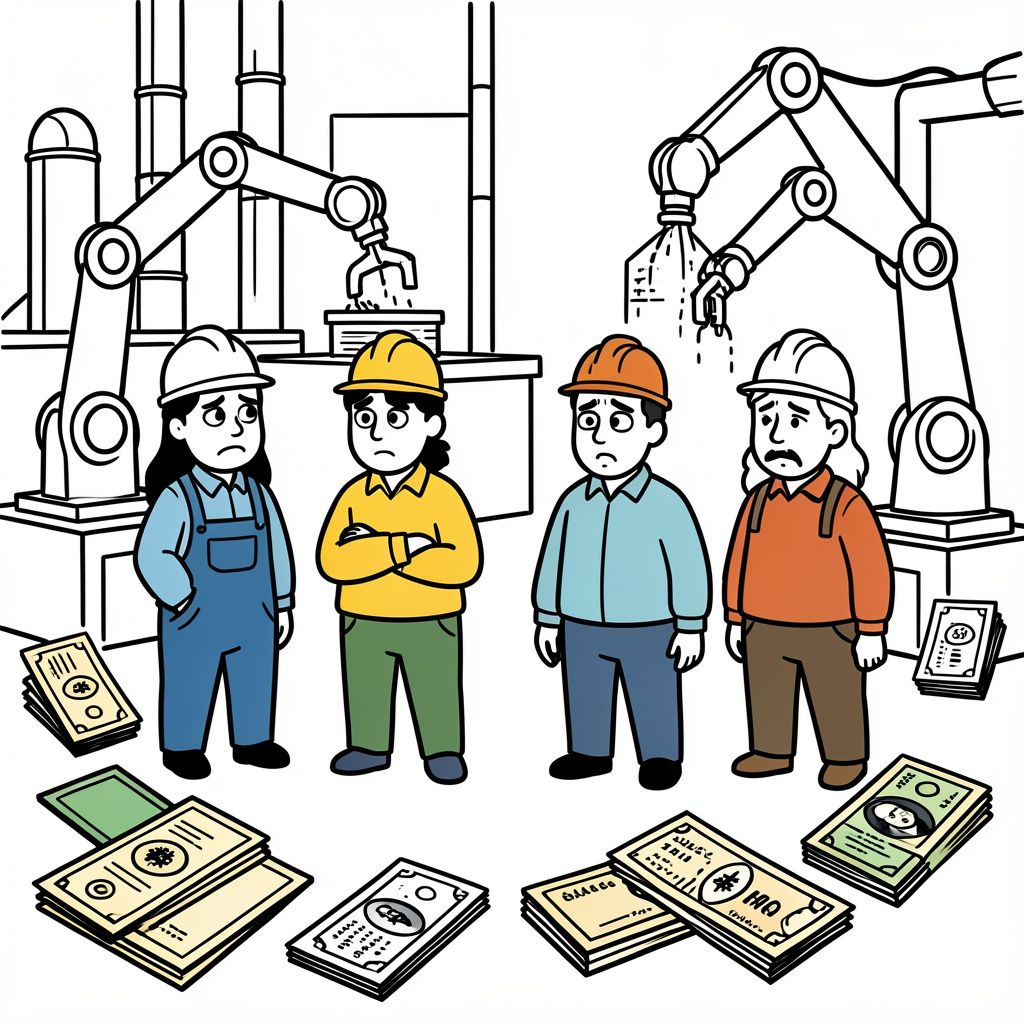
Goldman Sachs warns up to 15 million workers face automation displacement, with history showing firms aggressively execute technological layoffs only when an economic recession forces cost-cutting.
The AI Employment Displacement Forecast
Goldman Sachs economists now project that artificial intelligence could displace up to 9% of the U.S. workforce over the coming decade, equivalent to approximately 15 million workers[1][4]. This represents a significant escalation from the bank’s earlier 2025 estimate of 6-7% displacement, with the new figure incorporating updated productivity assumptions and accelerated adoption timelines[1][4]. The forecast aligns with a broader productivity boost of 15% expected in developed economies as AI tools permeate business operations[1][2][4]. While the projections suggest gradual implementation rather than an abrupt shock, history demonstrates that economic downturns dramatically accelerate such workforce transformations. As Goldman Sachs chief economist Jan Hatzius noted in his October 15, 2026 report: ‘AI labor disruption will gradually increase rather than delivering an abrupt labor market shock’[1].
Recession as the Catalyst for Automation
The Goldman Sachs analysis reveals a critical pattern: automation layoffs historically intensify during recessions, with the bank’s economists pointing to economic contractions in 1982, 2001, 2008, and 2020 as periods when AI-driven job displacement accelerated[4]. The current 9% projection assumes a baseline economic scenario, but the report explicitly warns that ‘a cyclical slowdown would likely accelerate AI-related automation and job losses, thereby amplifying the broader business cycle’[1]. This cyclical relationship creates a dangerous feedback loop where economic weakness triggers cost-cutting measures, which then deepen the recession through reduced consumer spending. The historical data shows that during healthy economic periods, only 23% of U.S. establishments have integrated AI into their regular workflows[4][5], but this figure jumps dramatically during economic contractions as firms scramble to maintain margins.
Immediate Labor Market Signals
The early indicators of this AI-driven displacement are already visible in the 2026 labor market. In September 2026 alone, artificial intelligence accounted for 21% of all announced job cuts in the United States, making it the leading cause of layoffs[1]. The technology sector bore the brunt of these cuts, with 29% of all September layoffs occurring in tech companies[1]. Challenger, Gray & Christmas data reveals that AI-related job cuts have been climbing steadily, representing 21% of total layoffs despite overall layoff announcements declining[1]. This suggests that companies are increasingly using economic uncertainty as justification for structural workforce reductions rather than cyclical adjustments. The concentration of AI-related layoffs in the tech sector reflects both its early adoption of AI tools and its sensitivity to economic downturns, as major tech firms have begun implementing cost-cutting measures that include significant AI integration[1][2].
The Corporate Response: Efficiency Over Expansion
Goldman Sachs’ research indicates that corporations are increasingly viewing AI adoption as a strategic imperative rather than an optional enhancement during economic downturns. The bank’s analysis shows that firms are prioritizing immediate operational efficiencies over cyclical rehiring, fundamentally altering long-term employment dynamics[1][2]. This shift represents a departure from traditional economic cycles where recessions led to temporary layoffs followed by rehiring during recovery periods. Instead, companies are implementing AI solutions that permanently reduce their labor requirements, creating structural unemployment that persists even after economic recovery. As Jan Hatzius explained: ‘Corporate cost-cutting strategies during market contractions will increasingly lean on AI integration rather than cyclical rehiring’[1]. This trend is particularly pronounced in industries with high white-collar employment, where AI tools can automate significant portions of administrative and analytical tasks.
Small Businesses Caught Between Opportunity and Disruption
While large corporations accelerate AI adoption to cut costs, small businesses face a more complex challenge of balancing growth opportunities with competitive pressures. Goldman Sachs’ October 2026 survey of 2,400 small business program graduates revealed that 86% are now using AI tools, up from 56% in 2024[2][5]. However, only 15% have fully integrated AI into their core operations, with over 75% requesting additional training to effectively leverage these technologies[2][5]. The bank’s new Small Business AI Institute, launched with a $500 million commitment, represents an attempt to bridge this capability gap[2][5]. The initiative partners with Google, Meta, OpenAI, and Anthropic to provide training and tools specifically designed for small business needs. As Goldman Sachs CEO David Solomon stated: ‘Every major technology shift has rewarded the businesses that adapt most quickly’[2][5]. This dual-track approach—large corporations cutting jobs while small businesses scramble to adopt AI—creates a bifurcated labor market where different segments of the economy experience AI’s impact in fundamentally different ways.
Investor Caution and Market Reassessment
The accelerating AI workforce transformation is occurring against a backdrop of growing investor caution regarding AI exposure. Goldman Sachs’ Rich Privorotsky noted on October 22, 2026 that investors are rapidly reducing their concentrated AI positions due to rising capital costs and power delivery constraints[3]. The previous long-AI, short-everything-else trade that dominated summer 2026 has begun unwinding, with Privorotsky describing recent weeks as ‘particularly painful for those types of consensual trades’[3]. The market’s reassessment reflects growing concerns about the sustainability of AI capital expenditures, with estimates suggesting $1.1 trillion in expected spending for next year[3]. Power constraints represent another critical bottleneck, with Privorotsky warning that ‘if you can’t get the power to actually energize a data center, will you actually be able to consume the chips you’ve already forward ordered?’[3]. This investor pullback creates additional economic headwinds that could further depress employment in AI-dependent sectors.