New York to Pioneer World’s First Carbon-Negative Food System
New York, Thursday, 18 June 2026.
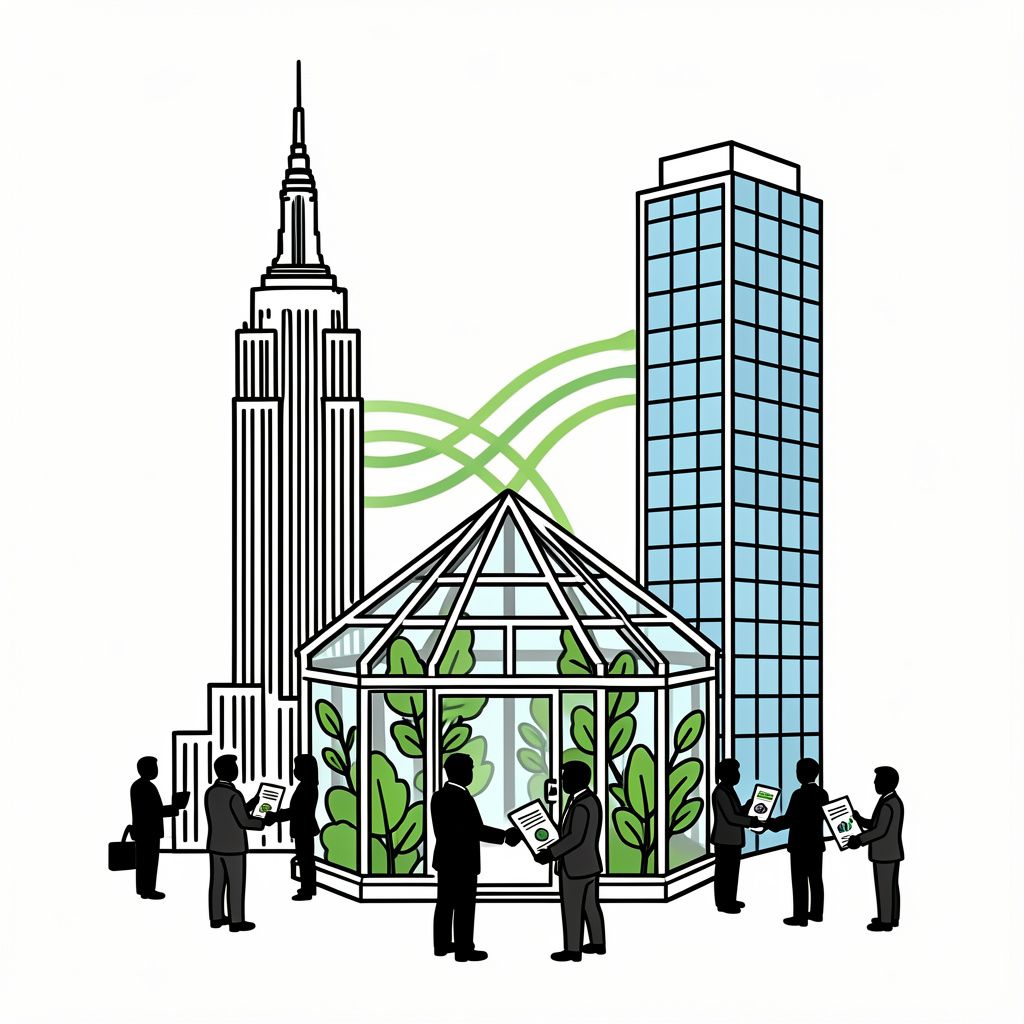
Empire State Greenhouses and Global Green are teaming up to build the first carbon-negative food infrastructure in New York, capturing and reusing emissions to create a self-sustaining food production system. This groundbreaking project could slash agriculture’s energy costs while producing fresh, local food—all with a negative carbon footprint. The partnership aims to set a new global standard for sustainable urban farming.
A New Model for Sustainable Agriculture
Empire State Greenhouses (ESG) and Global Green have announced a strategic alliance to develop the world’s first carbon-negative circular food infrastructure facility in New York, marking a significant milestone in sustainable agriculture [1]. This partnership introduces a groundbreaking model that integrates controlled environment agriculture (CEA) with renewable energy and waste recovery systems, creating a closed-loop ecosystem designed to eliminate one of agriculture’s largest operating costs—energy [1]. The facility will combine food production, renewable energy generation, waste recovery, cold-chain logistics, and local distribution into a single operating platform, setting a new standard for urban farming [1].
Addressing Food Security and Climate Goals
The project aims to tackle multiple challenges simultaneously: food security, decarbonization, water conservation, food affordability, and economic development in underserved communities [1]. By producing fresh organic food closer to consumers, the initiative seeks to reduce transportation emissions while improving access to nutritious food [1]. The circular Food-Energy-Waste platform is designed to create a carbon-negative footprint, potentially transforming how urban areas approach food production and sustainability [1]. Louis Ferro, President and Chairman of Empire State Greenhouses, emphasized the economic benefits: “By integrating food, energy and waste into one circular platform, we eliminate one of agriculture’s largest operating costs—energy. The result is stronger economics, a carbon-negative footprint and fresh, local food that benefits both investors and communities” [1].
Scaling the Solution Nationwide
ESG plans to build a national network of these circular Food-Energy-Waste facilities, with the New York project serving as the inaugural model [1]. This expansion strategy aligns with growing concerns about warehouse expansion in regions like California’s Inland Empire, where 55 million square feet of warehouses have been added since 2023, raising environmental justice concerns [2]. The Inland Empire’s rapid warehouse growth has become a focal point for environmental advocates, who argue that communities should not bear the burden of pollution while others benefit from economic growth [2]. William Bridge, CEO of Global Green, highlighted the broader implications: “Together with Empire State Greenhouses, we are demonstrating how circular infrastructure can reduce emissions, strengthen food security, create jobs and build more resilient local economies” [1].
The Technology Behind Carbon-Negative Food Production
The carbon-negative aspect of the project relies on several innovative technologies. The facility will capture carbon emissions from agricultural processes and either sequester them or convert them into usable products, effectively removing more carbon from the atmosphere than it produces [1]. This approach contrasts sharply with traditional agriculture, which is responsible for approximately 10% of U.S. greenhouse gas emissions [GPT]. The integration of renewable energy sources, such as solar or wind power, will further reduce the facility’s carbon footprint while providing a stable energy supply [1]. Waste recovery systems will convert organic waste into energy or compost, closing the loop on the circular economy model [1]. These technologies collectively aim to create a self-sustaining food production system that could redefine urban agriculture.
Economic and Environmental Implications
The economic implications of this project extend beyond reduced energy costs. By localizing food production, the initiative could decrease reliance on long-distance food transportation, which accounts for a significant portion of the food industry’s carbon emissions [GPT]. The U.S. food system is estimated to contribute between 25% to 33% of the country’s total greenhouse gas emissions when accounting for production, transportation, and waste [GPT]. The New York facility’s model could potentially reduce these emissions while creating local jobs and stimulating economic growth in the region [1]. Environmental justice advocates have welcomed the project, noting its potential to address both climate change and food insecurity without imposing environmental burdens on vulnerable communities [2]. The Center for Community Action and Environmental Justice (CCAEJ) has been vocal about the need for such solutions in the Inland Empire, stating: “Environmental justice means our communities should not bear the burden of pollution while others reap the benefits of growth” [2].
Timeline and Future Outlook
The announcement of the partnership was made on June 17, 2026, with construction of the New York facility expected to begin in the coming months [1]. While specific timelines for completion have not been disclosed, industry analysts anticipate that the project could serve as a blueprint for similar initiatives worldwide [1]. The success of this model could accelerate the adoption of carbon-negative food systems, particularly in urban areas where space constraints and environmental concerns pose significant challenges to traditional agriculture [GPT]. As the project progresses, it will be closely watched by policymakers, environmental groups, and the agriculture industry for its potential to reconcile economic growth with sustainability goals [1][2].