How High Interest Rates Are Unintentionally Driving Up Housing Rents
Washington, Monday, 5 October 2026.
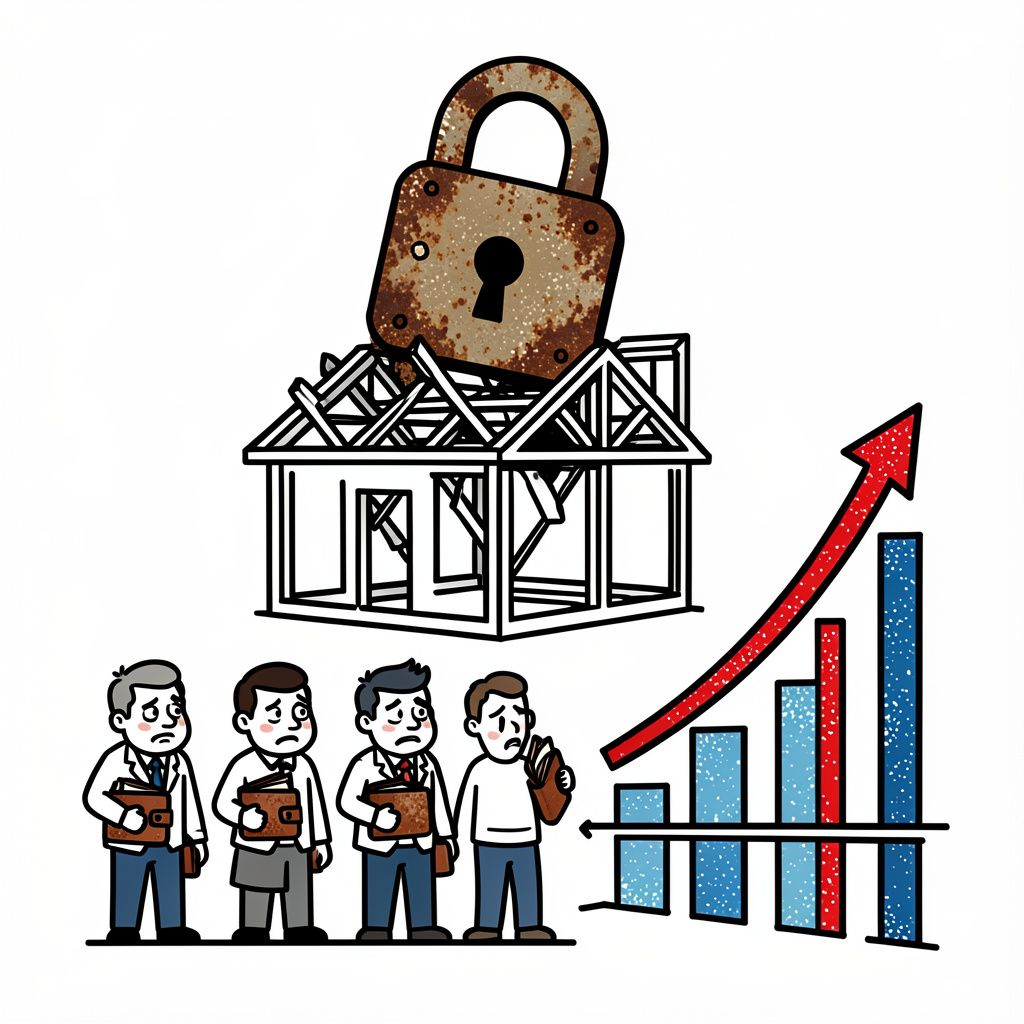
Elevated Federal Reserve interest rates are suppressing new home construction, creating housing shortages that push rental prices higher and paradoxically fuel the very inflation central bankers aim to control.
The Inflationary Feedback Loop
The Federal Reserve’s aggressive stance on interest rates is creating a paradoxical economic environment where measures intended to curb inflation are inadvertently sustaining it through the housing sector. Economists warn that sustained high interest rates suppress new residential construction, leading to supply shortages that drive rental prices higher. Torsten Slok, chief economist at Apollo Global Management, describes this phenomenon as the ‘higher rates, higher rent doom loop,’ where reduced building activity limits supply and pushes rents up, thereby keeping overall inflation elevated [1]. This dynamic presents a significant policy dilemma, as owners’ equivalent rent constitutes approximately one-quarter of the Consumer Price Index basket, meaning rental inflation directly impacts headline figures [1].
Construction Slowdown and Supply Constraints
Recent data underscores the severity of the construction slowdown contributing to this cycle. August 2026 housing data reveals private housing starts fell to 1,275,000 units, representing a 2.6% decrease from July 2026 and a 1.2% decline from August 2025 [1]. Furthermore, housing completions dropped significantly to 1,128,000 units, marking an 11.9% decrease from July 2026 estimates and a 27.1% decline compared to August 2025 rates [1]. As unit supply shrinks due to these reduced completion rates, rental prices are threatened with persistent increases, complicating the central bank’s goal of returning inflation to its 2% target [1].
Employment Data and Fed Policy Outlook
Labor market conditions are also influencing the Federal Reserve’s next moves, with recent reports suggesting a potential pause in rate hikes. On October 2, 2026, the U.S. Labor Department reported that employers added only 29,000 jobs in September 2026, missing the 90,000 expectation [3][4]. Consequently, the unemployment rate rose to 4.2% from 4.1%, driven primarily by increased workforce entrants rather than layoffs [3][4]. In response to the weakening labor data, interest rate traders estimate a 79.5% probability of a rate hold at the next Federal Open Market Committee meeting scheduled for October 27, 2026 [1][3].
Affordability and Borrowing Power
The impact of rising rates extends sharply to housing affordability, eroding purchasing power for prospective buyers. Mortgage rates climbed from 6.66% in early September 2026 to 7.28% by the week of October 2, 2026, correlating with the 10-year Treasury hitting a 24-year high [4]. This shift has tangible consequences for borrowers; a $400,000 loan payment increased by $166 per month, rising from $2,571 to $2,737 since early September 2026 [4]. Calculations based on provided data indicate that purchasing power for the same monthly payment dropped by approximately -11.5 percent, reducing capacity from $400,000 to $354,000 [4].
Political and Fiscal Pressures
The economic headwinds are creating political challenges for the administration, with mortgage rates exceeding 7% and headline inflation remaining at 3.4% as of October 4, 2026 [6]. Treasury Secretary Scott Bessent acknowledged the difficulty, stating the administration would avoid telling the public ‘how good they had it’ despite strong aggregate numbers [6]. Simultaneously, the U.S. national debt exceeds $40 trillion, resulting in an annual interest servicing cost of approximately $1 trillion, which limits fiscal flexibility [5]. Long-term Treasury yields are currently near two-decade highs, driven by persistent deficits and sticky inflation, raising concerns about the government’s comfort level with current rate environments [5].
Future Economic Trajectory
Looking ahead, analysts suggest the economy may be entering a period of subdued activity characterized by low hiring and low firing. Market conditions are currently defined by a 7.28% interest rate environment, which has significantly reduced buyer pools compared to periods when rates were near 6% [4]. While some economists argue underlying fundamentals still point towards higher rates if inflation remains stuck above 2.5%, others suggest policymakers might wait until December before considering another rate increase [1][3]. The resolution of this tension between controlling inflation and maintaining economic stability will define the financial landscape heading into 2027 [4].
Sources
- fortune.com
- www.facebook.com
- finance-commerce.com
- danielkaufmanre.substack.com
- money.usnews.com
- fortune.com