President Trump Plans to Declare Strategic Middle East Waterway a U.S. Territory
New York, Saturday, 15 August 2026.
President Donald Trump announced plans to claim the Strait of Hormuz as U.S. territory, raising significant global geopolitical and economic uncertainty across energy markets for the vital oil route.
A Campaign of Geopolitical Assertions on Long Island
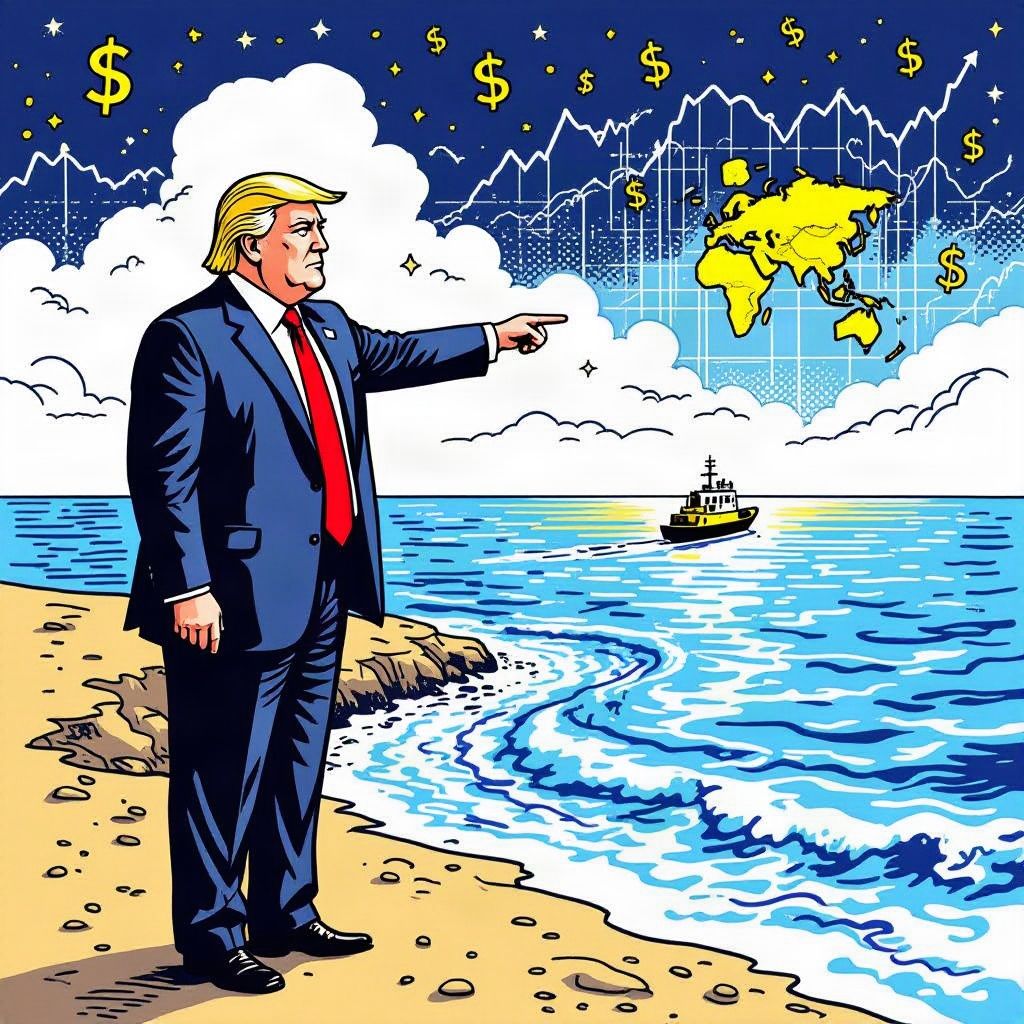
During a visit to the David S. Mack Center for Training and Intelligence in Garden City, Long Island, on Friday, August 14, 2026, President Donald Trump delivered a wide-ranging speech alongside Bruce Blakeman, the New York Republican gubernatorial nominee [5]. In his remarks, which primarily focused on his administration’s domestic anti-crime efforts, Trump declared his intent to designate the Strait of Hormuz as a United States territory once the ongoing conflict with Iran concludes [1][4][5]. “After we finish defeating Iran, which is being very badly defeated — pretty soon, I’ll be declaring the Hormuz Strait a territory of the United States,” Trump announced, pointing to active U.S. naval blockades as a demonstration of current American control over the waterway [5].
Intent and Legal Realities of the Waterway
This declaration represents a future campaign and war-time intent rather than an actively implemented official policy, yet it has already introduced significant geopolitical friction [1][4]. The Strait of Hormuz is governed under international maritime law, with its physical jurisdiction shared between the nations of Oman and Iran [1]. By asserting that the United States will unilaterally claim sovereignty over the strategic bottleneck, Trump’s Republican administration is directly challenging established global maritime frameworks [1]. The administration has already deployed a U.S. naval blockade in the strait twice over the last six months of the war, asserting what Trump describes as a “wall of steel” to control regional oil exports [1][3].
Energy Markets and the Economics of the Blockade
The Strait of Hormuz serves as a vital global trade artery, carrying roughly 20 percent of the world’s petroleum and natural gas supplies [1]. The ongoing war between the United States and Iran, which erupted on February 28, 2026, has severely disrupted these shipping lanes, causing energy prices to spike globally [1][2]. Vice President JD Vance recently emphasized that the administration’s primary objective in this conflict is economic, stating that keeping domestic oil and gasoline prices low for Americans is “goal No. 1,” even ranking above preventing Tehran from acquiring a nuclear weapon [3][5].
Declining Maritime Traffic and Economic Isolation
Despite the administration’s focus on stabilizing energy costs, physical transit through the strait has deteriorated. Data from Kpler reveals that on August 11, 2026, daily traffic through the waterway dropped to just 8 vessels, marking the lowest daily count since August 5 and representing a decrease of -33.333 percent from the 10-day average of approximately 12 ships [3]. To tighten pressure on Tehran, U.S. Treasury Secretary Scott Bessent announced plans to implement unprecedented “economic isolation” measures, alongside a physical blockade of Iranian ports in the strait, with specific actions expected to roll out next week between August 17 and August 23, 2026 [3].
Tehran Rejects U.S. Sovereignty Claims
Iranian military and political officials have swiftly rejected Trump’s assertions of U.S. dominance over the strait [3]. On August 13, 2026, Ebrahim Zolfaghari, a spokesperson for Iran’s central military command, Khatam-al Anbiya, insisted that the waterway remains under the “complete management and control” of the Islamic Republic, warning that no commercial vessels or tankers may pass without the permission and supervision of Iranian armed forces [3]. Additionally, the Persian Gulf Strait Authority—established by Iran on February 28, 2026, to manage transit and collect tolls—reiterated on the social platform X that the strait remains blocked and will not reopen until the United States accepts Iran’s specific conditions [3].
The Collapse of Diplomacy and Rising Escalation
This rhetorical escalation follows a series of failed diplomatic efforts earlier this year. A ceasefire enacted in April 2026 was briefly extended via an interim agreement in June to restore freedom of navigation, but the pact collapsed in mid-July 2026 when Iran resumed maritime attacks, prompting U.S. airstrikes on southern Iranian provinces [2]. Iranian Foreign Minister Abbas Araghchi dismissed the U.S. territorial claims as a major intelligence failure, describing the policy as “an even bigger miscalculation” [3]. Meanwhile, Mohammad Mokhber, an adviser to Iran’s Supreme Leader, warned of a new “definitive strategy” to transition the conflict into an offensive war, signaling that Tehran is prepared to permanently alter global power dynamics if its demands are ignored [3].