Decoding the May 2026 Economy: Record Output Clashes With Shrinking Household Savings
Washington, D.C., Sunday, 31 May 2026.
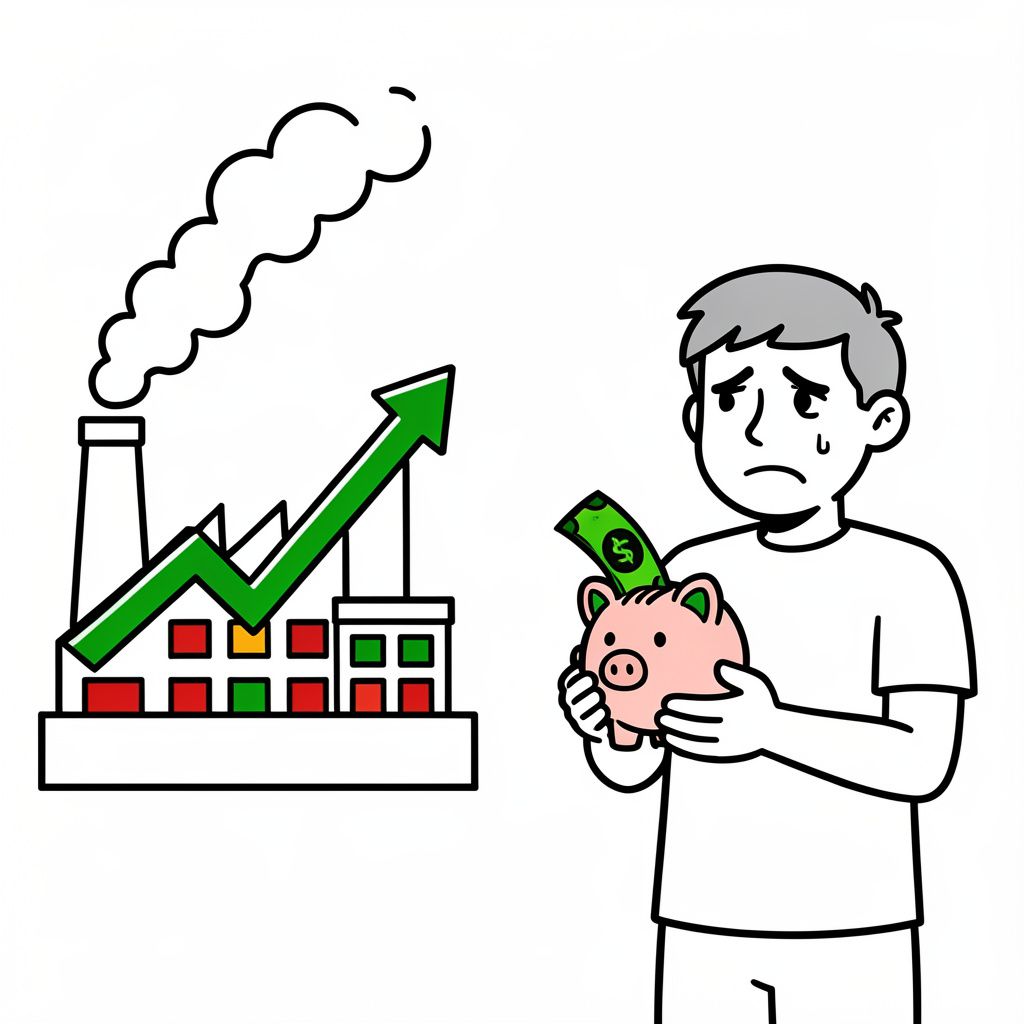
Despite record U.S. output in May 2026, the personal savings rate has plummeted to 2.6%, revealing the hidden financial strain inflation continues to place on everyday households.
The Macroeconomic Paradox: High Output vs. High Costs
The United States economy in May 2026 presents a perplexing dichotomy for analysts and policymakers alike. On a macroeconomic level, the nation is exhibiting robust output. Data for the first quarter of 2026 revealed that real gross domestic product (GDP) per capita climbed to $70,502, an increase from $68,979 in the same period of 2025 [1]. This represents a growth rate of 2.208 percent year-over-year. The Trump administration has actively promoted this growth, pointing to a record-setting 2025 where the S&P 500 hit 39 record highs, alongside claims of attracting over $2.7 trillion in artificial intelligence and technology investments [2]. Furthermore, the labor market remains relatively stable, with the unemployment rate sitting at 4.3 percent in April 2026 and total nonfarm payrolls reaching 158.736 million [1].
The Savings Squeeze and Structural Deficits
The most alarming indicator of household financial strain emerged on May 29, 2026, when the Bureau of Economic Analysis (BEA) released its Personal Income and Outlays report [3]. The data showed the U.S. personal savings rate plunging to 2.6 percent in April 2026, down from 3.2 percent the previous month [3]. This marks a cumulative 1.7 percentage point decline over a three-month period, dragging the savings rate to its lowest point since June 2022, and its second-lowest since April 2008 [3]. The underlying mathematics reveal a widening structural deficit in household budgets: core retail consumer spending increased by 5.7 percent year-over-year in April, while personal income grew by a mere 2.5 percent [3].
Collapsing Consumer Sentiment and Political Fallout
The psychological toll of these financial dynamics is evident in consumer sentiment metrics. In May 2026, the University of Michigan consumer sentiment index collapsed to a record low of 44.8 [1]. Within that survey, 57 percent of respondents explicitly stated that high prices had eroded their personal finances, while expectations for year-ahead inflation rose to 4.8 percent [1]. Economists note that many Americans are evaluating the current economic landscape through the lens of past economic trauma, often referred to as “the scar,” which prevents positive macroeconomic data from translating into public confidence [1].
A Bifurcated Economic Strategy
The administration’s broader economic strategy appears heavily weighted toward corporate and technological dominance rather than immediate consumer relief. The White House continues to champion initiatives like the GENIUS Act, which established a regulatory framework for stablecoins, and the creation of a Strategic Bitcoin Reserve to manage seized cryptocurrency assets [2]. Additionally, the administration touts high-profile corporate maneuvers, such as the U.S. government acquiring a 10 percent stake in Intel, and plans to relocate the U.S. Space Command to Huntsville, Alabama, promising 30,000 jobs [2]. Meanwhile, unconventional priorities, such as Treasury appointees pushing for a new $250 bill featuring President Trump’s face and plans to host a UFC fight at the White House in June 2026, highlight a stark disconnect from the immediate austerity facing average households [4].