Milan Deploys Troops as Luxury Retailers Board Up Windows
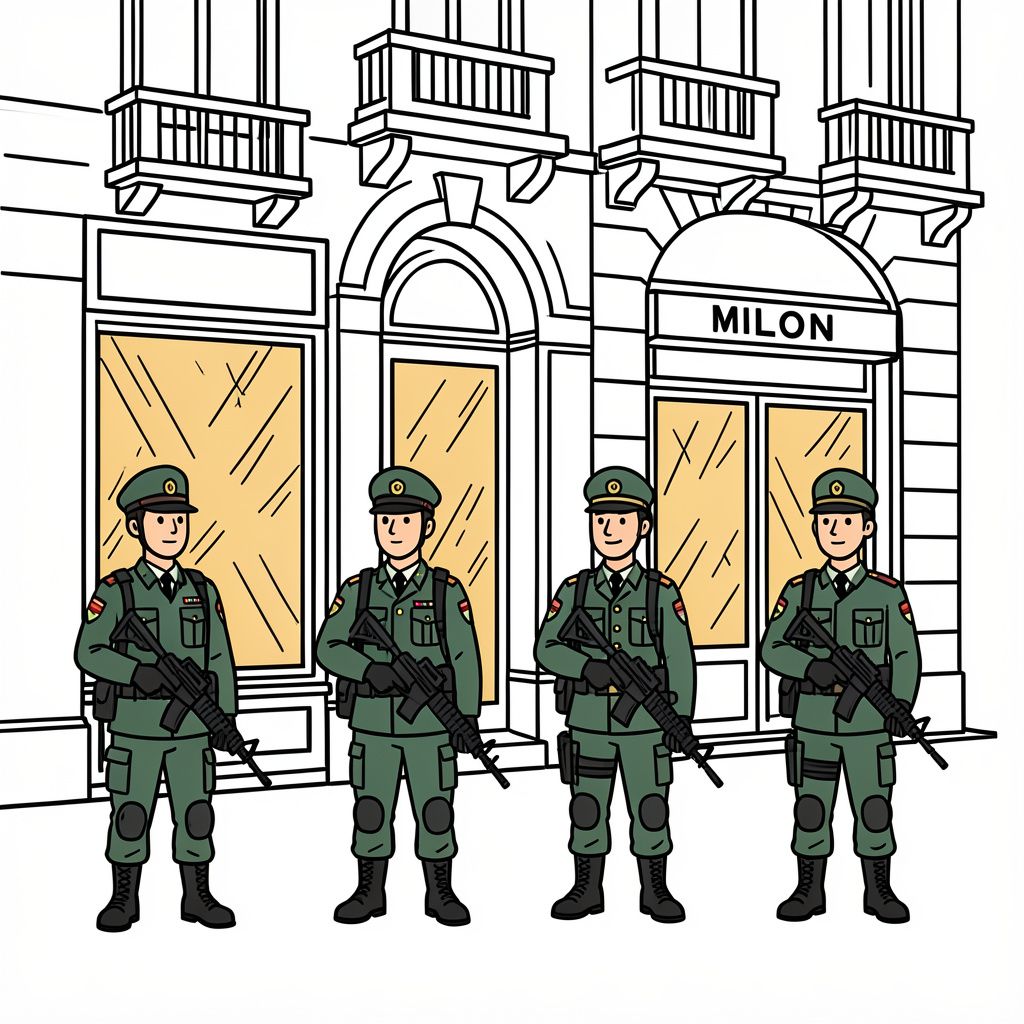
Milan, Sunday, 25 October 2026.
Elite soldiers secured Milan on Saturday after youth unrest forced luxury boutiques to barricade storefronts, as authorities investigated a freelance journalist for allegedly coordinating mass cost-of-living demonstrations.
Military Mobilization in Milan
On Saturday, 24 October 2026, Premier Giorgia Meloni deployed an additional 500 elite Italian Army soldiers to Milan, supplementing hundreds already stationed in the city and supporting approximately 5,000 police and security personnel [1]. The deployment followed a wave of civil unrest that had already prompted high-end luxury retailers, including Versace, Omega, Tiffany, and Gucci, to board up their storefronts in anticipation of further demonstrations [1]. Milan’s Mayor Giuseppe Sala expressed concern about a repeat of the violence that had characterized the previous weekend’s protests, stating support for the increased military presence [1]. Security measures included drone surveillance, railway station checks, and rapid-response units, with authorities fearing demonstrators might disperse into less heavily guarded neighborhoods [3].
Escalation of Unrest and Retail Precautions
The decision to deploy troops came after violent protests and looting on 17–18 October 2026 in central Milan, particularly around Piazza del Duomo and Via Torino, left dozens of stores damaged and led to the arrest of 45 individuals, including 34 minors [4]. In response, nearly all major luxury and retail brands—from Moncler and Max Mara to Zara and Esselunga—installed plywood panels over windows and entrances or hired private security firms such as Mondialpol to protect assets [4]. Rinascente in Piazza del Duomo closed its doors and pulled down shutters shortly after 15:00 on Saturday, underscoring the severity of commercial disruption in one of Europe’s most vital fashion and financial districts [4].
Organized Protests and Government Response
Thousands of young protesters marched through Milan on Saturday, participating in both anti-cost-of-living and pro-Palestine demonstrations that converged at Corso Venezia before reaching Piazza Leonardo da Vinci [4]. The protests were coordinated in part by the newly formed “October 17 Movement,” a grassroots coalition that had previously organized via encrypted chat groups and social media, with organizers announcing protest sites just hours before they began [1][alert! ‘organizers used real-time social announcements, leading to spontaneous convergence points’]. Authorities also reported that a 30-year-old freelance journalist, linked to the movement’s Instagram page, was being investigated as the alleged mastermind behind the unrest, with police conducting over 150 searches across Milan, Monza, Como, and 20 other cities [1][4]. Minister of Defense Guido Crosetto commented that the mastermind was not a marginalized figure but was connected to intellectual circles, hinting at broader ideological undercurrents [4].
Broader European Context and Underlying Tensions
While international attention had focused on protests in France, demonstrations also spread across multiple European cities on Saturday, including Rome, Turin, Madrid, Lisbon, and Tirana, where 2,500 police officers patrolled with water cannons deployed [1]. Milan’s welfare councilor, Lamberto Bertolé, attributed the unrest to a growing sense of exclusion and diminished prospects among young people amid persistent social and economic inequalities [1]. National figures such as Interior Minister Matteo Piantedosi affirmed the government’s readiness to confront any manifestation of disorder, while Vice Premier Matteo Salvini emphasized that incitement to crime would not be tolerated under the guise of free expression [4]. Meanwhile, Milan’s police chief reported identifying nearly 2,900 individuals during controls, with 3 arrests, 41 complaints, and 167 people taken to police headquarters, including 56 minors and 43 foreign nationals [4].