United States and China Agree to Lower Tariffs on Billions in Trade Goods
Beijing, Monday, 28 September 2026.
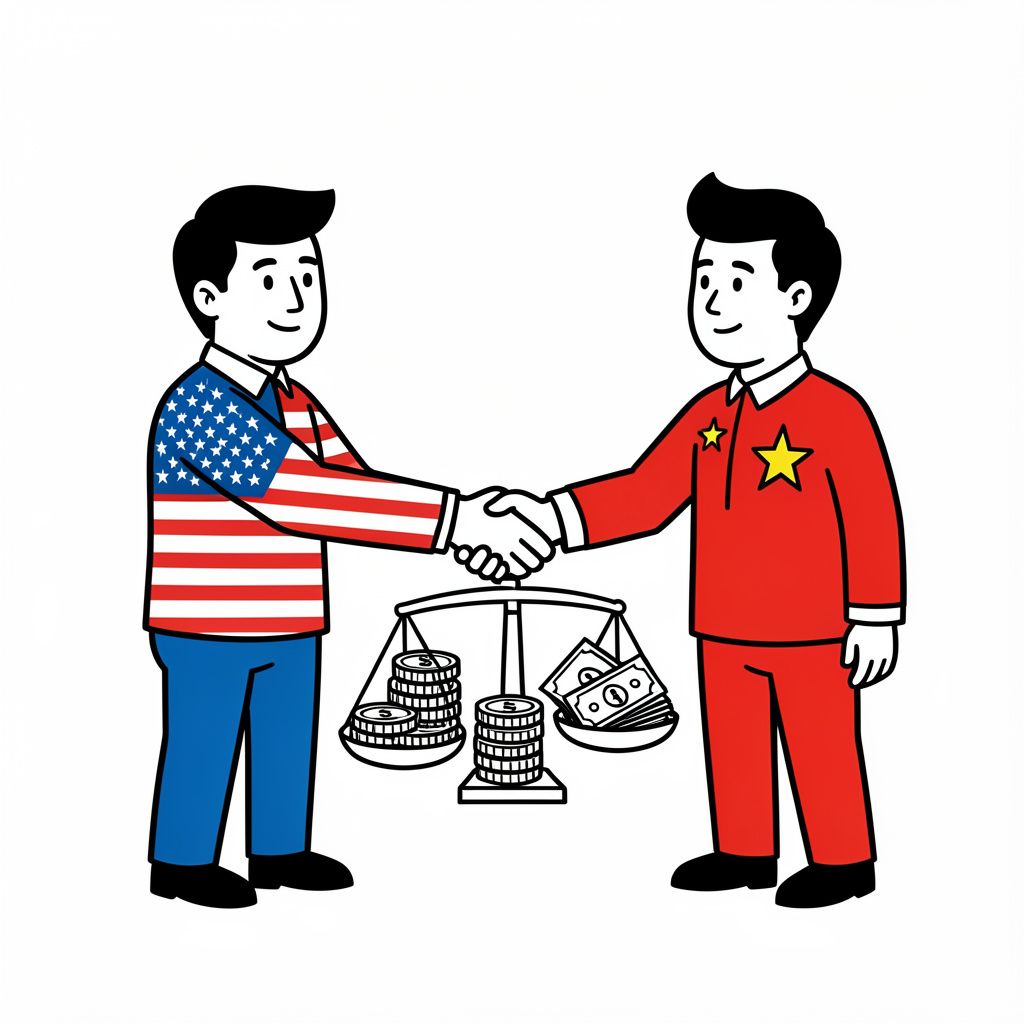
Following high-level talks, the U.S. and China agreed to lower tariffs on $30 billion of non-critical imports each, extending their broader trade truce through January 2027.
Reciprocal Tariff Reductions Announced
Following the conclusion of a three-day summit in Washington, D.C., the United States and China have agreed to reciprocal tariff reductions on $30 billion worth of imports each [1][4]. This development builds upon the previous trade truce extension reported earlier, which maintained essential access to rare earths and semiconductor chips [7]. The bilateral agreement aims to lower tariffs to most-favored-nation rates for 90 percent of the specified products, marking a significant de-escalation in trade tensions that peaked in April 2025 [1][4]. The total volume of trade affected by these mutual concessions amounts to 60 billion dollars, providing relief for international supply chains [1][4].
Product Categories and Market Access
Specific tariff reduction categories include U.S. imports from China such as toys, home appliances, baby products, and holiday gifts [1][4]. Conversely, China will reduce tariffs on U.S. imports including agricultural products, personal care products, medical devices, and coal [1][4]. While the framework facilitates Chinese imports of U.S. coal in 2027 and 2028, the status remains pending confirmation of domestic legal procedures for simultaneous implementation [1][6]. This targeted approach focuses on non-sensitive goods, allowing both nations to manage trade without compromising security interests [3][6].
Institutional Frameworks and AI Dialogue
A new China-U.S. Board of Trade will be established under the bilateral consultation mechanism to manage trade in non-sensitive products [1][3]. Additionally, the nations have agreed to launch a dedicated artificial intelligence dialogue led by Chinese Vice Premier He Lifeng and U.S. Treasury Secretary Scott Bessent [1][5]. The first AI-specific talk is scheduled to convene before November 30, 2026, and will include an AI-related incident communication channel [1][5]. This institutionalizes cooperation on emerging technology risks, despite differing terminologies such as the use of super intelligence [5][6].
Timeline and Strategic Extensions
The Kuala Lumpur trade arrangement has been extended to January 10, 2027, providing a stable window for further negotiations [1][5]. This extension adds 2 months to the previous deadline of November 10, 2026, ensuring continuity in economic relations [5][6]. China’s Ministry of Commerce announced these ten major outcomes on September 28, 2026, following consultations held between September 20 and September 23, 2026 [1][4]. The strategic de-escalation signals a shift towards balanced trade, though some implementation details await final legal reviews [1][6].
Sources
- www.globaltimes.cn
- www.whitehouse.gov
- ustr.gov
- www.foxnews.com
- thehill.com
- www.politico.com
- wsnext.com