Iran's Economic Crisis Deepens as Household Purchasing Power Collapses
Tehran, Monday, 19 October 2026.
Iran’s real per capita income has fallen over 46% since 2011, driven by soaring inflation, international conflict, and severe maritime sanctions that severely erode living standards.
Structural Divergence and Long-Term Stagnation
Iran’s real gross domestic income per capita has experienced a dramatic structural contraction, falling by more than 46% between 2011 and 2025—dropping from a baseline of 100 units down to approximately 54 units [1]. This contraction highlights a stark economic divergence within the region, as neighboring Turkey expanded its real per capita income by 70% to reach 170 units over the exact same period [1]. Long-term economic projections offer little immediate relief; statistical data shows that Iran’s per capita GDP stood at 4,260 U.S. dollars in 2025, with forecasts projecting a further decline of 330 U.S. dollars between 2025 and 2031 as productivity trends downward amid ongoing structural bottlenecks [2].
Escalating Inflation and Currency Depreciation
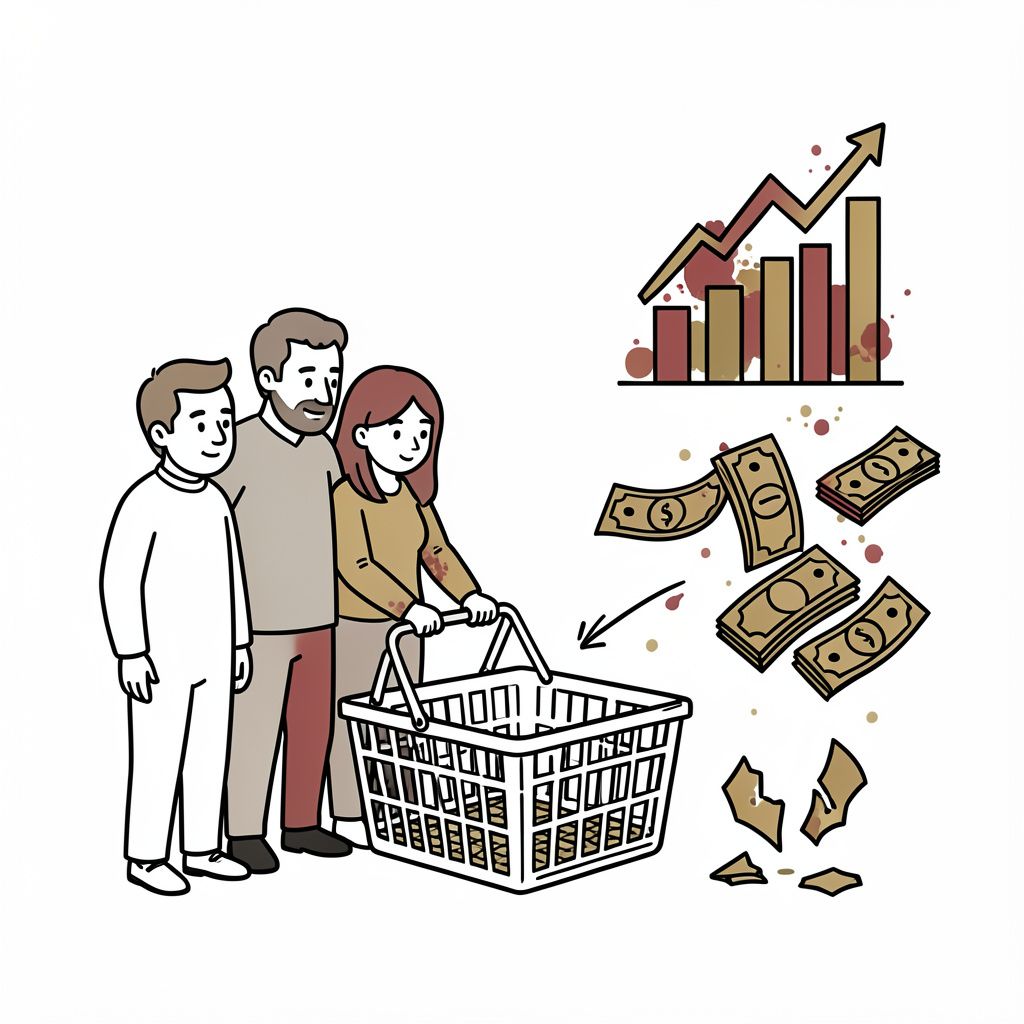
Severe inflationary pressures continue to erode Iranian household purchasing power. As of September 30, 2026, official data from the Statistical Center of Iran indicates an annual inflation rate of 73.6%, a year-on-year inflation rate of 89.8%, and monthly inflation running at 4.2% [4]. Following the escalation of U.S.-Israeli military conflicts on March 28, 2026, food inflation soared to a record high of 122%, driven by price surges in basic staples such as oils and fats, which rose over 340% [3]. Consequently, the cost of a basic food basket for a family of three reached over 16.8 million tomans during the month of Shahrivar (August 23–September 22, 2026) [3]. Foreign exchange markets reflect a similar rapid devaluation: on October 15, 2026, the U.S. dollar traded at approximately 267,500 tomans on the open market—up from roughly 155,000 tomans at the start of 2026, representing a depreciation of 72.581% despite a $2 billion central bank market intervention [4].
Fuel Policy Shifts and Budgetary Controversies
To mitigate fiscal deficits and address domestic supply shortages, Iranian authorities instituted energy pricing reforms. On October 13, 2026, government spokeswoman Fatemeh Mohajerani and President Pezeshkian stated that introducing a higher third-tier gasoline price resulted in a 7% reduction in domestic fuel consumption, allowing officials to claim that Iran no longer needs gasoline imports and saving an estimated $12 billion [1]. However, energy analyst Abdollah Babakhani disputed these fiscal figures, calculating that at an import cost of $0.86 to $0.94 per liter, the government’s claimed savings would only cover 35 to 38 million liters per day—well short of the 134 million liters consumed daily as reported by the National Iranian Oil Refining and Distribution Company on October 12, 2026 [1]. To cushion the impact on domestic consumers, the government announced a 500,000-toman increase in shopping-credit allowances [1].
Monetary Dynamics and Wealth Inequality
Monetary policy metrics reveal minor decelerations alongside persistent macro-inequalities. Central Bank of Iran Governor Abdolnaser Hemmati reported that year-on-year liquidity growth dropped from 56.4% in June 2026 to 54.4% in August, reaching 51.6% by the end of September 2026 [1]. Despite slowing liquidity creation, structural inequality has widened, with Iran’s Gini coefficient rising from roughly 0.37 in the early 2010s to approximately 0.39 in recent years [1]. Real estate distortions remain prominent in urban centers like Tehran, where land costs for one square meter can exceed actual apartment construction costs by over 15 times [1]. Looking ahead to the second half of the year, Farshid Shokrkhodaei of the Iran Chamber of Commerce warned on October 15, 2026, that the economy risks a new wave of inflation and acute shortages of essential imported goods such as medicines, sugar, and livestock feed [4].