Funding the Local Transition: A $71.5 Million Boost for Community Energy
Oakland, Friday, 9 October 2026.
Candide Group has closed its $71.5 million fund for local clean energy, already deploying $35 million to prove that community-led climate projects are commercially viable and financially sound.
Funding the Local Transition: A $71.5 Million Boost for Community Energy
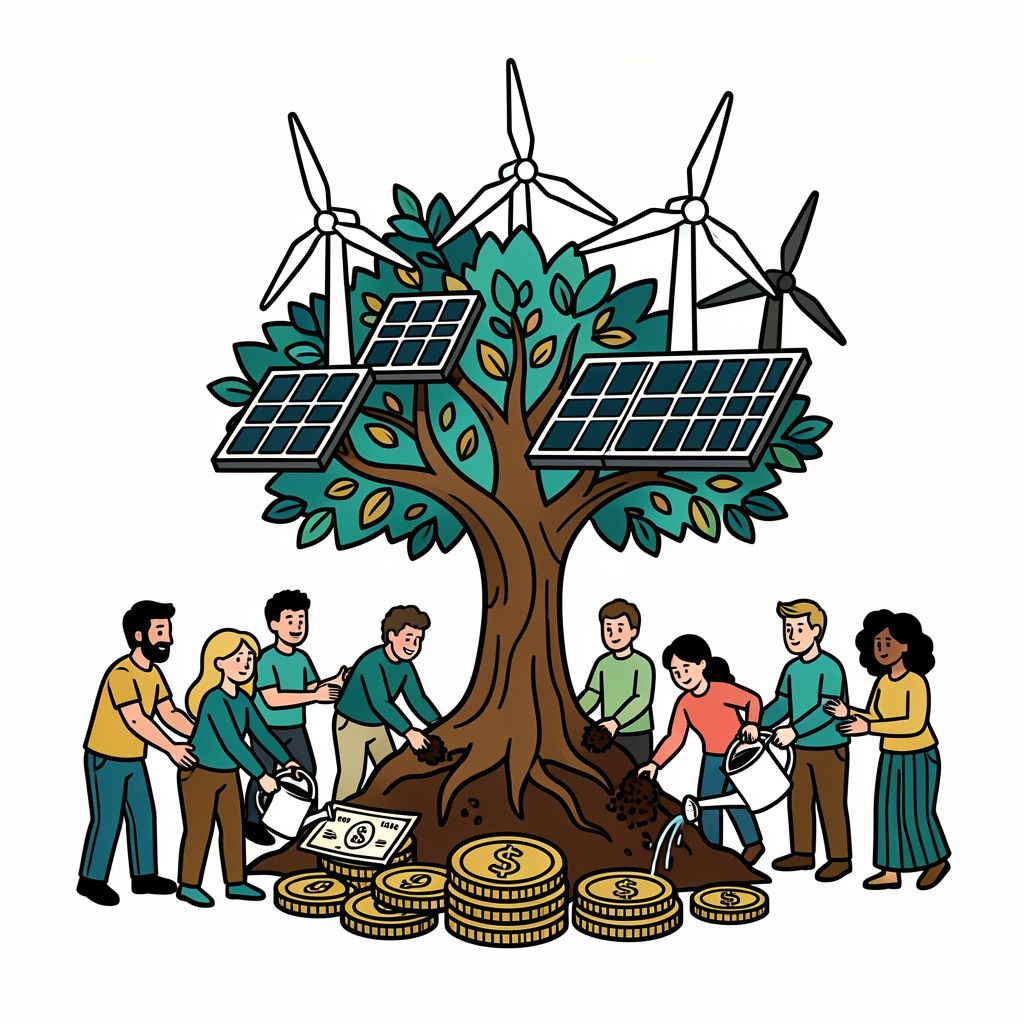
Candide Group has officially closed its Afterglow Climate Justice Fund with $71.5 million in capital, marking a significant step in financing clean energy access within historically disinvested communities [1][2]. The Oakland-based impact investment firm announced the final closing on October 8, 2026, establishing a catalytic debt vehicle designed to bridge financing gaps for developers serving marginalized areas across the United States [1]. By targeting projects that conventional lenders often deem too risky, the fund aims to demonstrate the commercial viability of equitable climate finance while offering a scalable model for inclusive green energy transition investments [1][2]. This closure represents a critical injection of capital into the local energy economy during a period of heightened focus on climate resilience [5].
Capital Structure and Investor Commitment
The fund reached a final close of $71.5 million, achieving 71.5 percent of its initial $100 million target [2][4]. Investors backing the vehicle include prominent mission-based organizations such as the John D. and Catherine T. MacArthur Foundation, which provided subordinated debt, and the Sobrato Family Foundation, leading the senior tranche [2][4]. Additional support comes from Builders Vision, Ceniarth, ImpactAssets, the Grove Action Fund, the McKnight Foundation, the Roy and Patricia Disney Family Foundation, the Schmidt Family Foundation, and Social Finance [2][4]. This capital structure is designed to absorb higher risks associated with emerging developers, thereby enabling projects that might otherwise fail to secure traditional bank financing [2]. The presence of these institutional investors signals growing confidence in the economic determinants of community-led climate solutions [5].
Deployment Status and Project Impact
Since its launch in 2023, the Afterglow Climate Justice Fund has already deployed over $35 million across 12 U.S. borrowers for projects including distributed solar, battery storage, and climate infrastructure [1][2]. This deployment represents 48.951 percent of the total closed capital, indicating a rapid initial uptake among eligible developers [2]. Notable investments include a $3.2 million loan to RE-volv, which helped triple their volume of financed projects over the last three years, and a $2.65 million loan to EnerWealth Solutions for the McDowell Creek Solar Facility in North Carolina [1][2]. The RE-volv financing alone facilitated 1.3 MW of clean energy and nearly $18 million in projected lifetime electricity savings for 30 nonprofits [1]. These projects directly address energy costs for communities, with some initiatives reporting average energy bill reductions of 20 percent in areas like Compton and East Oakland, California [2].
Market Gaps and Future Outlook
Candide Group intends to deploy the remaining $36.5 million of the fund by mid-2027, focusing on proof points that allow developers to eventually graduate to commercial capital sources [2][4]. Management notes that while there is a perception that clean-energy projects in underinvested communities are inherently riskier, their data suggests the issue lies in conventional financing structures rather than project viability [2][3]. Looking ahead, the firm is evaluating the launch of a follow-on fund, anticipating that future iterations may require less credit enhancement as a track record is established [2]. This strategy aligns with broader market movements, such as CalPERS increasing private credit allocations for energy transition opportunities, suggesting a shifting landscape for climate justice investing [4]. The success of this model could influence how policymakers and corporate leaders approach inclusive green energy transition investments in the coming years [1].