AMD Unveils Helios Architecture to Power Yotta-Scale AI Computing
Las Vegas, Tuesday, 6 January 2026.
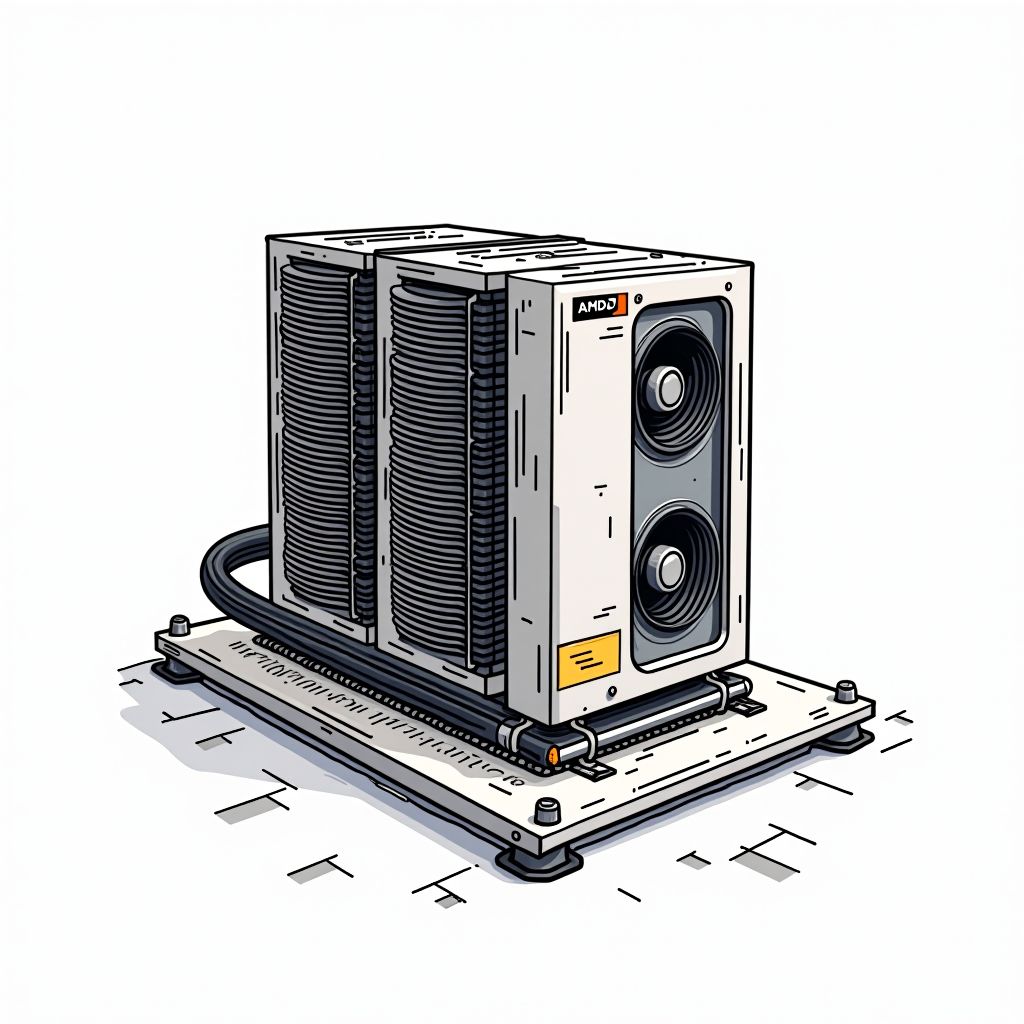
AMD’s Helios platform delivers nearly 3 exaflops per rack, utilizing liquid cooling and next-gen GPUs to establish a scalable blueprint for the approaching yotta-scale AI era.
Architecting the Yotta-Scale Future
At CES 2026, Advanced Micro Devices (NASDAQ: AMD) fundamentally shifted the trajectory of data center infrastructure with the unveiling of its “Helios” rack-scale platform on January 5 [1]. Designed as a comprehensive blueprint for the impending era of yotta-scale artificial intelligence, Helios represents a strategic pivot from component-level competition to integrated system architecture [1]. The platform delivers staggering performance metrics, boasting up to 3 exaflops of AI compute power within a single rack [1]. This announcement follows closely on the heels of AMD’s expansion into consumer and industrial markets; for context on their earlier CES revelations regarding “Zen 5” processors and automotive advancements, readers can review our previous coverage here.
Engineering Density and Connectivity
The Helios architecture integrates 72 AMD Instinct MI450 accelerators alongside the company’s new EPYC “Venice” CPUs, achieving a computational density that necessitates advanced liquid cooling solutions to manage power requirements exceeding 120kW per rack [2]. To facilitate the massive data throughput required for generative AI, the system utilizes the Ultra Accelerator Link (UALink) for GPU-to-GPU communication at speeds of 260 TB/s, while scaling across racks is handled by the Ultra Ethernet Consortium (UEC) standard via Pensando “Vulcano” DPUs [2]. Dr. Lisa Su, AMD’s Chair and CEO, emphasized that this platform is built to serve as the “compute foundation” for the next phase of AI, highlighting deep co-innovation with ecosystem partners [1].
Shattering the Memory Wall with HBM4
Central to the Helios platform’s capabilities is the Instinct MI450 accelerator, which leverages TSMC’s 2nm process technology and the CDNA 5 architecture [2]. A critical differentiator for this generation is the integration of 432GB of HBM4 memory, a specification designed to address the “memory wall” that often bottlenecks large language model performance [2][4]. This massive memory pool allows for greater data locality, optimizing hardware specifically for the high-end generative AI market [2]. Alongside the MI450, AMD also introduced the MI440X GPU for enterprise workloads and provided a forward-looking preview of the MI500 Series, which is slated for a 2027 launch on the CDNA 6 architecture [1].
Strategic Deployments and Market Response
Industry adoption of the new architecture is already underway, with Oracle committing to deploy 50,000 MI450 GPUs within its Oracle Cloud Infrastructure (OCI) starting in the third quarter of 2026 [2][7]. Furthermore, tech giants Meta and OpenAI are partnering with AMD to standardize on the Helios platform, signaling a broader shift toward open, non-proprietary infrastructure standards like the Open Rack Wide (ORW) initiative [2]. This momentum has resonated with financial analysts; TD Cowen recently named AMD a “Best Ideas 2026” pick, raising their price target to $290 as the company challenges Nvidia’s dominance in the data center sector [4][8]. As of January 4, AMD stock was trading between $223 and $226, with the market reacting to what many see as the onset of a “Trillion-Dollar Era” for the semiconductor industry [4].
Sources
- www.globenewswire.com
- markets.financialcontent.com
- www.ainvest.com
- www.financialcontent.com
- www.digitimes.com
- w.media
- www.techpowerup.com
- www.benzinga.com