How Changing Federal Policies Are Driving Up American Energy Bills
New York, Wednesday, 7 October 2026.
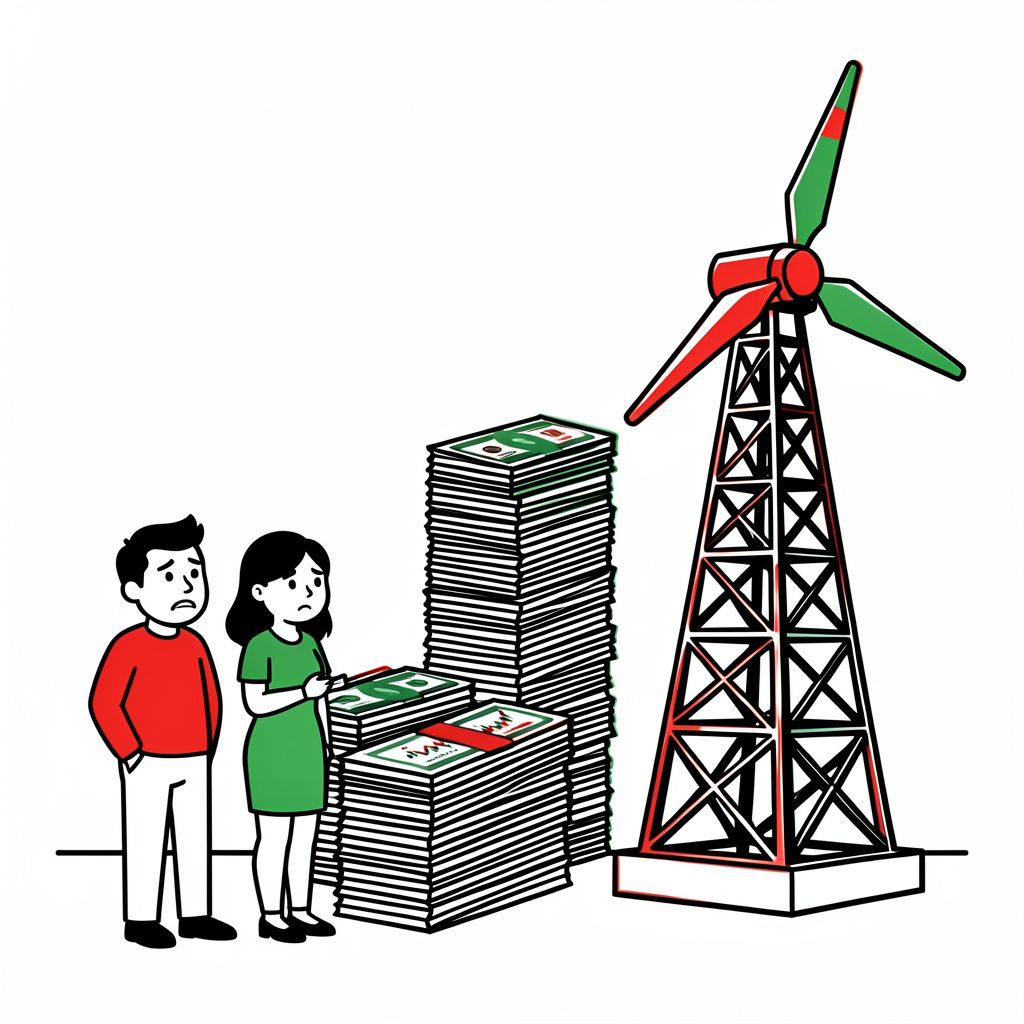
New research shows U.S. households face an extra $6,500 in energy costs through 2040 following federal policy shifts that canceled renewable energy projects and increased reliance on volatile fossil fuels.
Energy Sector Volatility and Stock Performance
Ten months into the administration’s expanded domestic drilling policy, major U.S. oil producers are facing lower valuations [1]. As of October 6, 2026, West Texas Intermediate crude is trading at $56 per barrel, representing a 22% year-to-date decline [1]. The Energy Select Sector SPDR Fund is flat in 2025, marking it as the worst-performing sector in the S&P 500 [1]. Surging domestic oil supply coupled with softer global demand has depressed market prices, prompting energy companies to shut down active rigs [1]. U.S. rig counts have decreased by 70 since early April 2026 [1]. Meanwhile, renewable energy sector indexes have outperformed traditional fossil fuel stocks as institutional investors shift capital [1].
Supply Dynamics and Rig Counts
Bank of America’s Francisco Blanch attributes the oil slump to an OPEC+ decision to increase quotas by 4 million barrels per day over an 18-month period beginning in April 2025 [1]. Cash crude prices are already in the $40s in Colorado and Kansas [1]. If crude weakens toward $50 or equities broadly sell off, the SPDR S&P Oil & Gas Exploration & Production ETF could quickly catch up to crude’s downside [1]. The Invesco Roundhill Clean Energy ETF has risen 67% year-to-date, outperforming oil equities for seven consecutive months [1].
Household Energy Cost Projections
Households in the contiguous United States will pay thousands of dollars more for energy through 2040 because of federal policy changes [2]. Energy Innovation modeling projects that U.S. households will pay an average of $6,500 more for energy cumulatively through 2040 [2]. Five specific states are projected to face higher costs of approximately $9,000 per household [2]. The administration is actively canceling new wind, solar, and hydrogen projects, which the think tank Energy Innovation projects will increase demand for natural gas in electricity generation [2].
Electricity Rate Trends
The U.S. Energy Information Administration projects residential electricity rates to rise from 17.3 cents per kilowatt-hour in 2025 to 18.6 cents in 2027 [5]. This increase represents a calculated rise of 7.514 percent over the two-year period [5]. Independent research firm Rhodium Group reported in April 2025 that the U.S. entered a period of rising electricity prices driven by natural gas volatility [2]. White House spokeswoman Taylor Rogers stated on September 30, 2026, that lowering electricity prices is a priority [5].
Refining Sector Resilience
In Q3 2026, the energy sector gained 16.5%, outperforming the S&P 500 which saw a 2.0% return [7]. Independent oil refiners outperformed other energy segments, with an average return of over 52% for the Big Three [7]. Refining profitability widened due to disruptions in Russian and Middle Eastern refining capacity [7]. By October 4, 2026, analysis indicated that U.S. refining capacity, rather than crude oil availability, has become the primary constraint on supply [7].
Global Stockpile Concerns
Global oil stocks have dropped from 10 billion barrels pre-war to less than 6 billion [6]. Saudi Aramco CEO Amin Nasser stated on October 5, 2026, that global oil stockpiles are scarily thin [6]. The G7 agreed to release up to 100 million barrels over four months to address supply [6]. The IEA forecasts a potential industrial demand destruction risk of 2.5 million barrels per day in 2025 [6].
Policy Implications and Political Response
Governor Maura Healey stated an all-of-the-above approach to energy is needed to lower people’s bills [3]. She emphasized the need for the Trump Administration to work with states on wind, solar, nuclear, or gas solutions [3]. Joe Biden created a grid crisis according to the White House, and President Trump is fixing it [5]. The administration is actively canceling new clean energy projects, which critics argue will raise costs [2].
Long-Term Economic Outlook
Experts indicate that rebuilding inventories will require an additional 2 million barrels per day of demand over the next two years [6]. Energy investing is often discussed as though investors are simply making a bet on the price of oil, but Q3 showed why that view is far too simplistic [7]. The outlook remains complex as policies shift between federal and state levels [2]. Across pretty much every state, the outlook is worse for states and the affordability crisis will be worse because of the combined set of policies [2].