A Costly Gamble: How One Quarterback's 2026 Draft Slide Highlights New Financial Risks in College Athletics
Pittsburgh, Sunday, 26 April 2026.
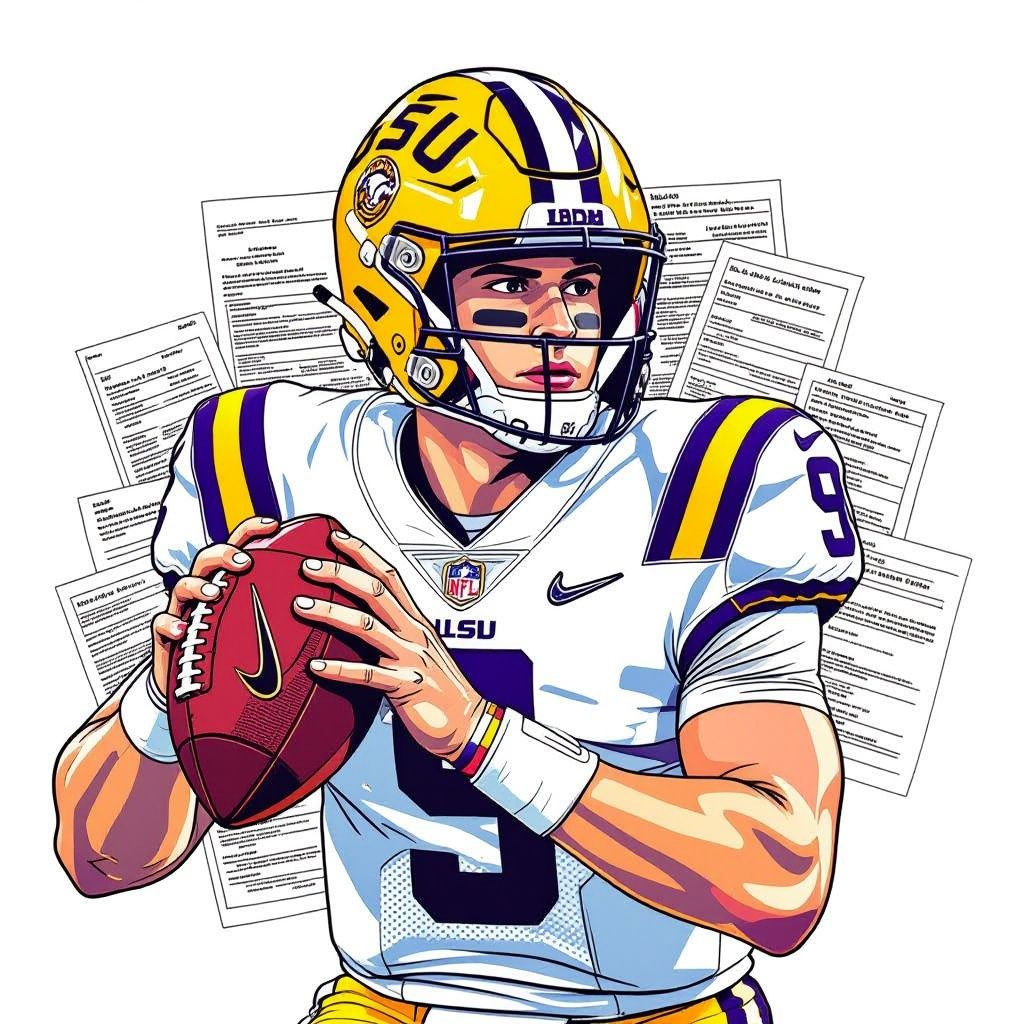
Bypassing guaranteed millions in 2025 for a final college season, LSU’s Garrett Nussmeier plummeted to the 2026 draft’s seventh round, exposing the severe financial risks facing modern student-athletes.
The Economics of Staying Put
The introduction of Name, Image, and Likeness (NIL) alongside revenue-sharing models has fundamentally altered the financial calculus for collegiate athletes [1]. Universities now possess the financial leverage to offer substantial compensation packages, incentivizing top-tier talent to delay their professional careers [1]. A prime example of this paradigm shift is Garrett Nussmeier, who, following a stellar 2024 campaign where he was a Manning Award finalist [3], was widely projected as a potential first-round selection—and even a possible No. 1 overall pick—in the 2025 NFL Draft [1][2][4].
A Season Derailed by Injury
The 2025 season quickly morphed from a victory lap into a medical nightmare. Nussmeier aggravated a knee injury during fall camp and subsequently battled a severe torso injury during his first three starts [4]. A medical evaluation later revealed a spinal cyst pressing against a nerve, which caused significant oblique discomfort [2][4]. Recalling the onset of the injury, Nussmeier noted, “Just routine routes on air. Just felt the stabbing pain in my abdomen. It was just a freak deal” [4]. These compounding physical ailments forced him to miss four games [5], severely limiting his effectiveness when he did take the field.
The Draft Day Freefall
Despite the disastrous senior campaign, some analysts maintained faith in Nussmeier’s foundational traits. During the pre-draft process, he proved his health with solid performances at the Senior Bowl, the NFL Combine, and his Pro Day [1]. Evaluators like Ayrton Ostly still ranked him as the third-best quarterback in the 2026 class [2], and mock drafts projected him to be selected as early as the third or fourth round by quarterback-needy teams like the New York Jets [3][6]. Dane Brugler of The Athletic noted that Nussmeier’s “arm talent and command are foundational traits that generally translate well to the NFL,” projecting him as a high-level backup [3].
Recalculating Risk in the NIL Landscape
Nussmeier’s dramatic fall from a projected No. 1 overall pick to the 249th selection serves as a critical case study for collegiate athletes and their financial advisors [1][2]. While NIL revenue sharing provides immediate, lucrative incentives to remain in school, it cannot insure against the catastrophic loss of future NFL draft capital caused by injury or performance regression [1]. The situation starkly illustrates that returning to college is no longer an automatic financial win-win [1]. For future prospects, weighing the immediate cash flow of an NIL deal against the long-term, guaranteed wealth of an early-round NFL contract will require far more rigorous risk assessment.