Trump Demands Interest Rate Cuts Under Threat of Halting Foreign Trade
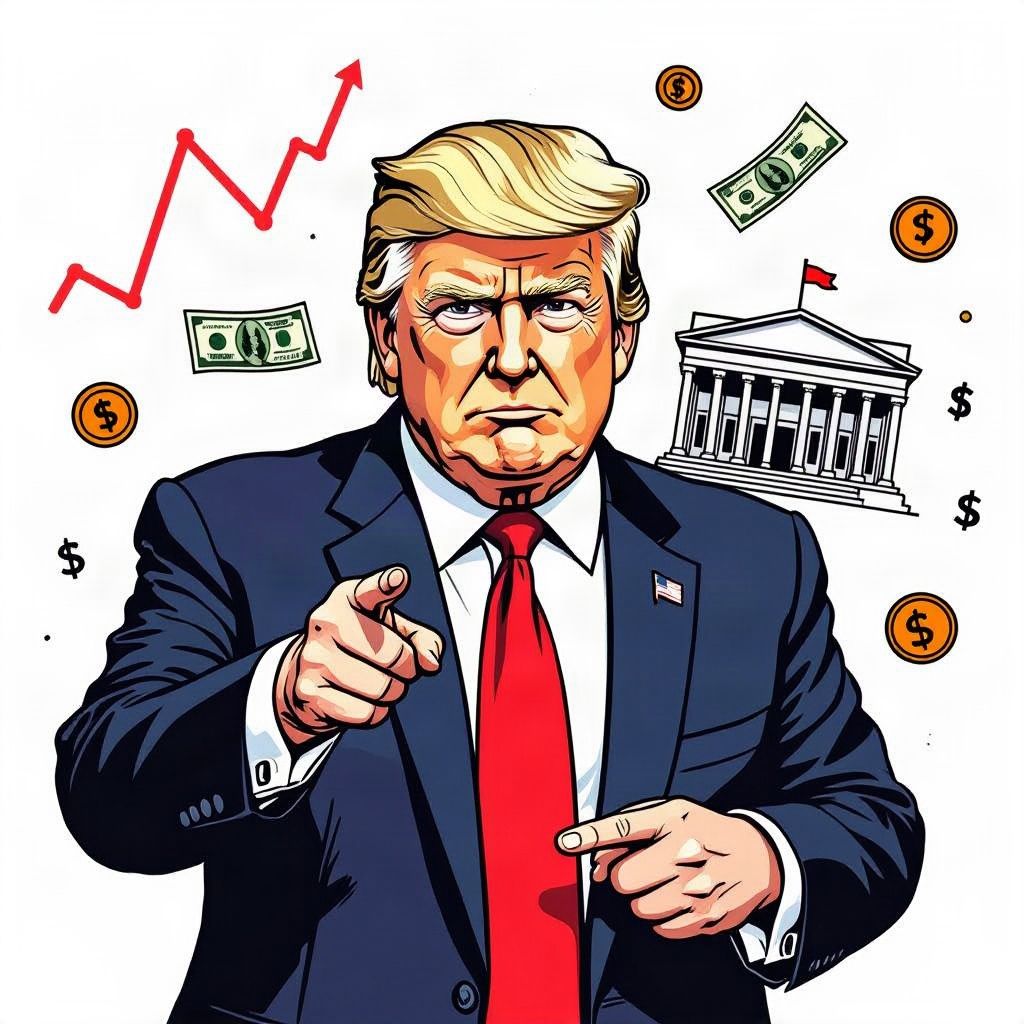
Washington, Friday, 4 September 2026.
President Trump threatened on Friday to halt trade with nations running surpluses against the U.S. if the Federal Reserve does not lower interest rates, despite recent rate hikes.
Trump Issues Trade Ultimatum to Federal Reserve
On Friday, 4 September 2026, President Donald Trump issued a statement demanding that the Federal Reserve immediately slash interest rates, threatening to unilaterally halt trade with nations maintaining trade surpluses with the United States if the central bank fails to comply [1][2]. This ultimatum introduces significant policy uncertainty for international trade and corporate capital expenditure planning, highlighting potential friction between presidential economic rhetoric and the statutory independence of the Federal Reserve [1]. President Trump stated, “LOWER THE RATE OR I’LL STOP TRADING WITH COUNTRIES WITH WHICH WE HAVE A DEFICIT,” citing a recent Supreme Court ruling as potential authority for this action [2]. The threat marks a shift from the relative calm following the appointment of Fed Chair Kevin Warsh, who was sworn in on 22 May 2026 [1][2].
Trump Issues Trade Ultimatum to Federal Reserve
The Federal Open Market Committee sets interest rates based on a congressional mandate for maximum employment and stable prices, independent of trade policy or personal credit score logic [1]. Federal Reserve Chair Kevin Warsh stated in a speech on 27 August 2026 that interest rate hikes could be implemented, noting that short-term interest rates are the predominant tool to achieve the dual mandate regarding the 2% inflation target [2]. The federal funds target range has remained at 3.50 to 3.75 percent since December 2025, with the committee voting 9-3 to hold rates at the July 2026 meeting [1]. Vice President JD Vance publicly advocated for lower interest rates on 3 September 2026, responding to recent inflation data, while National Economic Council Director Kevin Hassett addressed the Fed’s autonomy on 4 September 2026 [2].
Economic Data and Market Reaction
The Bureau of Labor Statistics reported on 28 August 2026 that 162,000 jobs were added in August 2026, with the unemployment rate at 4.1 percent [1]. This August gain exceeded the previous year’s monthly average of 31,000, representing a substantial increase in hiring activity 422.581 [1][2]. President Trump claimed this figure exceeds estimates by “double and triple,” using the data to argue for lower borrowing costs [2]. However, U.S. credit ratings currently stand at Aa1 with Moody’s, downgraded in May 2025, and AA+ with S&P and Fitch, indicating mixed confidence in U.S. fiscal stability [1].
Economic Data and Market Reaction
The U.S. trade deficit widened to US$88.6 billion in July 2026, its largest since March 2025, driven by a 24.4% increase [5]. Capital-goods imports reached a record US$140.3 billion in July 2026, fueled by AI-related technology and semiconductor demand [5]. Economic consequences include 30-year Treasury yields at 20-year highs and the Federal Reserve weighing a potential rate hike in September 2026 [5]. Jim Reid, a Deutsche Bank strategist, noted that tariffs are becoming a permanent fixture of U.S. economic policy, with little change in underlying economics [5].
Legal Challenges to Trade Authority
Multiple U.S. states and private entities are involved in ongoing litigation against President Trump regarding tariff authority, with an “Answering Brief” filed on 31 August 2026 in the United States Court of Appeals for the Federal Circuit [6]. The legal dispute centers on the interpretation of Section 122 of the Trade Act of 1974, which grants the President authority to impose limited tariffs to address “balance-of-payments deficits” arising from “fundamental international payments problems” [6]. The plaintiffs argue that in the current floating-exchange-rate system, current account deficits do not pose the specific risks to reserve assets that Section 122 was enacted to address [6]. Additionally, the administration is utilizing Section 338 of the Smoot-Hawley Tariff Act of 1930 to impose new tariffs on Canadian goods, a statute critics argue is a “zombie authority” [4].
Legal Challenges to Trade Authority
Previous legal attempts to justify tariffs by the administration included declarations of emergency rejected by the Supreme Court and balance of payments crisis claims rejected by the Court of International Trade [4]. In February 2026, the Supreme Court ruled in Learning Resources, Inc. v. Trump that the International Emergency Economic Powers Act did not grant the President authority to impose sweeping worldwide tariffs [5][6]. Legal experts argue that Section 338 was effectively repealed by the enactment of Section 301 of the Trade Act of 1974, and courts should reject these tariffs as patently illegal [4]. The administration is actively planning further tariffs against additional targets, potentially utilizing individual Section 301 or Section 232 cases [4].
Implications for Monetary Policy and Outlook
President Trump proposes cutting off foreign trade with countries running surpluses against the U.S., claiming recent Supreme Court authority, but economic analysis suggests this would reduce demand for U.S. Treasury securities and increase borrowing costs [1]. Michael Pettis, a non-resident senior fellow at the Carnegie Endowment for International Peace, argues that protectionism is usually a symptom of long-standing imbalances, not their cause [5]. The friction highlights the tension between the executive branch’s trade objectives and the Federal Reserve’s mandate to maintain stable prices and maximum employment [1][2]. National Economic Council Director Kevin Hassett stated on 4 September 2026 that “the Fed will do what it wants to do. We respect” [2].
Implications for Monetary Policy and Outlook
This ultimatum occurs two months prior to the midterm elections where high inflation is a primary concern [2]. The Federal Reserve is weighing a rate hike as soon as September 2026, pending further data [5]. Edward Mills, a Raymond James analyst, stated that “the US has not yet reached peak tariff,” suggesting continued volatility in trade policy [5]. The outcome of the legal challenges filed by 23 states could significantly impact the administration’s ability to enforce trade restrictions without congressional approval [6].