U.S.-Canada Trade War Threatens Michigan's Manufacturing Economy
Detroit, Wednesday, 2 September 2026.
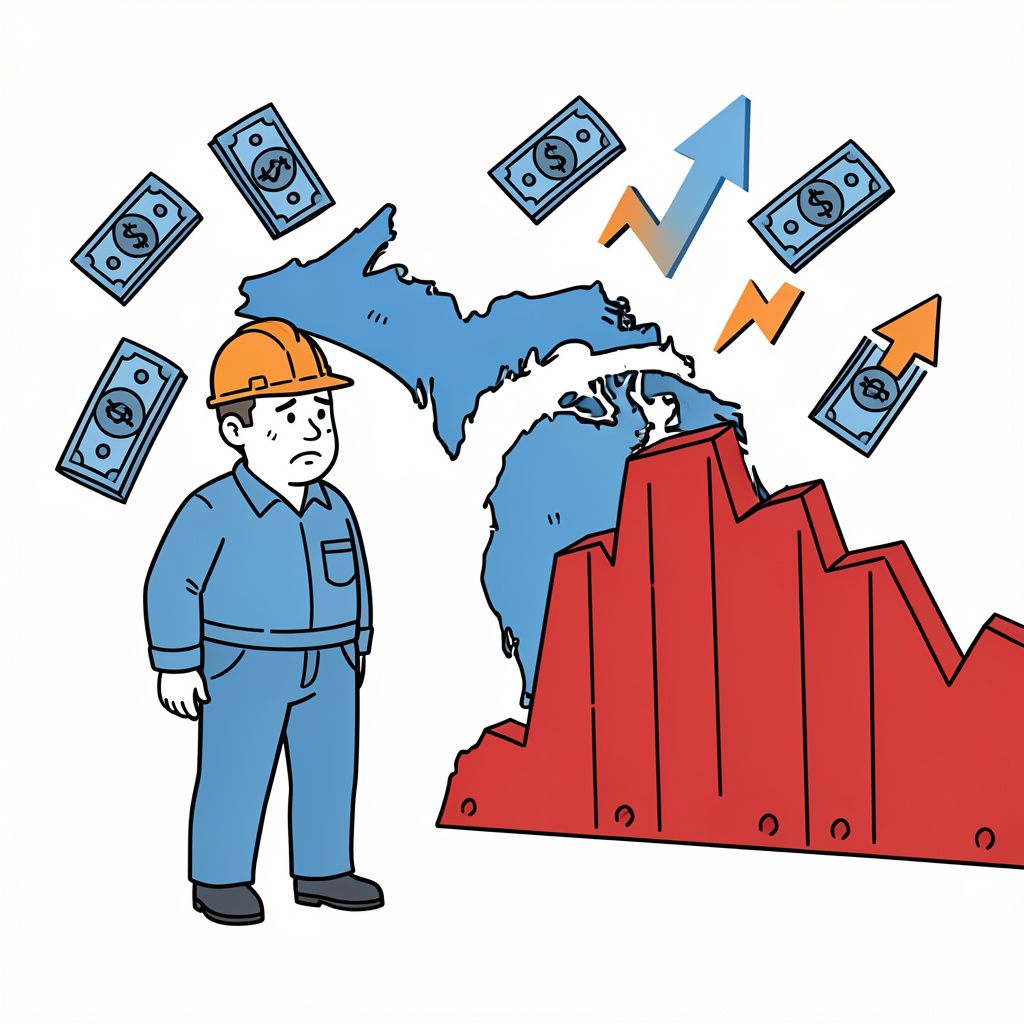
Escalating U.S.-Canada tariffs threaten $1.5 billion in Michigan exports, leaving local families facing $5,600 in added annual costs as retaliatory measures take effect on September 8, 2026.
Political Escalation and Candidate Responses
Democratic Senate candidate Abdul El-Sayed publicly criticized the federal administration’s trade policies during a press conference in Detroit on Monday, 24 August 2026 [1][2]. El-Sayed characterized the expanded trade war with Canada as a disastrous policy impacting Michiganders, stating that initiating such conflict implies fault on the part of the aggressor [1][4]. The Democratic candidate emphasized that while tariffs have specific uses, the current approach lacks strategic value and functions as a vanity war [2][4]. In response, White House spokesperson Davis Ingle labeled El-Sayed an extremist who allegedly wants to destroy the Michigan auto industry by banning gasoline-powered vehicles [1][2]. Meanwhile, Republican Senate candidate Mike Rogers defended a negotiation-focused approach during an appearance on Fox News on 31 August 2026, contrasting his strategy with El-Sayed’s confrontational stance [1][5]. Rogers argued that voters should choose a representative willing to work on trade deal specifics rather than one who opposes the president [2][4]. Vice President JD Vance also campaigned in Sterling Heights on 31 August 2026, urging support for Rogers without explicitly mentioning the ongoing trade friction with Canada [3][6]. Vance described El-Sayed as motivated by evil ideas rising in the United States, focusing on broader ideological differences rather than trade specifics [3][6].
Economic Impact and Retaliatory Measures
Canada announced retaliatory tariffs ranging from 15% to 50% on over 700 U.S. goods on 25 August 2026, aiming to match the impact of recent U.S. levies [5][8]. These measures are scheduled to take effect on 8 September 2026, posing a direct threat to Michigan’s manufacturing sector [5][8]. Analysis indicates that approximately $1.5 billion worth of Michigan exports to Canada could be constrained by these new tariffs [5][8]. This figure represents 6.356 percent of the state’s annual exports to Canada, which totaled $23.6 billion [5][8]. Michigan ranks as the seventh most exposed state to these tariffs, with key industries including iron, steel, aluminum, and automotive parts facing significant constraints [5][8]. Business leaders warn that the Detroit-Windsor corridor, the busiest commercial crossing in North America, facilitates integrated supply chains where components cross the border multiple times [5][8]. Consequently, costs compound when tariffs apply in both directions, affecting everything from cars to airplanes [5][8]. Families in Michigan have already incurred an estimated $5,619 USD in additional costs over the past year due to tariffs on aluminum, steel, and auto parts [3][6].
Federal Administration and Cross-Bolder Tensions
President Donald Trump stated on Truth Social over the weekend of 22–23 August 2026 that he did not want American businesses to import Canadian goods [1][2]. The President claimed his tariffs revived and saved the American automobile industry, citing profits from Ford and General Motors during his second term [1][2]. Treasury Secretary Scott Bessent criticized Canadian Prime Minister Mark Carney on 25 August 2026, claiming the Canadian leader chose to walk away from a trade deal [1][2]. Ontario Premier Doug Ford initially responded to Trump’s rhetoric with strong language before softening his tone on 30 August 2026 during an interview on ABC News [2][4][5]. Ford acknowledged the heated nature of the exchange but affirmed the necessity of standing up to continuous attacks on Canadian sovereignty [2][4]. The trade dispute has heated up significantly in the latter half of August 2026, with both countries slapping tariffs on each other’s goods [1][2]. Policakers and business leaders are closely monitoring these developments as potential logistical disruptions threaten regional supply chains and industrial output [5][8]. The situation remains fluid as the September 8 deadline for retaliatory tariffs approaches [5][8].