Global Oil Price Spikes Accelerate Africa's Shift to Electric Taxis
Johannesburg, Monday, 10 August 2026.
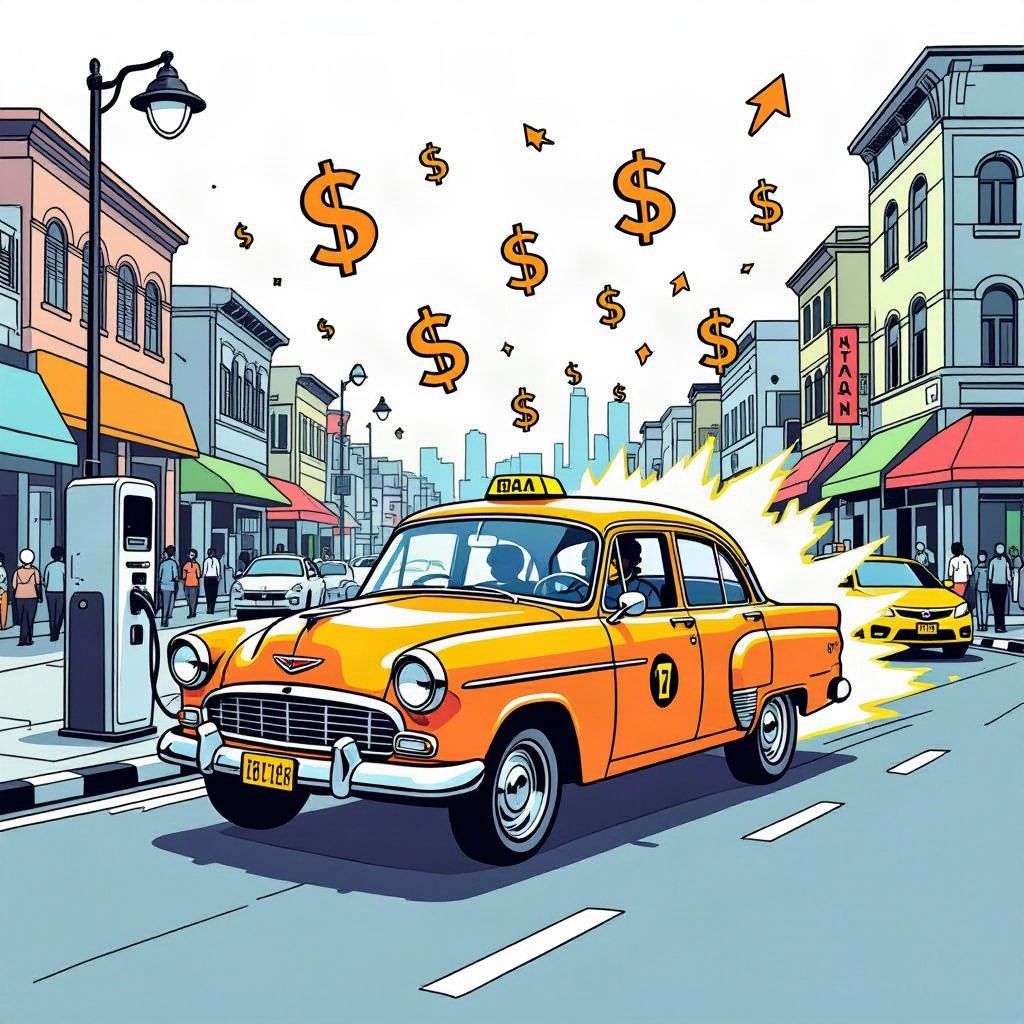
Escalating Middle East conflict and surging fuel prices are accelerating electric ride-hailing adoption in Africa. Fleet operators are rapidly expanding to capitalize on significant fuel savings despite local import taxes.
Geopolitical Tensions Drive Electrification
Escalating conflict in the Middle East has triggered a surge in global oil prices, directly accelerating the adoption of electric ride-hailing fleets across major African markets as of August 2026 [1]. Fleet operators are rapidly expanding operations to capitalize on the widening cost gap between traditional fuel-powered cars and battery-electric alternatives, fundamentally shifting mobility strategies in the region [1]. In Johannesburg, South Africa, Uber’s partner Valternative is deploying approximately 360 Henrey EV4 electric vehicles to compete with rival Bolt’s petrol-powered Bajaj Qute quadricycles [1]. This operational shift underscores how geopolitical volatility is unexpectedly driving green energy transition strategies in emerging markets, with Mahomed Jeewa, co-founder of Valternative, noting that the conflict is doing for electrification what the pandemic did for delivery services [1].
Capital Allocation and Strategic Expansion
In March 2026, Uber announced a significant investment of $298.61 million to be executed over three years, aimed at expanding mobility, delivery, charging infrastructure, and EV partnerships in South Africa [1]. This commitment averages 99.537 million per year through March 2029, providing the financial backbone for the rapid infrastructure rollout required to support electric fleets [1]. Valternative intends to expand this low-cost EV model beyond South Africa into Egypt, Morocco, Ghana, and Côte d’Ivoire, with ultimate ambitions to operate in eight African countries [1]. To support this growth, the company plans to install six to seven new charging sites monthly over the next year, addressing the critical challenge of limited charging infrastructure in coal-dependent energy grids [1].
Regional Market Valuations and Activity
Beyond South Africa, the Nigerian market is showing significant traction, with mobility company Moove recently closing $250 million at a $2.1 billion valuation after starting with just seven cars in Lagos [3]. Social media activity from August 8, 2026, highlights local dealers like Official EV Automobiles leading the conversation on EV adoption in Nigeria, indicating a broader regional trend beyond ride-hailing fleets [2]. This surge in valuation and activity suggests that investors are increasingly confident in African mobility solutions scaling from local streets to global autonomy models [3]. The convergence of high fuel costs and available venture capital is creating a unique environment for electric mobility providers to thrive despite infrastructure hurdles [1][3].
Infrastructure Growth and Policy Incentives
Supporting this transition, the South African e-bike market reached a valuation of USD 199.4 million in 2025 and is projected to expand to USD 400.9 million by 2034, reflecting a total growth of 101.053 percent over the period [4]. To stimulate local assembly and reduce import reliance, the government has implemented a 150 percent tax deduction on electric vehicle production assets, countering the current 25% import duty on electric vehicles compared to 18% for internal combustion engine vehicles [1][4]. In July 2026, the Department of Trade, Industry and Competition began discussions with investors to localize electric delivery-bike manufacturing, citing an estimated 65,000 delivery motorcycles already on South African roads [4]. These policy measures aim to mitigate load-shedding issues and fuel cost pressures while expanding e-bike usage beyond utility into recreation and health sectors [4].