Canada Launches First Rocket Factory to Secure Independent Space Access
Toronto, Tuesday, 16 June 2026.
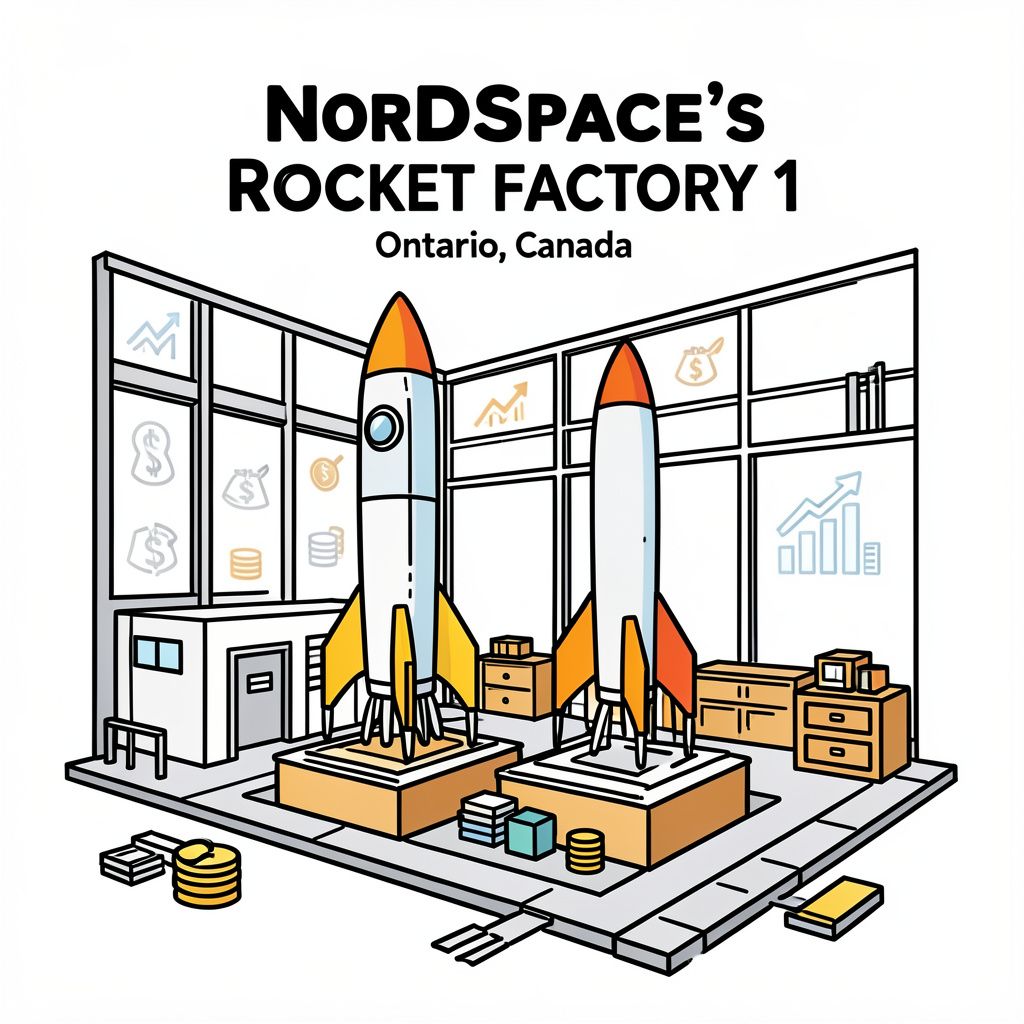
NordSpace’s new 60,000 m² Rocket Factory 1 in Ontario marks Canada’s bold leap into sovereign space launch capabilities. With the ability to produce two rockets simultaneously and a 10x expansion in capacity, this facility positions Canada as a rising player in the global space race—challenging foreign dependence and creating high-value jobs.
A New Era for Canadian Space Sovereignty
On 16 June 2026, NordSpace Corp. officially opened Rocket Factory 1 (RF-1) in Markham, Ontario, marking a pivotal moment in Canada’s space ambitions. The 60,000 m² facility, a tenfold expansion over NordSpace’s previous headquarters, is designed to produce light and medium-lift launch vehicles, positioning Canada as a sovereign player in the global space launch market [1]. The opening of RF-1 comes at a time when nations and private enterprises are increasingly prioritizing independent access to space for national security, commercial satellite deployment, and scientific research [1][3].
Advanced Manufacturing and Production Capabilities
RF-1 consolidates a comprehensive suite of in-house capabilities, including the Advanced Manufacturing for Aerospace Lab (AMA Lab), Space Systems Lab (SSL), multiple ISO clean rooms, and propulsion, structures, and avionics test facilities. The facility also houses a mission control centre and state-of-the-art manufacturing equipment, such as the largest single metal additive manufacturing machine in Canada and automated fiber placement (AFP) machines for cryogenic-compatible composite structures, set to arrive in summer 2026 [1]. With a capacity for 255 employees, RF-1 can produce two light-lift Tundra vehicles (1,100 kg to Low Earth Orbit, or LEO) concurrently or one medium-lift Tundra+ vehicle (2,000+ kg to LEO). The Tundra+ shares the Hadfield-150 engine architecture, with components such as combustion devices, chambers, and turbopumps already in production [1]. Additionally, RF-1 can manufacture up to 10 small satellites simultaneously, with larger satellite platforms currently in the design phase [1].
Strategic National Footprint and Future Expansion
RF-1 is part of NordSpace’s broader three-site national footprint, which includes Area 66 in Eastern Ontario—a propulsion test range with Darkhorse, Blackhawk (operational readiness expected summer 2026), and Nightfox test cells—and the Atlantic Spaceport Complex in St. Lawrence, Newfoundland and Labrador. The spaceport, which received environmental approval in January 2026, is under construction and will feature two launch sites, SLC-01 and SLC-02 [1]. NordSpace’s expansion plans also include Rocket Factory 2 (RF-2), a 200,000 sq ft facility dedicated to producing the Tempest reusable medium-lift rocket (5,000+ kg to LEO), with construction set to begin later in 2026 [1].
Economic and Geopolitical Implications
The opening of RF-1 is expected to have significant economic and geopolitical ramifications. The facility aims to boost advanced manufacturing employment in Ontario and support the re-shoring of space industry talent across Canada [4]. By providing sovereign, ITAR-free launch services from Canadian soil, NordSpace is reducing the country’s dependence on foreign launch providers, a strategic priority for national security and commercial satellite deployment [4]. NordSpace, established in 2022 as a 100% Canadian-owned company, is developing vertically integrated solutions, including orbital launch vehicles, spaceports, satellites, and mission-critical software, to position Canada as an independent launch provider [4].
Competing in the Global Space Race
Canada’s entry into the sovereign space launch market comes as the global space industry is projected to grow substantially over the next decade. The ability to launch satellites independently is increasingly seen as a critical component of national security, economic competitiveness, and technological leadership [1][3]. NordSpace’s Tundra and Tundra+ vehicles are designed to serve a range of applications, including responsive launch under the IDEaS Launch the North program, NORAD modernization, Arctic surveillance, wildfire detection, secure connectivity, and Earth observation [4]. By developing these capabilities domestically, Canada is positioning itself to compete with established spacefaring nations and emerging players alike.
Leadership Vision and Sovereign Control
Rahul Goel, CEO and Founder of NordSpace, emphasized the strategic importance of RF-1 in achieving sovereign control over Canada’s space capabilities. ‘Sovereignty is control,’ Goel stated. ‘Control requires doing the hard parts first—building the actual rockets. Skip or outsource the hard parts and you lose control. At NordSpace, we’re doing the hard parts first’ [1][4]. Goel further elaborated that RF-1 is the ‘production engine that makes that sovereignty real,’ ensuring that Canada is not ‘left permanently dependent on the priorities and schedules of foreign providers’ but instead becomes ‘the country that exports high-value solutions to its allies’ [1][4]. This vision reflects a broader shift in Canada’s approach to space, moving from a legacy of contributions to international programs—such as the Canadarm—to establishing a fully independent and competitive space launch ecosystem.
Looking Ahead: Canada’s Space Ambitions
The opening of RF-1 is a milestone, but it is only the beginning of Canada’s ambitious space agenda. With the construction of RF-2 and the Atlantic Spaceport Complex on the horizon, NordSpace is laying the groundwork for a comprehensive domestic space transportation system. The company’s Terra Nova dual-use demonstration satellite, set to launch on a SpaceX Transporter mission later in 2026, will further demonstrate Canada’s growing capabilities in space [1]. As Canada continues to invest in its space sector, the country is poised to become a key player in the global space economy, offering sovereign launch services, advanced manufacturing, and innovative satellite technologies to domestic and international partners alike.