Rising Gas Prices and Economic Strain Push Trump's Approval to Second-Term Lows
Washington, Thursday, 23 April 2026.
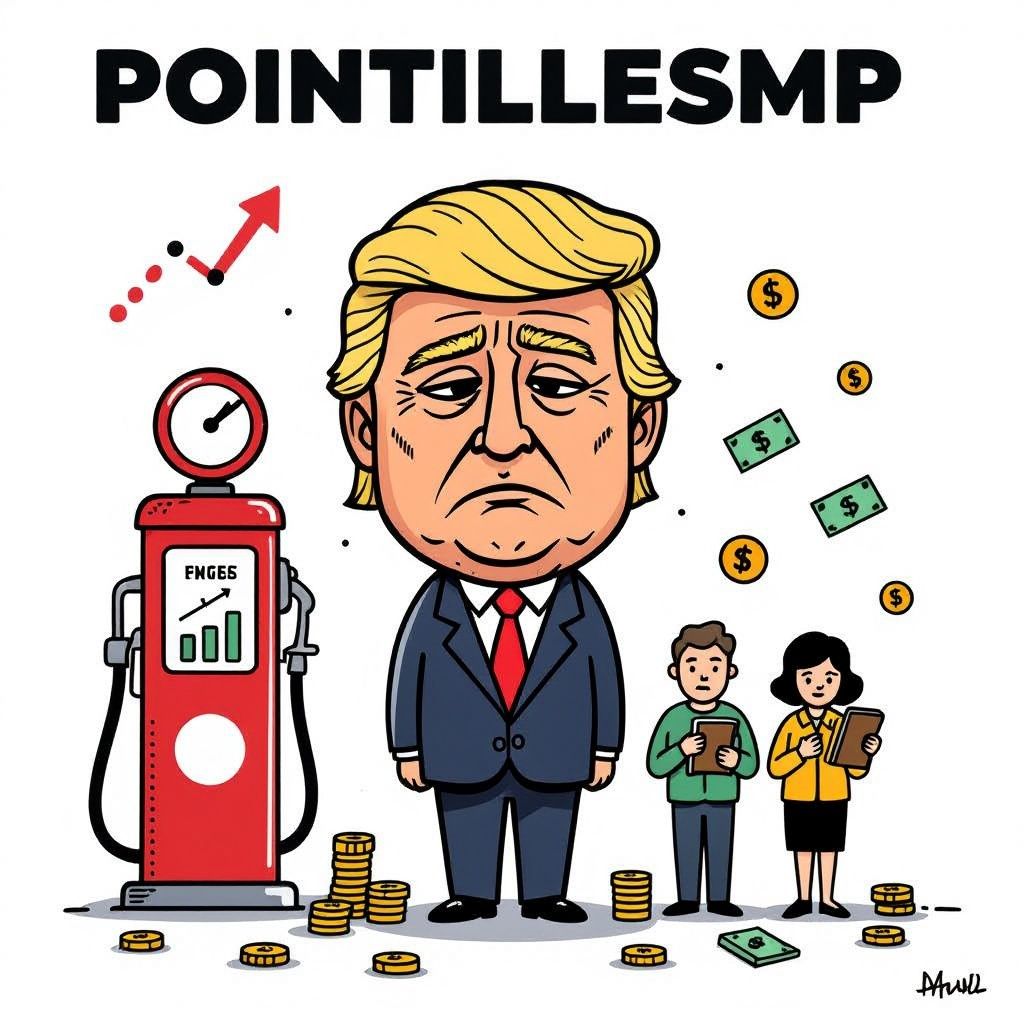
As the Iran war drives gas prices 27% higher, nearly 80% of Americans are changing their spending habits, plunging President Trump’s economic approval to a record second-term low.
Economic Anxiety and the Pump
Gas prices are 27% higher than a year earlier [2]. The ongoing war in Iran has exacerbated this inflation, with 69% of Americans stating they are extremely or very concerned about gas prices resulting from the conflict [4]. As of late April 2026, nearly 80% of Americans have taken financial action, such as relying more on credit cards or cutting non-essential spending, to cope with these high energy costs [1]. Consequently, President Donald Trump’s economic approval rating has plummeted. A CNBC All-America Economic Survey released on April 23, 2026, shows his economic approval at just 39%, with 60% disapproving [1]. This results in a net economic approval of -21, a 10-point drop from the prior quarter and the lowest net economic approval in any CNBC poll during either of his terms [1].
A Fracturing Republican Coalition
The political fallout from these economic pressures is exposing fractures within the Republican Party. While President Trump maintains a formidable 96% approval rating among his core MAGA base, his overall approval among Republicans has dropped 17 points to 82% [1]. The decline is particularly acute among non-MAGA Republicans, whose overall approval fell 19 points to 60% [1]. Micah Roberts, a partner at Public Opinion Strategies, noted that while a five-point drop in overall national approval is unfavorable, Trump continues keeping 60% of the Republican party highly motivated and firmly on his side [1].
Distractions Versus Policy Realities
As voters grapple with inflation and tightening household budgets, the administration’s messaging has drawn scrutiny for lacking focus on immediate economic concerns. President Trump addressed the nation on April 1, 2026, claiming the Strait of Hormuz would reopen and prices would fall once the conflict ended [4]. He reaffirmed this on April 18, 2026, stating his administration had “very good conversations going on” [4]. However, the timeline for stabilizing energy markets remains highly uncertain [alert! ‘Conflicting statements exist between the US administration and Iranian officials, who stated the strait would not be reopened’]. Meanwhile, the President’s recent social media activity has frequently diverged from economic policy [2]. In early April 2026, Trump posted extensively about topics ranging from White House ballroom construction and an AI-generated image of himself following a feud with Pope Leo XIV, to a UFC fight [2]. Mike Murphy, an anti-Trump former Republican strategist, observed that Trump’s original appeal to voters rested on his perceived economic competence—a reputation now being severely tested [2].