Elon Musk Shifts Strategy to Build Massive Chip Factory After Industry Rejections
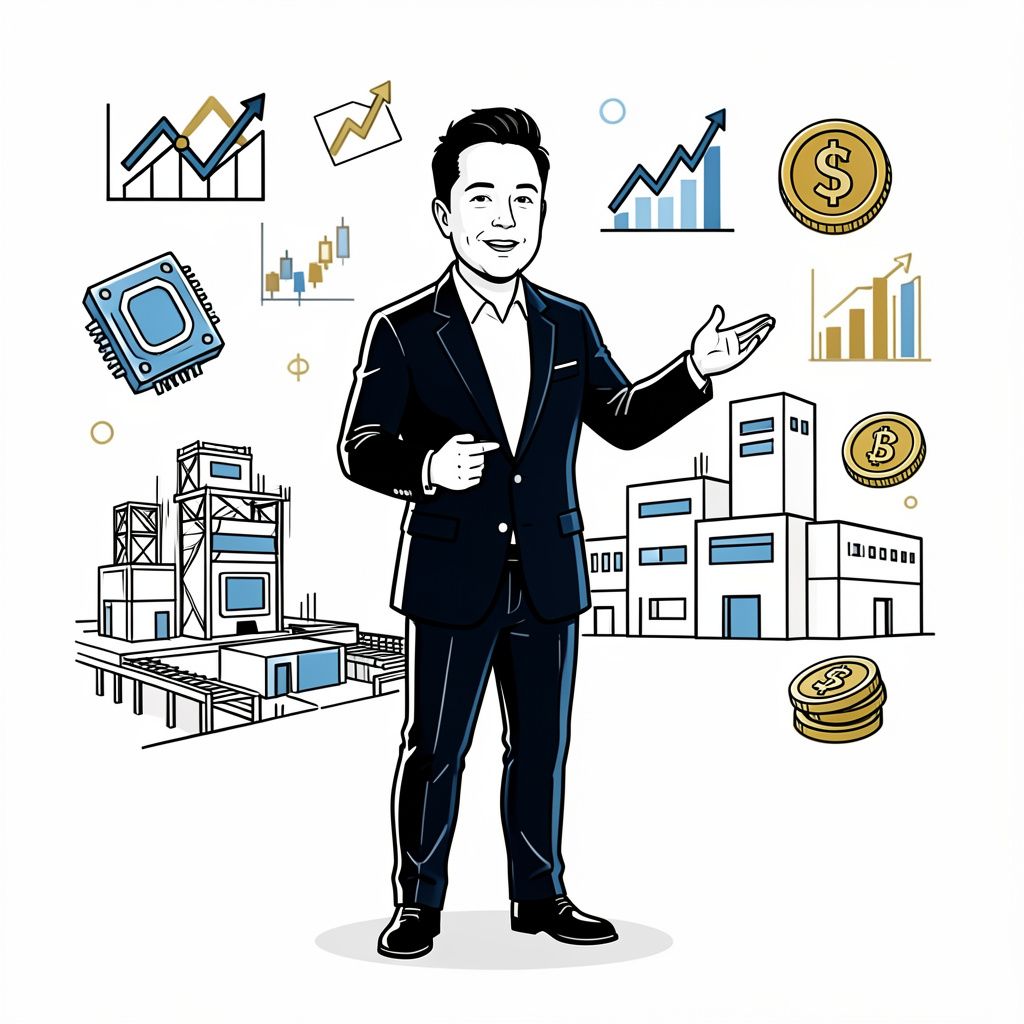
Austin, Tuesday, 20 October 2026.
After Intel, TSMC, and Micron rejected direct buyout offers, Elon Musk pivoted to building a $16.8 billion Texas chip plant using strategic partnerships to drive his artificial intelligence ambitions.
Strategic Pivot to Terafab Following Acquisition Rejections
Billionaire entrepreneur Elon Musk has shifted his semiconductor strategy after initial attempts to acquire existing fabrication plants from Intel Corporation (INTC), Taiwan Semiconductor Manufacturing Company (TSM), and Micron Technology (MU) were rejected [1]. Instead of purchasing legacy facilities, Musk is proceeding with the construction of a new semiconductor manufacturing initiative known as Terafab, located in Grimes County, Texas [8]. The project represents a significant capital commitment, with an initial investment figure of $16.8 billion aimed at securing supply chains for artificial intelligence and autonomous systems [3][8]. Construction activities for the facility reportedly commenced in October 2026, following a tax abatement agreement with the state of Texas [8]. This ground-up development strategy marks a departure from Musk’s initial preference to buy operational plants, a move necessitated by the chipmakers’ refusals to divest their facilities [1]. The ambition reflects a broader push to reduce reliance on external chip suppliers for Tesla (TSLA), SpaceX, and xAI operations [3].
Manufacturing Partnerships and Operational Control
Despite the rejection of buyout offers, Musk has secured critical technology partnerships to support Terafab’s development. Intel has officially partnered with the project to deploy its 14A manufacturing technology, providing a foundational process for the new facility [1][8]. Conversely, negotiations with TSMC have highlighted a divergence in operational philosophy; during the Q3 2026 earnings call on 2026-10-15, TSMC CEO C.C. Wei stated that his firm must run any joint facility for a partnership to work [4]. This condition contradicts Musk’s stated intention that his companies would build and run the fab themselves [4]. TSMC’s stance comes amidst strong financial performance, with the company reporting Q3 2026 revenue of $46.7 billion, an increase of 16.2% from the previous quarter [4]. The tension over operational control underscores the complexity of integrating legacy semiconductor expertise with Musk’s rapid execution model [4][8].
Supply Chain Expansion and Korean Suppliers
To support the massive infrastructure build-out, Tesla and SpaceX representatives are actively negotiating with South Korean semiconductor suppliers. A report from The Elec on 2026-10-20 confirmed that discussions are underway with approximately 10 Korean firms, including ENF Technology, Dongjin Semichem, and Hanmi Semiconductor [8]. These negotiations accelerated following site visits during SEMICON West 2026 in San Francisco, which took place from 2026-10-13 to 2026-10-15 [8]. Several companies have already advanced to signing nondisclosure agreements (NDAs), with KoMiCo signing a three-party NDA around 2026-09-19 regarding cleaning services [8]. The supply chain strategy explicitly excludes Chinese suppliers, favoring Korean and American firms like Lam Research and Applied Materials for critical components [1][8]. Industry observers note this execution speed is unprecedented in the semiconductor industry, with suppliers surprised by the project’s velocity [1][8].
Economic Projections and Production Capacity
The Terafab project aims for an initial production capacity of 100,000 wafers per month before 2030, with a long-term goal of reaching 1 million wafers per month [1][8]. This expansion represents a 900 increase in capacity from the initial target to the long-term goal [1][8]. Musk has claimed that the value of Terafab’s output will eventually place it in the top 20 of country GDPs in a single building [7]. This economic projection aligns with Musk’s broader view that digital super-intelligence could increase the global economy by 20% to 30%, adding approximately $30 trillion annually in incremental value [1]. Regarding the manufacturing approach, Musk noted in a recent discussion that while he lacks chipmaking experience, Tesla’s expertise in custom manufacturing equipment will be leveraged to improve throughput [6]. The facility is designed to manufacture semiconductors for autonomous vehicles, humanoid robots, and space-based economic expansion initiatives [1].
Sources
- wccftech.com
- www.facebook.com
- www.facebook.com
- finance.yahoo.com
- www.facebook.com
- www.facebook.com
- x.com
- www.thelec.net